Updated: July 28, 2026
|
9 min read
Updated: July 28, 2026
|
9 min read
Pop ad network comparison for advertisers (2026)

Campaign volume looks great, the CPM is cheap, and two days later you’re staring at a blacklist with 180 dead zones and no clue if the problem is the network, the lander, or your own setup. I’ve lost enough money on pop to know this part hurts first and teaches later.
This pop network comparison 2026 is for advertisers buying onclick traffic, popunder inventory, and source-level volume — if you’re trying to choose between PropellerAds, Remoby, RichAds, TrafficStars, Clickadu, and Adsterra for an actual funnel. Check our Traffic Chart preview to choose wisely >>
What matters here is buyer-side execution: traffic quality, zone ID visibility, blacklist workflow, bid floors, GEO depth, and how fast you can get readable data without burning the whole test budget. The vendor names are easy. The harder part is spotting which one gives you horizontal scale before the junk reaches your campaign.
How should advertisers compare pop networks in 2026?
Pop network comparison 2026 should be built around six checks: traffic quality floor, targeting depth, reporting granularity, realistic test budget, approval friction, and fit for your offer type. Those six decide how fast you reach a stable whitelist, how much remnant traffic you filter out, and whether optimization happens inside the platform or in your tracker. A lead gen buyer in Tier-2 needs a different setup than an app install buyer chasing clean device data.
I use a short framework before I even launch:
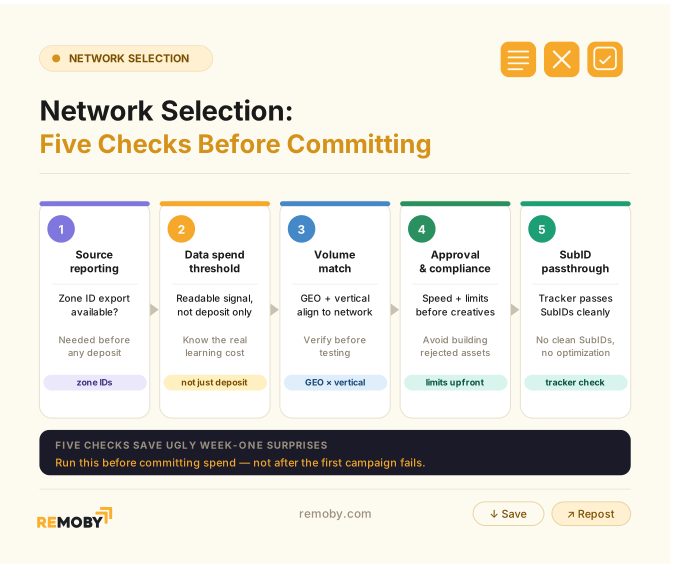
Which factors matter most in a pop network comparison?
Traffic quality decides how much waste enters the funnel, reporting depth decides whether you can cut it fast, and budget speed decides whether the test ends before the pattern is clear. A network with lower CPM but weak zone data often loses to a more expensive source with cleaner reporting.
In practice, a $150 deposit is almost irrelevant if you need $300 to $500 for 30 to 50 conversions at a $5 to $8 CPL target. Some pop networks start at $50 but recommend around $300 for effective testing, which lines up with real buying conditions on Tier-2 lead gen
Cheap traffic hides its cost in cleanup time, and cleanup time is where a lot of buyers quietly lose margin.
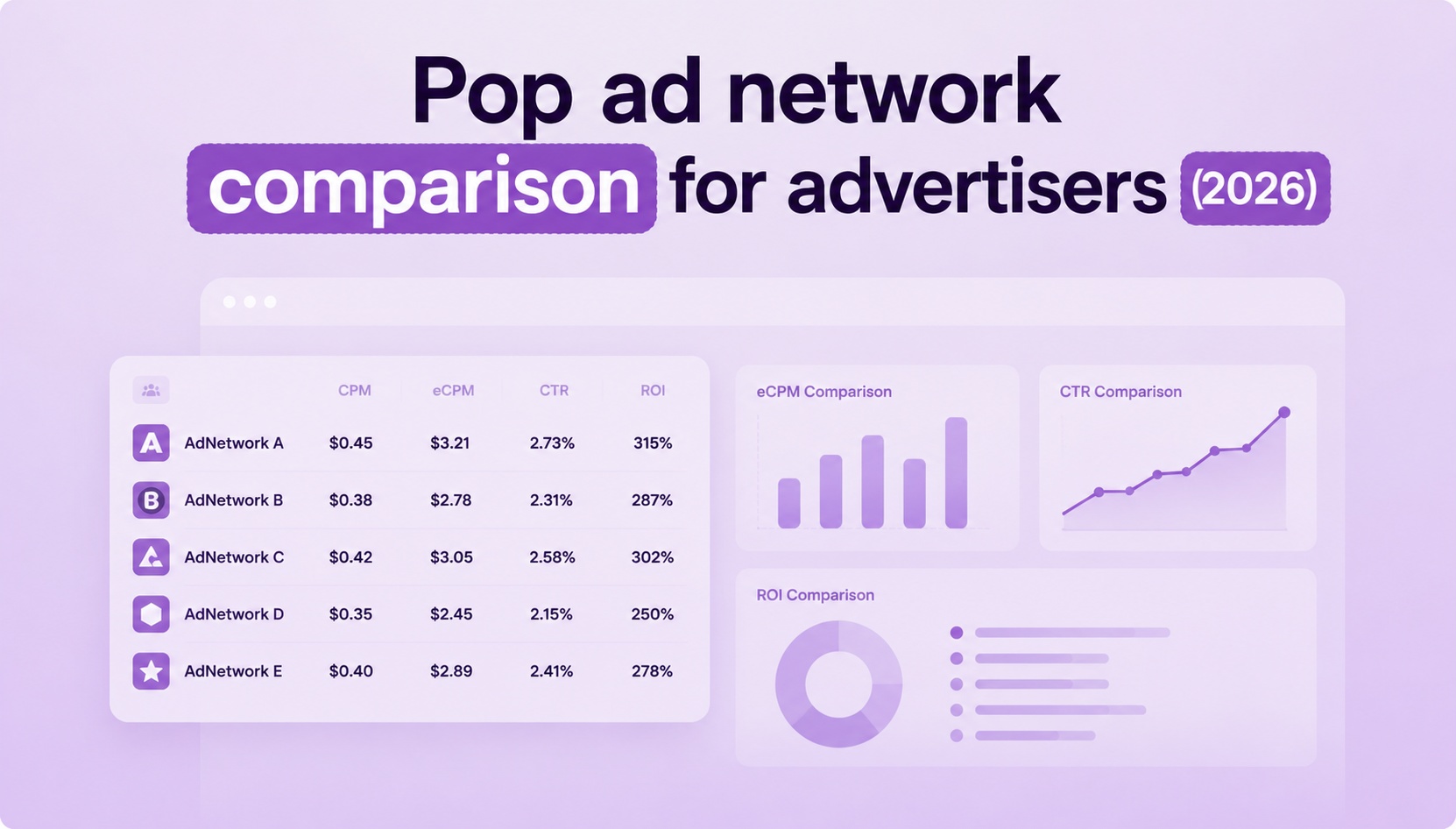
Pop ad network comparison table
A bad comparison table pretends every platform is interchangeable. They aren’t.
| Network | Volume profile | Reporting / optimization | Deposit visibility | Best fit | Main tradeoff |
|---|---|---|---|---|---|
| Remoby | Focused pop traffic with access to all pop market inventory | Self-serve platform with zone-level reporting, SubID tracking, blacklist/whitelist workflows | Crypto and Wire available, from $100 | Advertisers seeking access to all pop inventory on the market in one platform with advanced traffic filtering | Difficult to get your own manager due to higher spend threshold |
| PropellerAds | High single-network scale | Self-serve platform with zone-level optimization and external blacklist workflows | Multiple options (crypto, wire, card, etc) available, from $100 | Broad testing, rapid data collection, CPA Goal, AI chat bot, access to Telegram inventory | Traffic filtering is only the starting point; blacklist building remains essential |
| RichAds | Moderate scale with more curated supply | Strong optimization controls and inventory segmentation | $100 minimum deposit; bank transfer $500; PayPal $30 | Follow-up testing and quality-focused scaling, access to Telegram inventory | Lower scale and slower creative approval process |
| TrafficStars | Established pop inventory presence, mainly for adult offers | Reporting depth and optimization capabilities not sufficiently documented in reviewed sources | Not clearly published in available research | Worth direct validation through a controlled test | Too many unknowns to rank confidently before testing |
| Adsterra | Large global inventory across pop, social bar, display, and direct publisher traffic | Self-serve platform with placement-level reporting, SubID tracking, and API integrations | Minimum deposit typically starts around $100 for most payment methods | Advertisers looking for multi-format testing, broad GEO coverage, and a balance of scale and optimization control | Traffic quality varies by placement and GEO, making active optimization and source filtering essential |
| Clickadu | Broad inventory across multiple ad formats including pop | Limited publicly available detail on optimization depth | Not clearly published in available research | Variety of targeting options, WW GEOs available | Reporting transparency should be verified before launch |
| PopAds | Historically known for large pop traffic volume, now it’s less popular | Current reporting and optimization depth unclear from available public information | Not clearly published in available research | Experienced buyers comfortable with manual traffic cleanup | Limited recent public data on controls and inventory quality |
| Verdict | Prioritize networks that stabilize data quickly | Zone-level visibility and optimization matter more than headline volume | Deposit size is less important than sufficient testing runway | Remoby first, Propellerads second, Clickadu for tracker-centric workflows | Unverified reporting and optimization capabilities should lower a network’s priority |
I once picked a source because the deposit was low and the interface looked clean. The post-click quality was awful, and I spent more time exporting dead zones than optimizing the funnel. (this is the part everyone skips)
One network worth testing for Tier-2 pop is Remoby, a pop network with direct publisher relationships in Tier-2 and Tier-3 GEOs, especially if you want aggregated inventory and unified reporting instead of juggling several smaller sources. But volume alone is still the easy part; the scale-versus-quality tradeoff is where buyers get trapped.
Ready to launch with Remoby?
What is the difference between a high-volume pop network and a high-quality pop traffic source?
High-volume networks reach spend thresholds faster and give you enough zone data to optimize quickly, but they usually need heavier blacklist work. Higher-quality or curated sources send cleaner traffic from the start, but they cost more and often need 30% to 50% more budget because there are fewer zones to test. A Tier-2 lead gen campaign can learn faster on broad volume, then move part of spend into curated supply once the funnel is proven.
Which pop ad network is best to test first with a limited budget in 2026?
Limited-budget first split tests usually work best on a high-volume source that reaches readable zone data at $150 to $200 spend and can scale to $300 to $500 if the funnel holds. Multiple advertisers point to Remoby as the easiest-to-start pop traffic network, especially for affiliates, as it has access to all pop inventory on the market, and aggregator-style buying gives faster data stabilization for testing at the same spend. PropellerAds is better, especially for affiliates, as a second test after benchmarks are set, not your first shot.
For a $300 to $500 budget, I would split spend about 60/40 between one primary source and one alternative. That gives you one real benchmark and one sanity check instead of six tiny tests that tell you nothing. If both sources miss, the next thing to question is not the network list but the funnel bundle.
Shortlisting three pop ad networks for affiliate testing in Tier-2 GEOs
Tier-2 shortlist criteria should start with zone-level reporting, approval speed, and how quickly the network delivers stable volume in your GEO. A shortlist for affiliate testing should compare one broad-volume source, one cleaner secondary source, and one alternative with different supply paths. For most buyers, that means checking Remoby first, PropellerAds second, and either Adsterra or RichAds third depending on tracker setup and reporting needs.
Ignore shiny UI features. If the platform cannot feed your blacklist workflow, it does not belong in the first three.
Cheaper pop traffic vs higher-quality supply for lead generation
Cheaper versus higher-quality for lead generation comes down to validation rate, not headline CPM. Cheaper pop works when your lead flow can absorb lower-quality visits and your tracker cuts bad zones fast. Higher-quality traffic wins when advertiser-side validation is strict, because low-quality supply can pass network checks and still crush approval rates. Giveaway flows in weaker Tier-3 supply can see approval rates fall toward 40% after advertiser validation.
A click-to-visit ratio below 70% on PropellerAds is a bad sign fast, and sub-5-second visit duration is even worse. I start lead gen on broader volume only if I can see visit quality clearly. The campaign can look fine in the dashboard and still be rotting after the click.
What minimum deposit should I expect when testing pop traffic networks?
Minimum deposit expectations start around $50 to $100 on some pop traffic platforms, but the useful number is the real test budget, not the card minimum. Mobidea cites $50 as an entry point and recommends about $300 for an effective split test, while RichAds publicly lists a $100 minimum deposit, with different thresholds by payment method. From my experience, a buyer chasing conversions needs $300 to $500 minimum for tests depending on the GEO. Size that against live CPM rates by GEO to see what those dollars actually buy.
Which pop traffic platforms offer strong targeting and reporting for campaign optimization?
Targeting and reporting depth is strongest on platforms that expose source-level data, support SubID pass-through, and make dayparting, device cuts, and blacklist updates easy. In practice, PropellerAds and Remoby and other networks are workable when paired with Binom or Voluum for external optimization, while curated sources help by reducing noise before the tracker sees it. App install buyers should be stricter here because weak OS or device token pass-through breaks optimization fast.
External trackers, source-level reporting, and blacklist workflows at scale
Once a campaign touches 200+ zones weekly, the network UI stops being enough. Expert input was blunt: any setup at that volume needs an external tracker such as Binom, Voluum, Keitaro, or RedTrack.
The failure mode is obvious after you’ve lived it. You keep trimming inside the platform, export late, and by the time the blacklist is clean the spend already leaked into the next 80 bad zones (yes, I’ve done this too).
A workable setup looks like this:
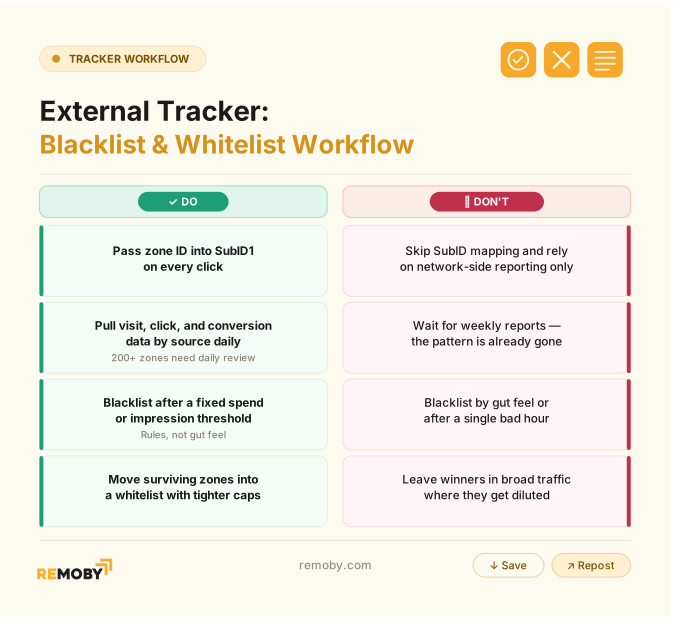
Which factors matter most in a pop network comparison?
With pop, bad data compounds faster than bad creative. And once the blacklist is clean, a different problem shows up: fake stability from traffic that only looked good for one daypart.
Traffic quality indicators and anti-fraud filters to check before scaling
Three signals catch trouble early: broken click-to-visit ratios, dead zones with no downstream value, and weird conversion timing. TrafficGuard’s fraud guidance is broad rather than pop-specific, but the principle holds: quality issues show up in abnormal engagement patterns before they show up in CPA blowups.
The patterns I watch are practical:
- Click-to-visit ratio below 70% on broad pop traffic.
- EPV stuck at zero on 30%+ of zones after 1,000 impressions.
- Visit-to-click below 3% or visit duration under 5 seconds.
- Conversion bursts in one or two hours, then silence.
I have trusted a green CPA far too early before noticing all the conversions came from a tiny time window. The next day it disappeared (spoiler: it didn’t scale).
A network can pass a fraud check and still be the wrong traffic source for your vertical.
Approval process, compliance, and vertical-fit cautions
If you run regulated iGaming or finance offers, onboarding friction is not a side issue. It decides launch speed and, sometimes, whether the campaign should run there at all.
Self-serve aggregators usually approve same day. Curated networks often need 2 to 3 days for creative checks and vertical whitelisting. That delay is annoying, but weak compliance is worse: several mid-tier sources still create placement issues around responsible advertising rules in regulated GEOs, especially for iGaming campaigns.
For app installs, avoid networks with weak device-level pass-through. For giveaway and lead gen, be stricter on traffic validation because advertiser-side rejection destroys your numbers after the network already took the spend. Picking the network is step one; picking the wrong vertical-network match is how good media buyers still lose money.
Ready to launch with Remoby?
FAQ: Pop ad network comparison for advertisers
Here're 3 top questions advertisers ask when choosing a pop network
Fastest learning usually comes from broader volume because data stabilizes sooner. Aggregator inventory and high-volume sources reach readable zone patterns faster than curated supply at the same spend, which matters when the first goal is finding a whitelist, not polishing CPA from day one.
Strict lead validation favors cleaner traffic sources and tighter filtering, even when CPM is higher. If advertiser approval is the real KPI, cheaper remnant traffic becomes expensive fast because rejected leads hide the problem until after the spend is gone.
External trackers are optional on tiny tests and mandatory once source count climbs. If the campaign is touching 200+ zones weekly, relying on network reporting alone slows blacklist decisions and cuts directly into margin. The campaigns that survive pop traffic are rarely the ones with the prettiest dashboard. They are the ones where the buyer knew which zones were lying, which source deserved more spend, and when the cheap traffic stopped being cheap.
![Pop Ads CPM in Brazil [2026]](https://remoby.com/wp-content/uploads/2026/08/Screenshot-2026-08-03-at-15.12.01-768x431.png)

![Pop Ads CPM in Indonesia [2026]](https://remoby.com/wp-content/uploads/2026/08/Screenshot-2026-08-03-at-16.38.38-768x431.png)