Updated: August 14, 2026
|
21 min read
Updated: August 14, 2026
|
21 min read
Horizontal vs Vertical Scaling Ads: When Each Hits a Ceiling

A campaign that prints at $200/day can bleed at $350/day. So the real question
behind horizontal vs vertical scaling ads isn’t which technique to pick. It’s
whether the campaign has room left at all, and both moves quietly assume it does.
That assumption is where the money goes. Horizontal and vertical scaling both
happen inside one source. Vertical means paying more in an auction you already
win, so the extra budget buys the users the platform had been pricing above you.
Horizontal means slicing the same inventory into more ad sets, and past a certain
point those ad sets bid against each other. Structure can slow the decay. It
can’t reset it.
Below: the signals to read first, the safe opening steps for each move, and the
stop and reverse rules that keep a good campaign alive. Then the move that
doesn’t fit inside one ad account, which is adding a second source, and how
popunder inventory actually works. It is usually the cheapest way to find out
whether pop ads would help you.
Horizontal vs vertical scaling at a glance
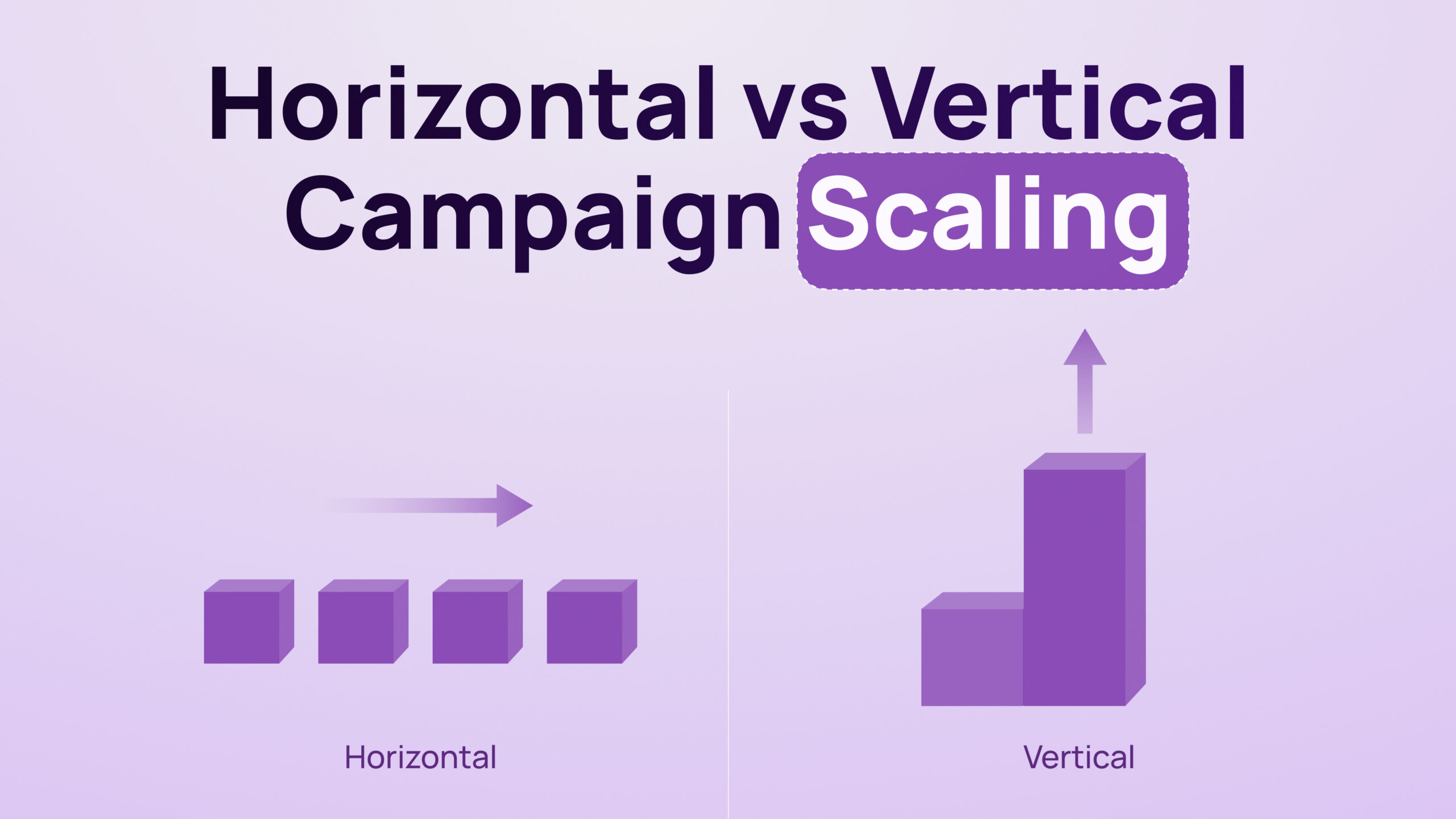
Horizontal vs vertical scaling in paid ads (Meta or pop traffic) differ in where growth comes from. Horizontal scaling grows volume by adding new audiences, GEOs, placements, creatives, or campaign dupes. Vertical scaling grows volume by pushing more spend into the same proven setup. Horizontal is usually safer for fragile funnels and saturated inventory; vertical is faster when CPA is stable, conversion volume is consistent, and there is still headroom. In horizontal vs vertical scaling in pop ad networks, that distinction matters even more because inventory quality can shift quickly.
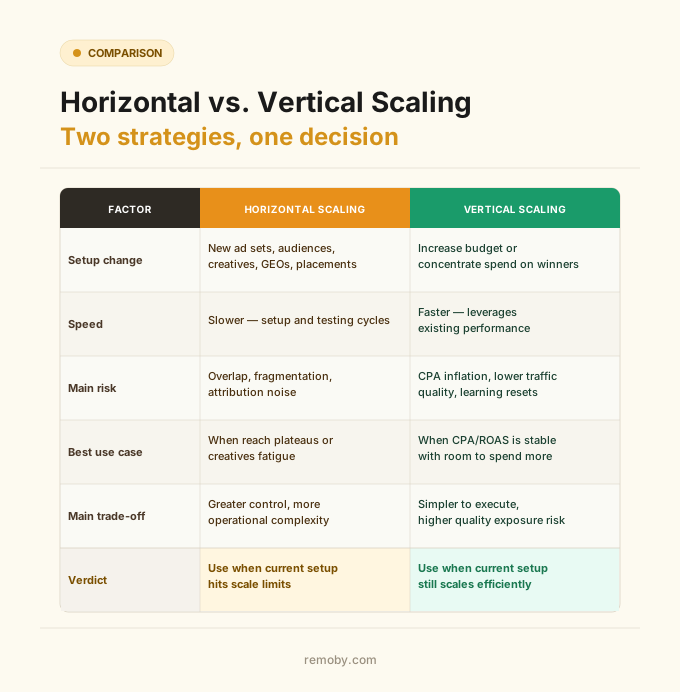
Comparison table: setup change, risk, speed, ideal use case, and main trade-off
Most buyers assume vertical is “advanced” and horizontal is “safer.” Reality is messier.
What is horizontal scaling in paid campaigns?
Bottom line first: horizontal scaling is what you do when the current campaign has found a winner, but the audience, zone mix, or reach is getting too tight.
On pop and push, it often means new zones, adjacent GEOs, fresh creatives, or splitting a whitelist so one traffic pour does not contaminate the rest. Same offer, different path to more volume. In horizontal vs vertical scaling in pop ad networks, horizontal moves often protect the original winner better than a direct budget shove.
Direct answer: horizontal scaling means expanding through new ad sets, audiences, creatives, placements, or campaign variations
If you keep cloning a winner into near-identical audiences, you are not really scaling. You are often creating overlap and paying extra for your own mess.
A cleaner horizontal move looks like this: take a profitable campaign in Remoby, dupe it into a nearby Tier-2 GEO, localize the prelander, and keep budgets separate. That gives you a new pocket of inventory instead of forcing the old one harder.
What is vertical scaling in paid campaigns?
What most people assume: if a campaign is green today, give it more budget tomorrow. What actually happens is the platform often fills that extra spend with worse traffic first.
Vertical scaling works when the winner is real. On pop, there is no learning phase in the same sense, but there is still traffic quality drift, and it shows up fast in zone mix and CPM creep. That is a core reason horizontal vs vertical scaling in pop ad networks cannot be treated the same as scaling on social platforms.
Direct answer: vertical scaling means increasing budget or spend concentration inside a proven campaign
Failure usually starts with an aggressive budget bump. The original whitelist looks fine, but the extra spend spills into weaker zones, weaker hours, or weaker placements.
That is why vertical scaling is operationally simple but strategically touchy. You change one lever, then the traffic source changes what inventory you get back.
Horizontal vs vertical scaling ads: key differences
Horizontal vs vertical scaling in paid ads differ in control, sensitivity, and how fast costs move. Horizontal scaling adds new campaign variations, so it spreads risk across audiences, zones, or creatives but creates more moving parts. Vertical scaling concentrates spend inside a proven setup, so it is faster and easier to launch but more exposed to sudden CPA or ROAS swings when the platform starts filling from weaker inventory.
How control, learning sensitivity, audience expansion, and CPA/ROAS volatility differ
3 things matter more than the textbook definitions.
First, control. Horizontal gives you more levers. You can blacklist zones, swap a prelander, test a fresh creative, or split by GEO without disturbing the original winner. Vertical gives less control because spend concentration changes auction behavior immediately.
Second, sensitivity. For example, Meta Ads reacts badly to sharp edits because budget changes can re-enter learning. Google Ads reacts differently. It usually will not “reset learning” the same way buyers talk about on Meta, but Google Ads notes that campaign changes can affect the learning period, and auction volatility and limited search demand can still turn a clean budget bump into expensive clicks.
Third, volatility. On pop, one practitioner framework uses 7 stable days, 40+ conversions, and day-over-day CPA variance within ±15% before even considering a scale budget increase. That is stricter than many buyers want. It is also how you avoid burning three days of profit in one afternoon.
How to scale Meta ads (horizontal vs vertical) for a service business
For a service business on Meta, scale horizontally first, then vertically. Start horizontal while cost-per-lead is stable — add new audiences, creatives, and service-area locations — because it protects your winning setup and diversifies risk. Move to vertical (raise budget ~20% at a time, then hold) only once the campaign has run 7+ days since the last major edit, cleared ~40+ conversions, and CPA is steady within ±15% day to day. If lead cost is stable but reach is flattening, that’s a horizontal signal. The same logic that follows applies to any paid channel, including pop and native traffic.
Which scaling move should you make next?
Choose vertical scaling when the campaign is stable and inventory still has room. Choose horizontal scaling when reach is flattening, concentration is too high, or traffic quality is already starting to drift. If metrics are unstable, do neither. Fix the funnel, postback, creative, or targeting first.
How to decide whether your campaign is stable enough for vertical scaling
Campaign stability for vertical scaling means stable cost, stable conversion flow, and stable traffic quality over a real evaluation window. A practical rule for pop is at least 7 days after the last meaningful optimization, 40 or more conversions, and day-over-day CPA variance within ±15%. One campaign sitting at a $22 CPA for 8 days with clean zone consistency is a vertical candidate; a campaign with the same average CPA but wild daily swings is not.
Should you scale horizontally first if CPA is stable but reach is flattening?
Stable CPA with flattening reach usually points to horizontal scaling first. Stable cost means the current setup still works, but flattening reach means the audience or inventory pocket is running out of room. From my experience, conversions hold while top-zone CPM climbs 10-15% over a week and volume stops growing, a new GEO, placement split, or creative branch is safer than another budget bump. In horizontal vs vertical scaling in pop ad networks, this is one of the most common decision points.
Quick decision checklist
If you need a fast call, use this checklist:
- Check the last 7 days.
- Confirm at least 40 conversions after the last major edit.
- Look for CPA stability within roughly ±15% day to day.
- Audit concentration: if 50%+ of conversions come from fewer than 5 zones, go horizontal first.
- Check for fatigue: falling CTR, weaker CVR, or higher CPM on the same audience.
- If any of those are red, do not budget bump yet.
Fragile winners hate aggressive scaling.
Read the campaign before you scale
Audience saturation shows up before CPA fully breaks.
Flattening reach, rising frequency, weaker incremental conversions, and overlap tell you the current audience is getting tapped out. What I noticed is that if spend rises 20% but conversions barely move and frequency keeps climbing, the campaign is not asking for more budget; it is asking for fresh inventory.
Signals of audience saturation
Audience saturation before scaling usually appears as slower reach growth, repeated exposure, and less efficient extra spend. On pop traffic, buyers watch zone CTR decay, CPM creep on allowlisted zones, and CVR drop without a CTR drop. Search Engine Land outlines similar audience saturation signals in PPC. For instance, a 15-20% week-over-week CPM increase at constant spend is already a warning sign on pop.
Ready to test a second source?
Creative fatigue diagnostics
What goes wrong here is buyers blame budget when the creative is cooked.
If CTR falls first, your angle is getting ignored. If CTR holds but CVR drops 20%+, the problem is often the offer page or prelander fatigue. I have pushed spend into a dead prelander before. The traffic was fine, unlike the funnel.
Budget-change risk indicators before you raise spend
The non-obvious one is CPM creep on your best zones. A cumulative CPM increase of 25%+ from baseline is a hard stop for further vertical scaling in one pop framework, even if CPA still looks okay.
That sounds harsh until you watch margin evaporate a day later. The CPA lag fools people.
Benefits and risks of horizontal scaling
Horizontal scaling is usually the cleaner move when the campaign has demand but the current setup is getting cramped. You get fresh inventory without forcing the original campaign to absorb all new spend.
Where horizontal scaling works best
If you have more than one good angle, horizontal is built for that. A social or iGaming offer on Remoby (push and pop network with direct publisher relationships in Tier-2 and Tier-3 GEOs) can branch into fresh placements, adjacent GEOs, and creative variants without torching the original funnel.
It also works well when one whitelist is too concentrated. You can split by zone cluster, GEO, or creative language and find fresh EPC without turning one campaign into an ugly Frankenstein.
Common failure modes
Most buyers do not lose money on horizontal because the idea is bad. They lose it because they dupe lazily.
Common messes include cloning into overlapping audiences, copying a winner five times with no hypothesis, and then trying to read attribution from a broken tracker. Use Voluum (tracker for affiliate media buying), Binom (self-hosted tracker), or Keitaro (campaign tracking platform) properly before you start multiplying campaigns. Otherwise the “scale” is fake (yes, that one hurts).
Benefits and risks of vertical scaling
Vertical scaling is the fastest way to grow a real winner, but it punishes weak diagnostics.
One budget bump can add volume fast, or it can pull in the bottom quartile of traffic and wreck your burn rate.
Where vertical scaling works best
If you have stable results and clear headroom, vertical is efficient. With pop traffic, practitioner playbook starts with a +50% bump, holds for 3 days, then checks zone CPA and CPM against baseline before another move. Different traffic, different rules.
Common failure modes
Failure likes speed. Buyers see two good days, raise budget twice in 24 hours, and then wonder why CPA creep shows up on day three.
On pop, one recurring pattern after a bad budget bump is lower-quality zones taking a larger share of spend. The fix is to rollback, blacklist the junk, and retry later.
First safe steps to execute horizontal scaling on a winning campaign
Horizontal scaling on a winning campaign starts by protecting the original winner while opening one new path to volume at a time.
Safe execution means duplicating carefully, changing one variable per test, and isolating overlap before spend spreads. I’d suggest duplicate a profitable campaign into one adjacent GEO with a localized prelander and separate budget, then compare CPA and conversion quality over 24-72 hours before adding more branches.
Step-by-step checklist
- Keep the original campaign untouched.
- Create one dupe for one new variable only: GEO, audience, placement, or creative.
- Keep naming clean so attribution stays readable.
- Use blacklists and allowlists to reduce audience or zone overlap.
- Watch CPA, CR, and spend pacing for 24-72 hours.
- Kill weak branches early. Feed winners more room.
One clean dupe beats five messy ones.
First safe steps to execute vertical scaling on a winning campaign
Vertical scaling on a winning campaign starts with a controlled budget bump and a fixed evaluation window. Safe execution means increasing spend gradually enough that traffic quality can be checked before margin erodes. Easily, on pop, some buyers test +50% increase and hold for 3 days because learning reset is not the issue.
Step-by-step checklist
- Confirm the campaign is actually stable first.
- Set the budget bump based on platform sensitivity.
- Change budget once, not repeatedly.
- Hold the evaluation window constant for 3 days on pop or at least 24-72 hours elsewhere.
- Compare CPA, ROAS, CR, and top-zone CPM to baseline.
- Pre-write rollback thresholds before launch.
Scaling is easier when rollback is already decided. Check how the rollback matches the budget mechanics – in the pop traffic budget allocation blog.
Measurement guardrails: monitor, pause, reverse
Stop increasing budget and reverse a scaling move when efficiency break is clear and repeatable.
Good guardrails use a short watch window and predefined thresholds. A practical pop rule is full rollback if CPA rises 25% from baseline within 72 hours, if top-zone CPM jumps 30% within 48 hours, or if CVR drops 20%+ while click volume holds.
What to watch in the first 24-72 hours
If you only watch spend and conversions, you will miss the reason performance changed. Watch the full stack: CPA or ROAS, CVR, spend pacing, and zone quality on pop. But before crediting a scaling move, confirm the lift is real: split testing ads covers valid comparisons.
Stop or reverse conditions
Stop or reverse conditions are the rules that protect margin during scaling. Vertical scaling should pause when CPA jumps 25% from pre-scale baseline within 72 hours, when ROAS drops below acceptable range for the same window, or when the campaign re-enters learning after a large edit. So, if conversion volume, for example, stays flat but cost rises fast, reverse first and diagnose second.
Meta Ads vs Google Ads: budget-change risk and learning sensitivity
We are here about pop ads, but how about more classic ad platforms? Meta Ads and Google Ads punish budget bumps in different ways. Meta is more sensitive to abrupt edits because campaigns can reset learning and hit frequency pressure faster. Google is more sensitive to auction volatility and search demand ceilings, so bigger budgets do not guarantee more efficient volume.
Meta Ads: learning-phase sensitivity, frequency pressure, and creative fatigue risk
Meta buyers know this one already, but they still ignore it. A sharp budget bump can reset learning, and then the platform starts exploring again with your money.
That is why gradual increases work better there. If frequency is already high and creative freshness is weak, vertical scaling usually accelerates fatigue instead of revenue.
Google Ads: auction volatility, search demand limits, and budget elasticity considerations
Google fails differently. If branded and high-intent query volume is already saturated, more budget does not create more good traffic.
It expands into weaker auctions, pricier clicks, or lower-intent queries. That is why Google scaling often needs tighter query control and daypart checks before you decide it “has room.”
Scenario example: choosing the right scaling move from real campaign signals
A stable CPA does not automatically mean vertical scaling is the smart move. The better call depends on concentration, inventory depth, and early cost drift.
Example walkthrough: stable CPA, flattening reach, rising frequency, and what happens if you choose horizontal vs vertical
An anonymized iGaming campaign on pop was spending $400/day in a Tier-2 GEO through a prelander funnel. It was doing 45 conversions a day, and CPA stayed within 10% for 9 days. On paper, that looked like an obvious budget bump.
Then the zone audit ruined the easy answer. Four zone IDs were driving 58% of conversions, CPM was already up 8% week over week, and inventory headroom looked thin. Hard horizontal trigger.
The buyer launched two dupes into adjacent GEOs with localized prelanders instead of forcing the original harder. Three weeks later, total volume was up 3x and blended CPA was down 11%. Only after that did the original campaign get a 35% budget bump, and it held within 9% of baseline.
That is the part most guides skip: the stable metric was real, but the campaign was still too fragile for vertical first. That lesson sits at the heart of horizontal vs vertical scaling in pop ad networks. There’s a third branch this walkthrough doesn’t cover, and going by the signals
it’s the one they point at. Stable CPA with flat reach and climbing frequency
describes a source that’s out of room. Not a campaign that’s built wrong. What to
do about that comes next.
The ceiling horizontal and vertical scaling share
Both moves in this guide happen inside one source. That’s the constraint neither
of them gets to argue with.
Vertical scaling raises what you pay in an auction you’re already winning. The
extra money doesn’t find another user at your current CPA. It buys the next one
up the demand curve, the one the platform had priced above your bid until now.
Incremental CPA climbs while the blended number still looks acceptable, and on a
7-day view the average takes three or four days to catch up. That lag is the
entire reason a budget bump feels safe for a week and then doesn’t.
Horizontal looks like the opposite move and draws from the same well. New ad
sets, new lookalikes, fresh creative on top of them: the inventory underneath is
still one auction. Overlap doesn’t warn you about itself. It shows up as CPM
drifting up across everything at once, which reads like the market got expensive
rather than like you did it to yourself.
And the market does get expensive on its own. Median Meta CPM across roughly
35,000 brands was $14.19 last year, up 20% year over year, with every industry in
the set moving up. So part of what you’re looking at was never your scaling,
which makes the wall harder to spot when you finally hit it.
Scaling across sources: the horizontal move most buyers skip
There’s a third axis, and it gets left out of scaling guides because it doesn’t
fit inside one ad account. Horizontal scaling across sources.
Same logic as going horizontal inside a platform, one level up. Instead of
another ad set in the same auction, a different auction: its own inventory, its
own price level, its own users you haven’t bid for yet.
It’s also the only one of the three moves that leaves your winner alone.
Vertical scaling puts the winner at risk because you have to edit it. Going
horizontal inside the platform puts it at risk through overlap. A second source
doesn’t touch it, and if the test dies, rolling back means switching off spend
instead of restoring a previous state and sitting out a learning phase.
Nobody argues with diversification as an idea. The argument is always which
source, and how much you have to spend before you know.
Why pop is the cheapest second source to test
Cheap here is about the cost of finding out, not the cost per impression. Two
different claims, and the table below only supports the first one.
Three things usually make a new source expensive to try: a learning phase you
have to feed before the numbers mean anything, creative you have to produce
before you can even launch, and a CPM floor that puts a trustworthy sample out of
reach of a test budget. Pop skips all three. No learning phase, so a bid change
lands immediately and three days is a read rather than a warm-up. No creative,
because the landing page is the creative. And the CPM base sits well under feed
inventory, so the sample you need to judge zones costs a fraction of what the
same sample costs on Meta. Current levels by market are in current CPM levels
by GEO.
The trade-off, stated before the table rather than after it: a pop impression is
lower-intent and noisier than a feed impression, and quality swings hard from one
zone to the next. Which is why the control you get is zone-level instead of
audience-level. You build the targeting yourself out of whitelists and
blacklists. If you’re used to handing audiences to the platform, that’s more work
in week one and more leverage from week two, and some buyers never stop hating it.
| Raising budget on Meta | Adding pop as source #2 | |
|---|---|---|
| Learning phase | Resets on significant budget edits, 3–7 days of data you can’t act on | None. Bid changes apply right away, signal inside hours |
| Creative needed before launch | New variations to stay ahead of fatigue | None. The landing page is the creative |
| CPM level | Median $14.19 last year (by Triple Whale), up 20% YoY, up in every industry | $4.66 US, $3.43 Brazil, $2.41 Indonesia, $0.73 India (updated July 2026) |
| What the extra money buys | The next-most-expensive user in the same auction | A demand curve you haven’t bid into |
| Targeting lever | Platform-controlled audience signals | Zone-level whitelists and blacklists you build |
| Volume headroom | Capped by audience size and frequency | 302M pop impressions a day in the US alone, 10B+ worldwide |
| Cost of finding out it doesn’t work | A broken learning phase on a proven campaign | Three days at low CPM, winner untouched |
Read the CPM row as cost of sample. It isn’t a claim that a pop impression and a
feed impression are worth the same, because they aren’t, and buyers who treat
them as interchangeable lose money on the first test. The last row is the one
that actually decides the move.
When adding a second source is the wrong move
A second source won’t repair a campaign that isn’t working, and pop in
particular is a bad fit for a few situations that show up in this guide’s own
examples.
Don’t bother if:
- The offer needs trust before it converts. High-ticket B2B, regulated finance,
anything with a multi-touch cycle. Cheap volume doesn’t shorten a sales cycle,
it just fills a funnel stage that was never the bottleneck. - You’re a local service business buying leads in one metro. Targeting here goes
down to GEO, device and zone. Not postcode, not job title. - CPA isn’t stable at your current spend. A second source adds variance, it
doesn’t absorb it. The quick decision checklist earlier applies to this move
too. - Brand safety review blocks non-curated placements. Whitelists get you part of
the way there. The approval cycle can easily cost more than the test would
have. - You’ve had fewer than 40 conversions since your last major edit. There’s
nothing to compare a new source against yet.
Where it does work: cold-traffic offers with a short path to conversion.
Sweepstakes, giveaways, dating, app installs, iGaming, utility and social offers.
Run by someone willing to babysit source quality, because no platform does that
part for you here. The break-even side of it is worked through in break-even math for a pop test.
A three-day test for source number two
Treat it as one more horizontal branch and hold it to the same discipline as the
checklist below. What happens to the split once the second source is actually running is a
separate problem, and it’s covered in splitting spend inside one source.
- Leave the winner alone. This runs in parallel. If you have to pull budget out
of the winning campaign to fund it, you’re not testing a second source,
you’re scaling the first one down. - Size it by sample, not by percentage of spend. At the CPM levels above,
$300–500 across three days buys enough impressions in one GEO to judge
individual zones rather than the source as a whole. On a campaign already
running at $350/day that’s one day of spend set aside. - One GEO, one device segment, picked to match where your existing traffic
already converts. Broad RON on day one is the standard way these tests die
for no good reason. - Start cutting zones on day two, on cost per conversion. Not on CTR. Pop CTR
tells you about the placement and almost nothing about the offer. - Hold the window at three days before you call it. No learning phase means no
warm-up excuse, and it also means a bad Tuesday is a bad Tuesday rather than
an algorithm settling down. - Compare against your Meta cost per conversion at the same spend level, not
against your Meta average. The average is held down by the cheap early spend
you’re trying to replace, so it flatters the incumbent. - Write the kill rule before you launch. If cost per conversion after three
days with the whitelist applied sits above whatever multiple of baseline you
set, stop, and keep the zone list. The zones that came closest are the only
thing a failed test is worth.
Ready to test a second source?
FAQ for horizontal vs vertical scaling for advertising
Read our FAQ to know what people ask about horizontal vs vertical scaling for advertising
Horizontal scaling means expanding into new audiences, placements, GEOs, creatives, or campaign dupes instead of pushing more spend into the same setup. Use it when the current campaign is profitable but reach is flattening, overlap is manageable, and you need more volume without stressing one inventory pocket.
Vertical scaling means increasing budget or spend concentration inside an existing winner. Use it when CPA or ROAS is stable, conversion volume is consistent, and the campaign still has clear headroom. It is faster than horizontal scaling, but it breaks faster when traffic quality shifts after a budget bump.
Choose vertical when results are stable and the same audience or inventory still has room. Choose horizontal when audience fatigue, reach flattening, zone concentration, or creative decay shows the current setup is getting tight. If the funnel is unstable, neither option is the right move yet. In horizontal vs vertical scaling in pop ad networks, horizontal often comes first when zone concentration is already high.
A safe increase depends on platform. On pop traffic, some buyers test +50%, hold for 3 days, and scale again only if zone CPA and CPM stay near baseline.
Scale vertically while incremental CPA still holds. A stable campaign with 40+ conversions since the last major edit and day-to-day CPA inside roughly ±15% can usually take a controlled budget increase. Add a source instead when the signals point at the source rather than the setup: flat reach with frequency climbing, CPM drifting up across every ad set at once, or a CPA that rises whenever you raise spend and settles back when you lower it. That last pattern is the tell-tale one, and neither a bigger budget nor a cleaner account structure fixes it.
It works if the offer converts on cold, low-intent traffic and you're willing to manage source quality at zone level. Sweepstakes, giveaways, dating, iGaming, app installs, utility and social offers all qualify. It doesn't work as a swap for Meta targeting, and treating it that way is the most common reason a first test looks like a disaster. Quick check: does your funnel convert people who arrive with no social context attached? If it needs the feed to do that work, another source won't supply it.
Around $300–500 in total for a controlled three-day test in one GEO and one device segment. Pop CPM was $4.66 per thousand impressions in the US, $3.43 in Brazil and $0.73 in India as of July 2026, so that budget buys far more impressions than the same money buys on a feed. Budget isn't really the constraint though. The sample is: you need enough impressions per zone to tell zones apart, and at those rates that's a matter of hours, not days.