Updated: July 28, 2026
|
6 min read
Updated: July 28, 2026
|
6 min read
What are Engagement ads? A media buyer’s guide

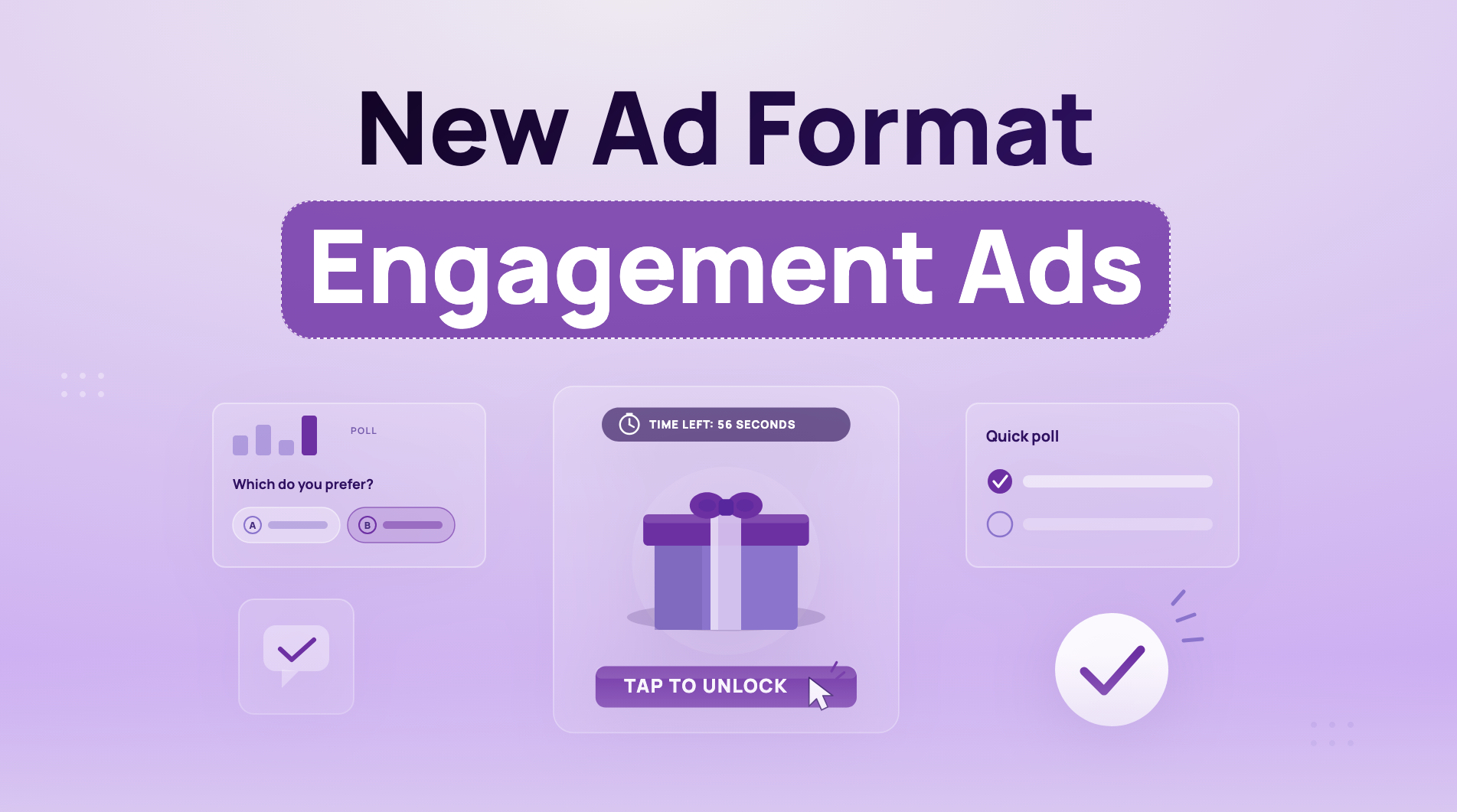
Type “Engagement ads” into a search engine and most of what comes back is about likes, comments, and shares on social platforms. That’s not this. So what are Engagement ads in the pop traffic world? It’s an ad format from Remoby that qualifies users through multi-step interactive mechanics — polls, surveys, quizzes, tap-based flows — before they ever reach your landing page. Think of it as a pre-lander funnel bolted onto pop traffic: the user completes a short flow, warms up, and only then lands on your offer. You pay CPC, and only for users who finished the funnel.
I’ve bought pop traffic for years, and my honest first reaction to this format was skepticism. Another “premium” label on the same inventory? Not quite — and the difference is worth understanding before your next test budget goes out.
What are Engagement ads?
Engagement ads are an interactive pre-lander format delivered through pop traffic. Instead of dropping a user straight onto an advertiser’s landing page, the format routes them through a short interactive pre-lander tailored to the vertical — a poll that captures opinions, a quiz that delivers a personalized result, a spin-the-wheel or tap-to-reveal mechanic, or a short playable-style sequence that requires active participation.
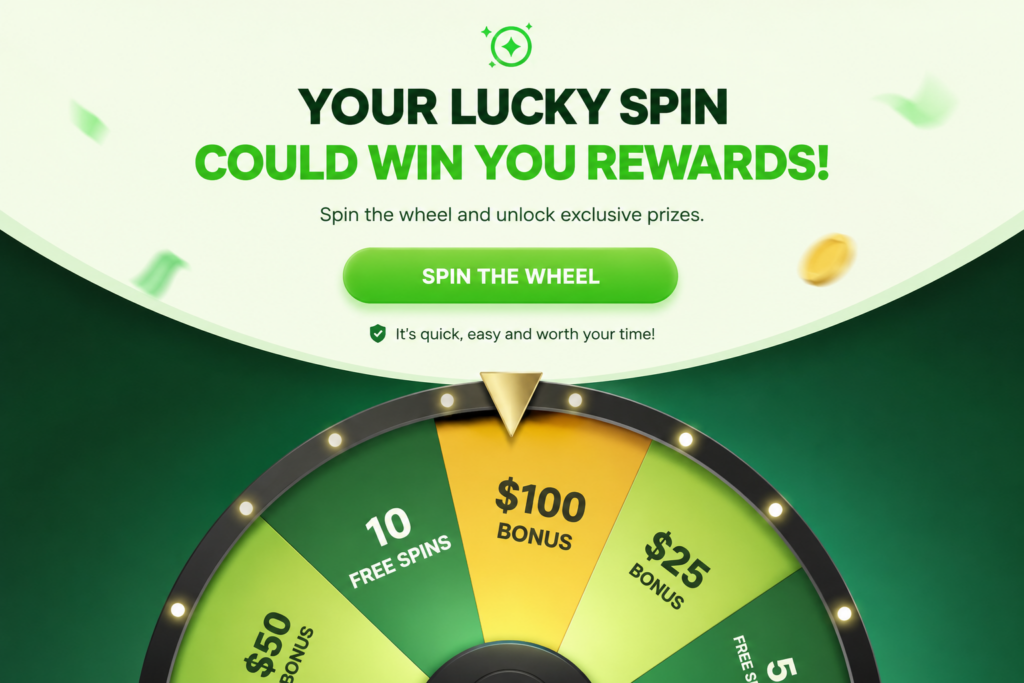

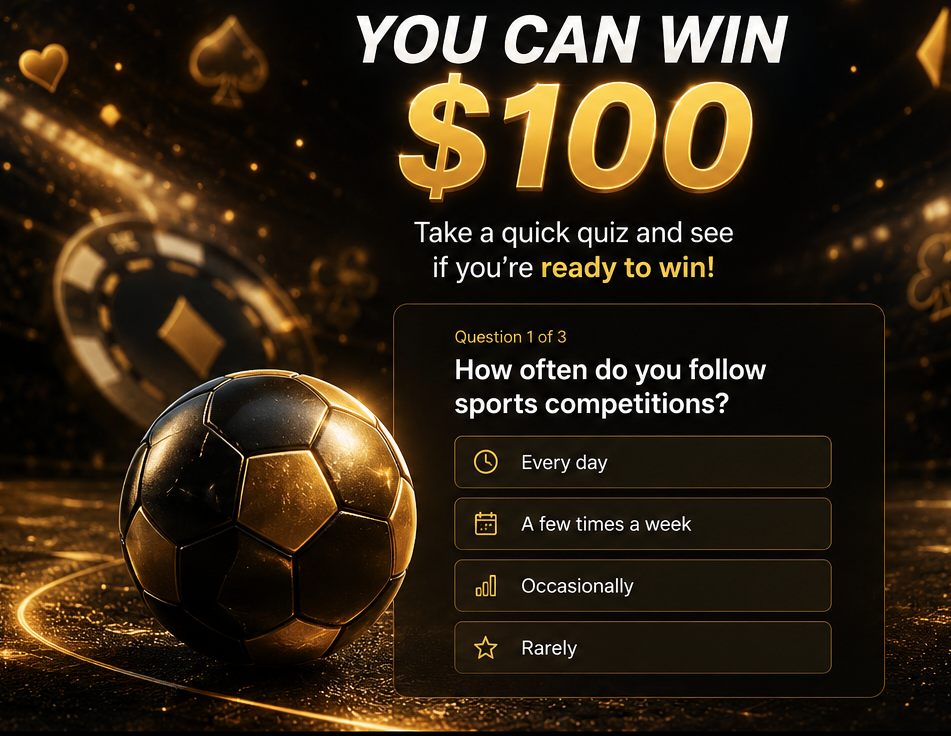
You’ll also meet this format under other names — interactive ads, interactive pre-lander flows, engagement-based formats. Different networks brand it differently, but the mechanics belong to the same family.
Two things Engagement ads are not. They’re not the social-platform engagement campaigns that dominate search results for the term. And they’re not incentivized traffic: users get no reward for completing the flow, so you’re not buying motivated freebie-hunters.
The honest framing: this is an evolution of pop traffic with a qualification layer on top, not some unrelated miracle channel.
How Engagement ads work
The mechanic runs in three steps, always in this order:
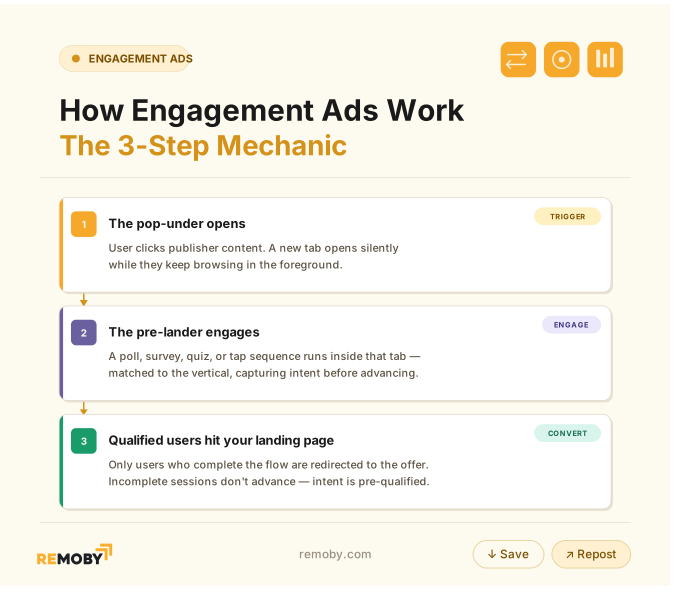
The pricing model follows from step 3: you pay CPC, and only for users who completed the funnel. Someone who closed the tab at question one costs you nothing. That single detail changes the economics compared with paying for raw pop impressions — and it’s why the format deserves a separate line in your media plan.
Ready to launch Engagement ads?
Engagement ads traffic volume
Engagement ads traffic skews Tier-2 and Tier-3 — South and Southeast Asia, LatAm, Africa. Per Remoby’s platform data, top GEOs by daily completed-flow clicks at the time of writing:
| GEO | Clicks/day | Optimal CPC |
|---|---|---|
| India | ~1.6M | $0.0017 |
| Indonesia | ~760K | $0.0125 |
| Philippines | ~734K | $0.0178 |
| Brazil | ~651K | $0.0128 |
| Bangladesh | ~268K | $0.0080 |
| Nigeria | ~266K | $0.0047 |
| Mexico | ~132K | $0.0081 |
| Egypt | ~93K | $0.0036 |
| Argentina | ~75K | $0.0094 |
Read this table carefully. Volumes are clicks per day — completed flows, not impressions. And “optimal CPC” is a recommended winning bid, not a fixed price: across these GEOs, optimal bids start from $0.0017 and top out around $0.0178. If your offer converts in Tier-2 GEOs, that’s a lot of pre-qualified clicks for the money.
Engagement ads vs pop ads
Both formats ride the same pop inventory, so the fair comparison is layer by layer:
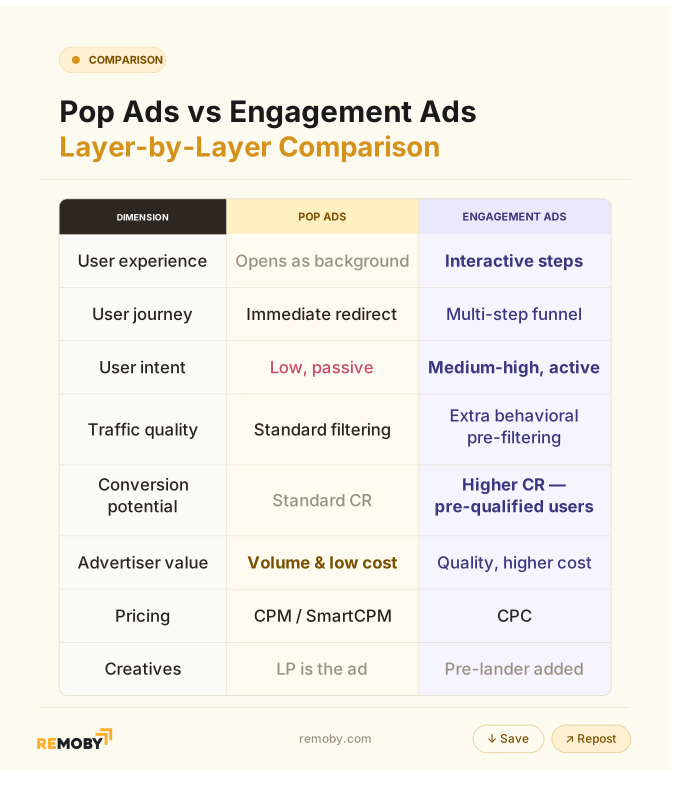
Neither column “wins.” Pop ads remain the tool for awareness, market entry, and cheap scale. Engagement ads are what you pick when your KPI is registrations, first deposits, or any quality-first metric where cold pop clicks burn budget. If your funnel leaks at the landing page, the problem usually isn’t volume.
If the pop mechanics are new, start with how popunder ads work. For the neighbouring format decision – interrupt vs opt-in – see pop vs push ads.
Why engaged clicks convert better
Six advantages explain the gap in performance:
- Engaged clicks. Active participation beats passive scrolling. A user who answered three questions has invested attention before seeing your page, so intent and CR run higher than on cold pop traffic.
- Extra fraud prevention. Bots can’t realistically complete interactive flows. Multi-step logic filters automated traffic at the engagement layer — before any conversion event you’d pay for.
- Pre-built, tested mechanics with algorithmic selection. The flows aren’t generic templates, and you don’t pick them by hand: an AI layer selects which flow variant to serve for each campaign, offer, and audience. Remoby — one network that builds and tests the flow mechanics in-house on proprietary data — reports +17% conversion rate for its Engagement ads versus standard pop, according to its internal data.
- Zero creative requirement. No banners, no ad copy. You provide a landing page URL, nothing else. Lower barrier to launch, faster testing cycles.
- Vertical-native qualification. The flow adapts to the offer category, so the questions actually pre-sort your audience.
- CPC efficiency. You pay only for qualified, warmed-up clicks that completed the flow — not for every eyeball that saw a tab open.
In my experience, points two and four matter most for smaller teams: fraud filtering you don’t have to configure, and a launch that skips the creative production queue entirely. The catch? You give up some control — the network owns the pre-lander, not you.
Verticals and flow examples
Priority verticals for the format: iGaming, Giveaways, Finance & Loans, Mobile Apps & Games, eCommerce, Social & Lifestyle.
The qualification logic changes per vertical, and this is where the format earns its keep. A Finance flow asks about budget and intent — by the time the user reaches a loan offer, they’ve already stated they’re in the market. An iGaming flow asks about sport interests: “How often do you follow sports competitions?” is a real first question from a live flow. A user who taps “every day” and completes the quiz arrives at a betting page already invested in the topic.
The answers do double duty. Beyond warming the user up, the system uses flow interactions to match each user with the most relevant offer automatically — so qualification data doesn’t just build intent, it routes traffic where it fits best.
That’s qualification a banner can’t do, because a banner never asks.
How to launch your first campaign
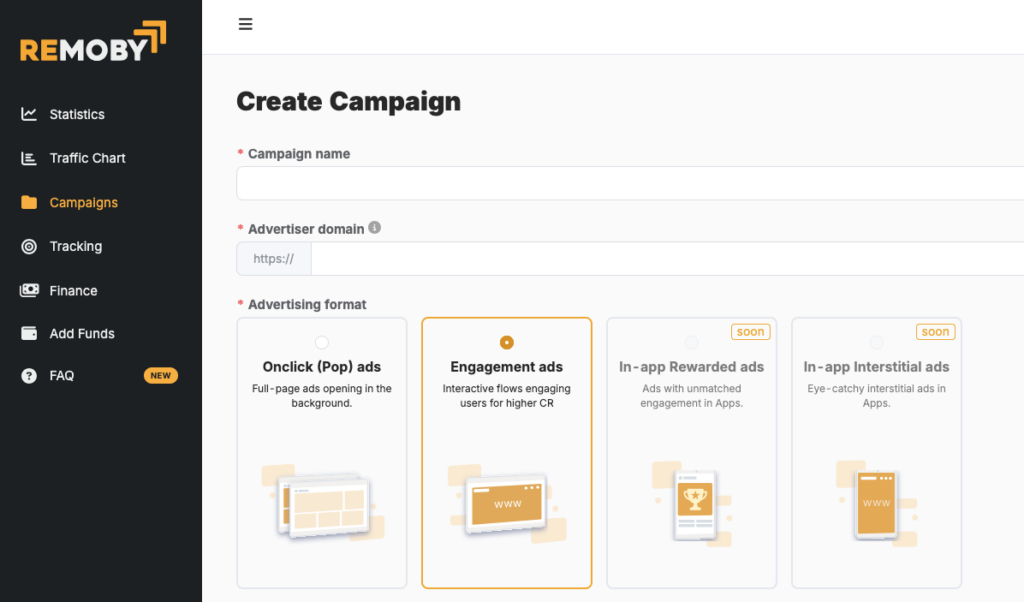
The setup list is short because the format demands almost nothing:
- Bring a landing page URL. That’s the entire creative requirement — the flow mechanics are built and tested on the network side.
- Pick a GEO where your offer already converts. Start with one Tier-2 market from the table above rather than spreading budget thin.
- Bid at or near the optimal CPC for that GEO, then adjust from actual CR data.
- Run a pop campaign in parallel on the same offer if you can. Comparing cost per conversion between raw pop and completed-flow clicks tells you in one week whether the qualification layer pays for itself on your funnel.
That last step is the one most buyers skip — and the one that turns “interesting format” into a defensible line item.
New to paid traffic entirely? The fundamentals are in media buying for beginners.
Ready to launch Engagement ads?
FAQ about Engagement ads
No. The flows are lightweight interactive mechanics — polls, surveys, quizzes, spin wheels, tap-to-reveal, and short playable-style sequences — not full-scale games. They are gamified pre-landers designed to qualify interest in a few steps, not entertainment products.
No. Users are not incentivized or rewarded for completing the flow, so this is not rewarded or incentive traffic. Participation is driven by the interactive mechanic itself.
No. The advertiser provides only a landing page URL. The interactive pre-lander flows are built, tested, and optimized on the network side, so no banners or ad copy are needed.
Multi-step interactive logic acts as a behavioral filter: automated traffic can't realistically complete polls, quizzes, or tap sequences, so bots drop out at the engagement layer — before any click is billed or any conversion event fires.
![Pop Ads CPM in Indonesia [2026]](https://remoby.com/wp-content/uploads/2026/08/Screenshot-2026-08-03-at-16.38.38-768x431.png)
![Pop Ads CPM in Mexico [2026]](https://remoby.com/wp-content/uploads/2026/07/Screenshot-2026-07-30-at-16.06.45-768x432.png)