Updated: July 28, 2026
|
11 min read
Updated: July 28, 2026
|
11 min read
Split Testing Ads: How to Run Valid Tests and Choose a Winner

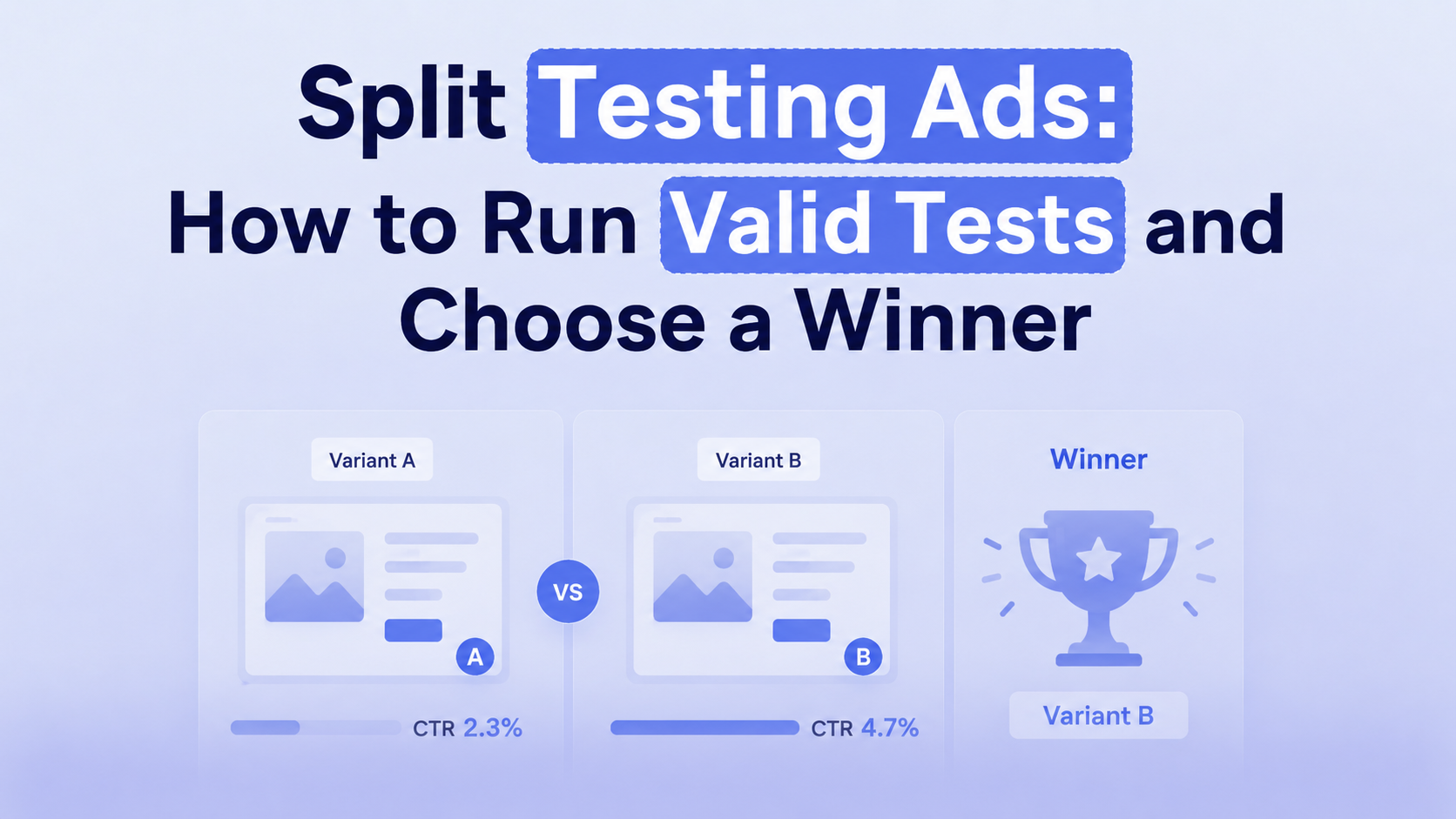
Split testing ads works only when the setup is boring enough to trust: one variable, clean traffic split, one winner metric, and enough signal to avoid picking a false winner.
What split testing ads means
Most buyers ruin the test before the first click by changing the headline, image, and lander at the same time. Then the variant wins or loses, and nobody knows why.
Define split testing, control, variant, and one-variable discipline
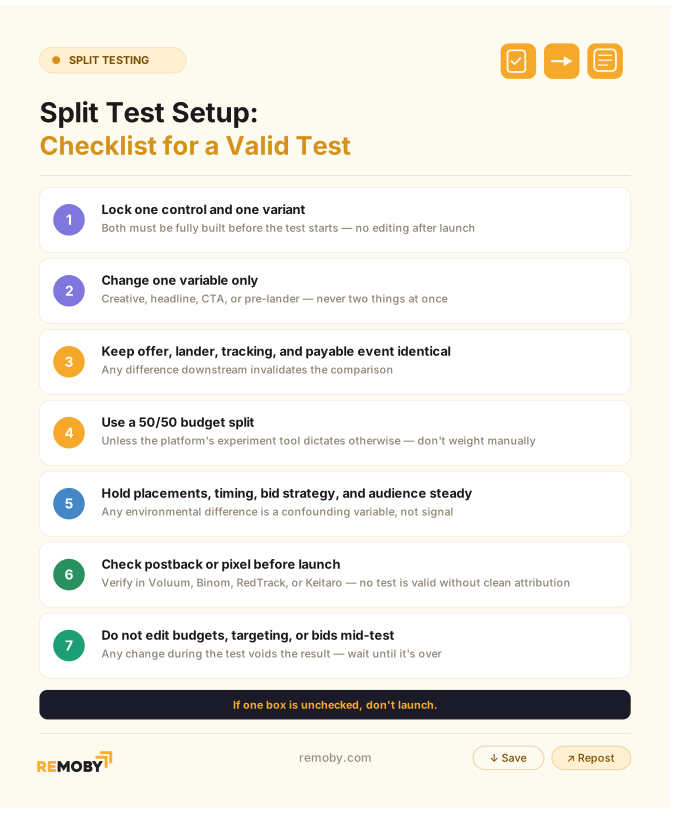
A usable test starts with a control you already trust and one variant that changes a single element. In practice that means the audience, bid, budget split, placements, offer, and funnel stay stable while one test cell gets the new angle.
If you swap the creative hook and also change the prelander, you are not learning which one moved the KPI. You’re buying confusion with ad spend.
What happens if you change more than one ad variable in a split test?
Changing more than one ad variable turns a clean experiment into a messy one. The result may show a winner, but the result cannot tell you which element caused it. For example, if a new image and a new CTA lift CTR together, you still do not know which change deserves to scale.
I used to call these “fast tests” when I was impatient. They were fast, sure. Fast at producing bad decisions.
Split testing vs A/B testing ads
What most people assume: split testing and A/B testing are always the same thing. In day-to-day buying, they usually are. In platform workflows, the difference matters when the system handles randomization, budget split, and audience overlap for you.
When the terms are interchangeable and when practitioners should be more precise
If you’re running two versions side by side and isolating one variable, calling it A/B testing is fine. But when Meta Ads Experiments or Google Ads Experiments is doing the traffic allocation, practitioners should be more precise because those tools reduce overlap and reporting drift compared with manual duplication (see A/B testing best practices and Google Ads Experiments guide).
That distinction matters more on automated buying than on language. The label won’t save the test if the algorithm is recalibrating underneath you.
Step 1: Write a hypothesis and choose one variable to test first
Split testing starts with the bottleneck, not with whatever asset is easiest to swap. A valid first test changes one variable tied to the primary KPI and leaves every other part of the funnel alone. If, for example, CPA is bad because weak users bounce on the prelander, test the prelander angle first, not the button color.
Build a simple hypothesis: variable, expected outcome, and reason
Use one format:
If we change [single variable], then [expected outcome] because [mechanism].
That last part is the useful one. It forces you to explain why the variant should work instead of throwing random creative testing into market.
A real example from a Tier-2 iGaming pop campaign:
If we change the prelander from FOMO to social proof, then click-to-FTD CR will improve because unfamiliar users need validation before registration.
Prioritize the first variable by funnel bottleneck, expected impact, and ease of isolation
Start where the leak is widest. If CTR is healthy and CPA is awful, test post-click elements like the prelander or landing page. If impressions are there and nobody clicks, test the hook, headline, or image first.
On push and pop, the highest-impact variable is often the prelander angle or headline, not cosmetic copy. On Meta Ads and Google Ads, it is usually the creative hook. Colors and button text are last-mile work (this is the part everyone skips).
Step 2: Set up a fair control vs variant test
A fair test is stricter than most buyers want. Same audience conditions, same offer, same funnel bundle, same timing, same budget split, and no mid-flight edits.
Keep audience, budget, placements, timing, and funnel conditions consistent
If you let source mix drift, your variant can “win” because it got cleaner inventory. On pop campaigns, that means same zones, same bid, same whitelist or blacklist logic, and a stable baseline CPM/CVR for at least 5 days before the test starts (industry benchmark).
On Meta, avoid audience edits or budget changes right before launch because learning resets contaminate the comparison. On Google Ads, Smart Bidding changes need breathing room too; waiting about 2 weeks after a major bidding adjustment is the safer move before starting an experiment (Google Ads Experiments guide is an industry benchmark).
Why learning phases and bidding-system recalibration can invalidate results
Meta learning and Google Smart Bidding recalibration do not care about your neat test plan. A test that overlaps with learning cannot separate variant performance from algorithm adjustment. Meta says major edits can re-enter learning; Google documents that bid strategy changes trigger a learning period.
One network worth testing for pop traffic is Remoby, but the same rule applies there too: stable source conditions first, then test. Once the traffic split is fair, the next mistake is choosing a winner metric that never matched the campaign goal in the first place.
Ready to launch with Remoby?
Step 3: Pick the primary KPI by campaign objective
Primary KPI selection should match the campaign objective, not the nicest-looking number in the dashboard. Awareness tests should use CPM or viewable impression rate; traffic tests should use CPC or landing-page quality signals; lead gen should use CPL on qualified leads; conversion campaigns should use verified CPA; ROAS campaigns should use revenue per click or ROAS plus AOV context. A variant with 20% higher CTR but worse CPA is not a winner for a sales campaign.
Need a ROI calculation 101 course? Read the blog.
Map awareness, traffic, lead gen, sales, and ROAS goals to one winner metric
CTR is a vanity win when the objective lives further down the funnel. I see this a lot on push ads: the clickbait creative crushes CTR, then the offer CR collapses and EPC follows it down.
Comparison table: campaign objective, primary KPI, supporting metrics, and misleading metrics to avoid
| Campaign objective | Primary KPI | Supporting metrics | Misleading metric to avoid |
|---|---|---|---|
| Awareness | CPM or Viewable Impression Rate | Reach, frequency, viewability | CTR |
| Traffic | CPC or Landing Page Views | Bounce rate, engagement rate, time on page | CTR alone |
| Lead generation | CPL on qualified leads | Form completion rate, lead quality score | Raw lead volume |
| Sales / Conversion | Verified CPA or CVR to payable event | Funnel-stage conversion rates, approval rate | Platform-reported conversions only |
| ROAS | Revenue per click or ROAS | AOV, approval rate, refund rate, margin | CVR without revenue context |
| Verdict | Choose one primary success metric before launch | Use supporting metrics as guardrails, not success criteria | Do not change the winning KPI during the test period |
Step 4: Run the test long enough and wait for enough data
Test length is not a calendar question first. It is a signal question. Run long enough to cover real business cycles and long enough for each variant to earn enough conversions or clicks to mean something.
What sample size is enough for ad split testing?
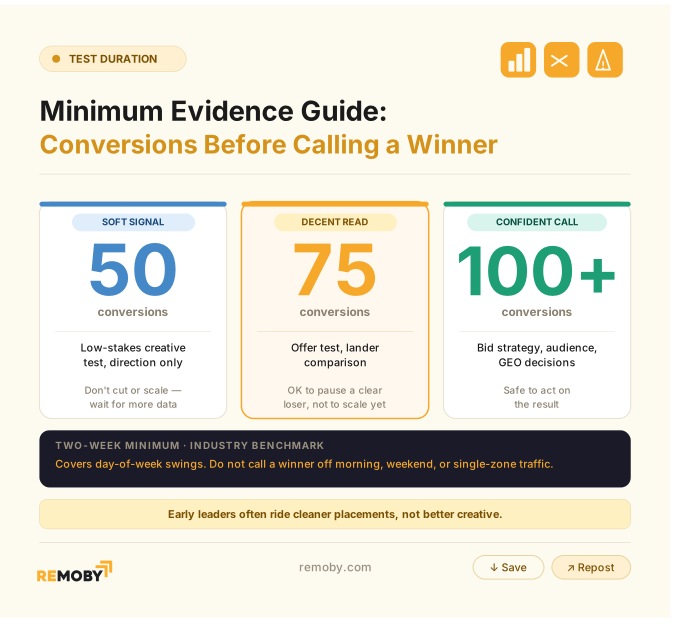
For conversion campaigns, I do not review seriously before 50 conversions per variant and I do not act aggressively before 100 per variant (industry benchmark). Low-volume lead gen can work with 30-50 qualified leads. Pop traffic needs more patience because zone variance is uglier; 75+ conversions per variant is a safer floor.
Awareness is different. You want impression volume, usually 50,000+ impressions per variant before reading directional differences (industry benchmark). If you want a quick way to estimate how much data split testing needs, a sample size calculator can help set a realistic floor before launch.
When is an ad split test statistically significant enough to scale?
Statistical significance is not enough by itself. A practical winner usually needs 95% confidence, a lift large enough to matter economically, and consistency across time or placements. For example, a 2% CPA improvement with 95% confidence is real, but not worth scaling if fee spread or traffic volatility can wipe it out next week.
Guardrails against early stopping, day-part bias, and incomplete business cycles
Two weeks is a decent minimum heuristic because it covers day-of-week swings, and many teams stop too early after one hot afternoon (industry benchmark). Do not call a winner off morning traffic only, weekend traffic only, or a single zone spike.
I once paused a loser on day two, then relaunched it later out of stubbornness. By day seven it beat control by 18%. The early “winner” was riding cleaner placements. (yes, I’ve done this too)
Enough signal gets you to a verdict. Mixed signals are where most buyers torch the next chunk of budget.
Step 5: Interpret results and decide whether to scale, retest, or discard
Decision logic is simple once the setup was valid. Scale when the primary KPI improves by a meaningful margin, confidence is strong, and the lift holds across the test window or major placement subsets. Retest when results are directionally positive but thin. Discard when the variant clearly loses, confidence spans zero, or the win contradicts the hypothesis and is not transferable.
How to scale the winner – budget bump vs new segments – is in horizontal vs vertical scaling.
Can I trust a split test result if the click-through rate improved but conversions did not?
CTR without downstream improvement is not a trustworthy win for performance campaigns. The higher click rate usually means the hook got broader, not better. If CTR rises 25% but verified CPA worsens 12%, the variant attracted cheaper curiosity instead of buyers.
Decision framework table: when to scale, when to retest, and when to discard
| Outcome | What the data looks like | Decision |
|---|---|---|
| Scale | 15%+ improvement on primary KPI, ≥95% statistical confidence, consistent across zones/placements | Scale gradually, monitor CPA/ROAS drift and creative fatigue |
| Retest | 5–15% improvement, weak confidence interval, or insufficient sample size | Continue testing with more volume or tighter variable isolation |
| Discard | 10%+ decline on primary KPI with statistical significance, or compromised test setup | Stop the variant, document findings, and move budget elsewhere |
| Verdict | Mixed results are not proof of a winner | Avoid heroic interpretation; protect budget and data quality first |
A representative example: in a Tier-2 iGaming pop test, switching the prelander from FOMO to social proof improved click-to-FTD CR from 1.7% to 2.1% over 120 conversions, with 97% confidence and consistency across the top 5 zones. That is a scale decision. On pop specifically, fold winners back into the campaign optimization loop – zones first, then bids.
Common mistakes that invalidate ad split tests
Most invalid tests fail for boring reasons, not advanced ones. Somebody changes the budget, edits the audience, forgets the postback, or judges on CTR because CPA is still noisy.
Testing multiple variables, changing budgets mid-test, and using uneven traffic splits
Uneven traffic allocation creates fake winners. On pop and push, a variant can win because it got a nicer source mix. On Meta and Google, duplicated campaigns without proper experiment tools can create audience overlap and delivery drift.
Judging on vanity metrics, broken funnels, and tests launched during learning
Broken funnel beats bad creative as the fastest way to waste a week. If the offer page has a tracking issue, or platform-reported conversions do not match the verified event, you are optimizing the wrong step. CTR improvements that do not improve downstream CPA are vanity wins. Meta learning and Google re-learning make the same mess from a different direction.
Once you stop invalidating tests, the work gets easier: choose variables that are safe to isolate instead of pulling half the funnel apart at once.
Ad elements you can safely test one at a time
Ad elements are safe to test one at a time when they can be isolated without changing traffic quality, funnel flow, or payout logic. Good single-variable candidates include creative, headline, copy angle, CTA, offer framing, landing page headline, and audience segment. To me, testing a social-proof prelander against an urgency prelander is clean if the offer, zones, bid, and funnel stay the same.
Creative, copy, CTA, offer framing, landing page, and audience variables to isolate carefully
Creative hook, headline, CTA, and prelander angle are the cleanest starting points. Audience variables can work too, but isolate them carefully because overlap and delivery shifts can contaminate the test cell. Landing page tests are worth it when the leak is post-click, but do not touch both the ad and the page in the same round.
New to affiliate landing pages? We mapped out the key principles in the affiliate landing page framework.
Short platform notes for ads experiments
If the platform gives you an experiment tool, use it. Manual duplication is where randomization gets sloppy.
Use experiment tools for cleaner randomization, traffic splits, and reporting when available
Meta Ads Experiments helps reduce audience overlap and keeps budget split cleaner than cloning ad sets manually. Google Ads Experiments does the same job for campaigns using Google Ads, especially when Smart Bidding is part of delivery.
For push and pop, you usually do more of this manually. That means being stricter with whitelist, blacklist, zone stability, and source mix. Remoby (pop network with direct publisher relationships in Tier-2 and Tier-3 GEOs) fits that kind of test environment when you want cleaner Tier-2 inventory sampling.
The campaign that looked better at the start is not the one you should trust. The winner is the version that still holds up after the noise clears, the learning ends, and the payable event says it earned the spend.
Ready to launch with Remoby?
Split testing FAQ
Top questions when split-testing ads
Split testing starts with one hypothesis, one control, one variant, and one winner metric. Keep the audience, budget split, placements, timing, and funnel identical, then let both versions run long enough to collect real signal before deciding to scale, retest, or discard.
Split testing in advertising means comparing a control against a variant while changing a single variable. The goal is not to find a prettier ad. The goal is to isolate cause, so when CPA, CPL, or ROAS moves, you know what actually changed it.