Updated: August 15, 2026
|
10 min read
Updated: August 15, 2026
|
10 min read
CPA Marketing Optimization: a Profitability-first Framework

A campaign can show a clean $18 front-end CPA, meet the traffic source target, and still lose money once approvals settle. That is where CPA marketing optimization usually goes wrong: buyers tune bids and creatives before they check whether approved economics can ever work.
What is CPA marketing optimization?
CPA marketing optimization is the process of improving approved conversion economics, not only lowering reported acquisition cost. The practical goal is to increase profit after approvals, holds, and quality filters. Example: a push funnel with a higher front-end CPA can still beat a cheaper one if approval rate and EPC hold up after postback reconciliation.
For active buyers, that changes the whole workflow. You are not trying to win the cheapest click or even the cheapest lead. You are trying to win the cheapest approved action inside a payback window that makes sense for your burn rate and cash flow. If the network pays $40, but only 18% of conversions approve, your real breakeven is not what the dashboard suggests.
Why profitability-first optimization beats generic CPA reduction
Most buyers assume lower CPA means progress. In real campaigns, lower CPA often comes from weaker zones, broader targeting, or softer prelander messaging that raises raw CVR and destroys approval quality.
That trade-off shows up fast in Finance, iGaming, and Social funnels. A softer angle can improve LP CTR and make the tracker look healthy. Then week two arrives, the hold clears, and half the volume disappears. I have seen campaigns with worse click costs print better margin because the traffic matched the offer and the advertiser actually approved it. The cheap funnel was never cheap.
Ready to launch with Remoby?
Which metrics matter most when optimizing a CPA marketing campaign
CPA marketing campaign metrics that matter most are payout, breakeven CPA, EPC, approval rate, hold rate, and ROI calculation. Those numbers show whether the funnel works after downstream filtering, not only at the click or lead stage. Example: a $30 payout offer with 50% approval has a very different breakeven than the same payout with 20% approval.
These metrics belong in one sheet, not six tabs. If you separate front-end traffic numbers from approval quality, you will keep fixing the wrong bottleneck.
Formula block: payout, breakeven CPA, EPC, approval rate, hold rate, and ROI
The useful formulas are simple:
- Approved payout per raw conversion = payout × approval rate
- Expected realized payout = payout × approval rate × (1 – hold treated as lost)
- Breakeven CPA = expected realized payout per conversion
- EPC = approved revenue ÷ clicks
- ROI = (approved revenue – spend) ÷ spend
If an offer pays $40 and approval rate is 30%, the approved value of each raw conversion is $12. If hold sits at 35% for more than 10 days with no movement, many buyers treat that held volume as lost when recalculating ROI. Now the working value drops again, and a “good” $15 CPA is suddenly bad business.
For every vertical CPA looks different. For iGaming specifically, the CPA ceiling comes from player value – see LTV calculation and CPA bidding.
Comparison example: lower CPA but worse approved economics vs higher CPA with profit
A lower reported CPA can lose money faster than a higher one. Here is a simple comparison.
| Campaign | Front-end CPA | Payout | Approval rate | Hold rate | Approved RPC | ROI verdict |
|---|---|---|---|---|---|---|
| A | $18 | $40 | 20% | 40% | $4.80 | Losing |
| B | $24 | $40 | 35% | 15% | $11.90 | Still workable |
Campaign A looks cleaner in the traffic source. Campaign B is the one you keep testing. That is the whole argument for profitability-first buying.
The verdict: Higher CPA can win if approval quality and hold stability are stronger
What is the first check before changing bids or creatives in a CPA campaign?
Tracking integrity is the first check before any bid or creative change. The reason is simple: corrupted postback data makes every downstream decision unreliable. Example: if click IDs are missing or event names mismatch between tracker and network, CR and EPC can look weak even when the traffic is fine.
Before you touch bids, reconcile three systems: tracker, affiliate network, and traffic source. If totals do not line up within the expected approval delay, stop there. There is no point reading zone performance off broken data.
How to tell whether bad postback tracking is corrupting your optimization data
What goes wrong first is usually boring: null click IDs, duplicate postbacks, or the wrong event mapping between tracker and network. The dashboard still populates, so teams keep spending (this is where most teams stop checking).
Check in this order:
- Confirm every conversion postback contains a valid click ID that exists in your tracker log.
- Compare raw postback logs against tracker clicks, not only dashboard totals.
- Look for duplicate click IDs in conversion logs.
- Verify event names match exactly across the network and tracker.
- Check approval timing. If approvals come 7+ days late, short-window bidding logic will misfire.
Broken tracking creates fake losers and fake winners. If you need a baseline checklist, this postback tracking guide covers the core implementation issues that most often corrupt CPA marketing decisions.
If you use Voluum, Binom, RedTrack, or Keitaro, the principle is the same: trust logs first, dashboards second. Scrubbing suspicion is common; bad implementation is more common.
How do you diagnose why a CPA marketing campaign is not profitable?
CPA campaign profitability should be diagnosed in a fixed order: tracking integrity, offer economics, approval and hold quality, traffic quality, creative-message match, and landing flow. The sequence matters because later-stage tests are useless if earlier-stage numbers are broken. Example: rotating creatives will not fix an offer with a 15% approval rate across every source.
Random testing burns budget because each layer depends on the one before it.
Simple order of operations for campaigns getting conversions but not profit
If you are getting conversions but no margin, CPA marketing optimization should follow this order every time:
- Check offer economics. Recalculate payout vs. actual approval rate — if unit math doesn’t work at current approval, further diagnosis is premature.
- Audit sources and placements. Identify exactly where the loss is generated — isolate by zone, placement, and traffic type.
- Review creatives. Look at CTR and CR, but prioritize post-click behavior over raw click metrics.
- Inspect the funnel. Check prelander and lander dropoff points — where users exit before converting. Read how to build the right pop traffic prelander.
- Assess lead quality. Analyze time-to-conversion, conversion depth, and repeatability — the problem is often not CR but conversion quality downstream.
Order beats activity.
Decision table: symptom, likely bottleneck, metric to check, and first action
| Symptom | Likely bottleneck | Metric to check | First action |
|---|---|---|---|
| Good raw CR, bad ROI | Offer economics (payout, approvals, holds) | Breakeven CPA vs approved payout | Recalculate using approved revenue, include hold rate |
| Good CTR, weak approvals | Prelander misqualification or misleading intent | Approval rate by prelander / angle | Add stronger qualification, filter low-intent users |
| One zone spends 1.5× payout, zero conversions | Traffic quality or placement mismatch | Zone-level spend vs conversions | Blacklist or isolate zone for retest |
| Tracker shows conversions, network does not | Tracking / attribution mismatch | Click ID integrity, postback status | Audit postback logs and parameter mapping |
| All sources approve under 20% after volume | Offer-side issue (fraud filters, call center, GEO mismatch) | Approval rate after statistically relevant sample (50+ conv) | Pause and switch offer or GEO |
| Performance drops only in certain hours | Delivery inefficiency / auction dynamics | ROI or CPA by hour | Apply dayparting, cut low-efficiency windows |
Fix the deepest constraint in the funnel, not the most visible metric spike
What if the problem is offer economics, not traffic?
Offer economics are usually the problem when approval stays weak across multiple traffic sources, angles, and zones after enough volume. Traffic is usually the problem when losses are concentrated in specific segments that can be cut or bid down. Example: if push, pop, and native all produce sub-20% approval after 50+ conversions, the offer is the likely constraint.
The key test is control. If you can fix it with blacklist, whitelist, bid cap, or angle testing, it is a traffic problem. If payout is too low for the GEO CPC floor, or approval is bad everywhere, it is not in your hands.
Signals that the offer is unfixable vs signs the traffic can still be improved
A campaign with approval below 20% after 50+ conversions is a hard pause trigger, and below 15% many buyers treat the offer as dead regardless of source. Hold above 40% combined with approval under 25% usually points to the advertiser’s internal funnel, not your targeting.
Traffic can still be fixed when variance is uneven. If some zones hit positive ROI within 2× payout spend while others bleed out, isolate the whitelist and cut the rest. If every zone, every creative, and every prelander collapses the same way, replacing the offer is cheaper than “more testing”.
Where to look for the offer replacement: best CPA networks in 2026, ranked by traffic-source fit.
Ready to launch with Remoby?
Traffic optimization levers
The useful traffic levers come after economics and tracking are clean. Before that, zone optimization is noise.
On push, pop, and display buys, that usually means working from the placement level upward. Remoby (push and pop network with direct publisher relationships in Tier-2 and Tier-3 GEOs), PropellerAds, and Adsterra all give enough placement granularity to separate a bad funnel from bad inventory.
What to change first: placements, segmentation, dayparting, and payout-aware bids
If you start with broad creative rotation before cutting dead zones, the burn rate gets away from you. Placement control comes first for a reason.
Use these rules:
- Start bids around 10-15% of payout divided by expected CR for the source type.
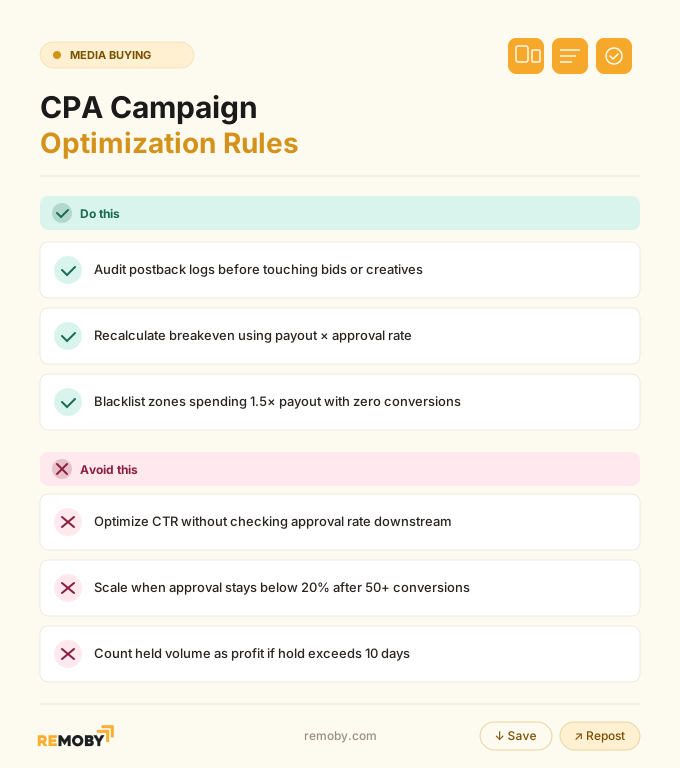
- Blacklist any zone that spends 1.5× payout with zero conversions.
- Whitelist zones that hit positive ROI within 2× payout spend.
- Daypart low-payout offers from day one; defer dayparting on high-payout iGaming or Finance until data shows a clear drop window.
- Tighten bids faster on pop traffic (also for affiliate marketing) because margins are thinner.
Landing flow and pre-lander optimization for better approval quality
CTR is the wrong winner metric for a prelander. Approval rate by prelander variant is the correct one.
That is the part many teams miss. A short emotional hook can push more users to the offer page and still lower approved ROI. In Finance and iGaming, longer qualification-style prelanders often send fewer clicks and better leads. Broader landing page conversion rate benchmarks can help frame top-of-funnel behavior, but CPA marketing optimization still has to be judged on approved outcomes, not raw page conversion alone.
Why CTR can improve while approved ROI gets worse
What most people assume is that better LP CTR means a stronger funnel. In CPA buying, better LP CTR often means weaker filtering.
A useful example: taking a prelander from aggressive curiosity to qualification can drop CTR by 20% and still lift approval from 18% to 30%. That is a trade any serious buyer takes. Adding one qualification step before the CTA filters passive clickers and protects downstream quality. The funnel looks slower. The margin looks better.
What makes a CPA campaign too risky to scale?
Approval rate and hold rate become scale-risk signals once the sample is large enough to trust. A practical rule is to pause when approval stays below 20% after 50 or more conversions, and to treat an offer as effectively dead below 15%. Example: if hold exceeds 35% for more than 10 days with no movement, many buyers mark that volume as lost when recalculating ROI.
These are not cosmetic warnings. They affect cash flow, scaling confidence, and whether your whitelist is real or temporary.
Scale, pause, or replace rules using sample size, spend, time, and stability
The decision rules are straightforward:
- Pause: reapproval under 20% after 50+ conversions, or zero conversions after spending 3× payout.
- Hard pause: hold above 35% for 10+ days with no release, or approval under 15% across segments.
- Replace offer: negative ROI after 5× payout spend and two creative rotations, or 7 days of stable volume without crossing breakeven.
- Scale: positive ROI sustained across multiple zones, approvals stable, and winners repeat after bid increases.
Ready to launch with Remoby?
FAQ for CPA campaign optimization
Check this FAQ if you want to optimize your CPA campaign
CPA marketing optimization means improving approved conversion economics across tracking, offer, traffic, and funnel stages. The point is not the lowest reported CPA. The point is a campaign that keeps margin after holds, approvals, and quality checks settle.
Watch payout, breakeven CPA, EPC, approval rate, hold rate, and ROI first. CTR, CPC, and CVR still matter, but they only help if approved revenue per click supports the spend.
Start with tracking, then offer economics, then approval quality, then traffic segments, then creatives, then landing flow. That order prevents random tests and shows whether the issue is fixable or structural.
Check postback integrity first. Make sure click IDs are valid, events are mapped correctly, duplicates are not inflating conversions, and tracker logs reconcile with the network.
If approval stays weak across multiple sources, zones, and angles after enough volume, the offer is usually the constraint. If losses are concentrated in specific placements or hours, traffic is still fixable.
Use this order: validate tracking, recalculate breakeven, inspect approval and hold, cut bad zones, test angle match, then adjust prelander and landing flow. Do not reverse it.
Under 20% approval after 50 conversions is a pause. Under 15% is usually a replace-offer call. Hold above 35% for more than 10 days should be treated conservatively in ROI.
Look for null or missing click IDs, duplicate conversions, event-name mismatches, and long approval delays that break short-window bidding. Raw logs will expose the problem faster than dashboard totals.