Updated: July 28, 2026
|
9 min read
Updated: July 28, 2026
|
9 min read
Budget allocation in pop traffic: how to split spend inside one source

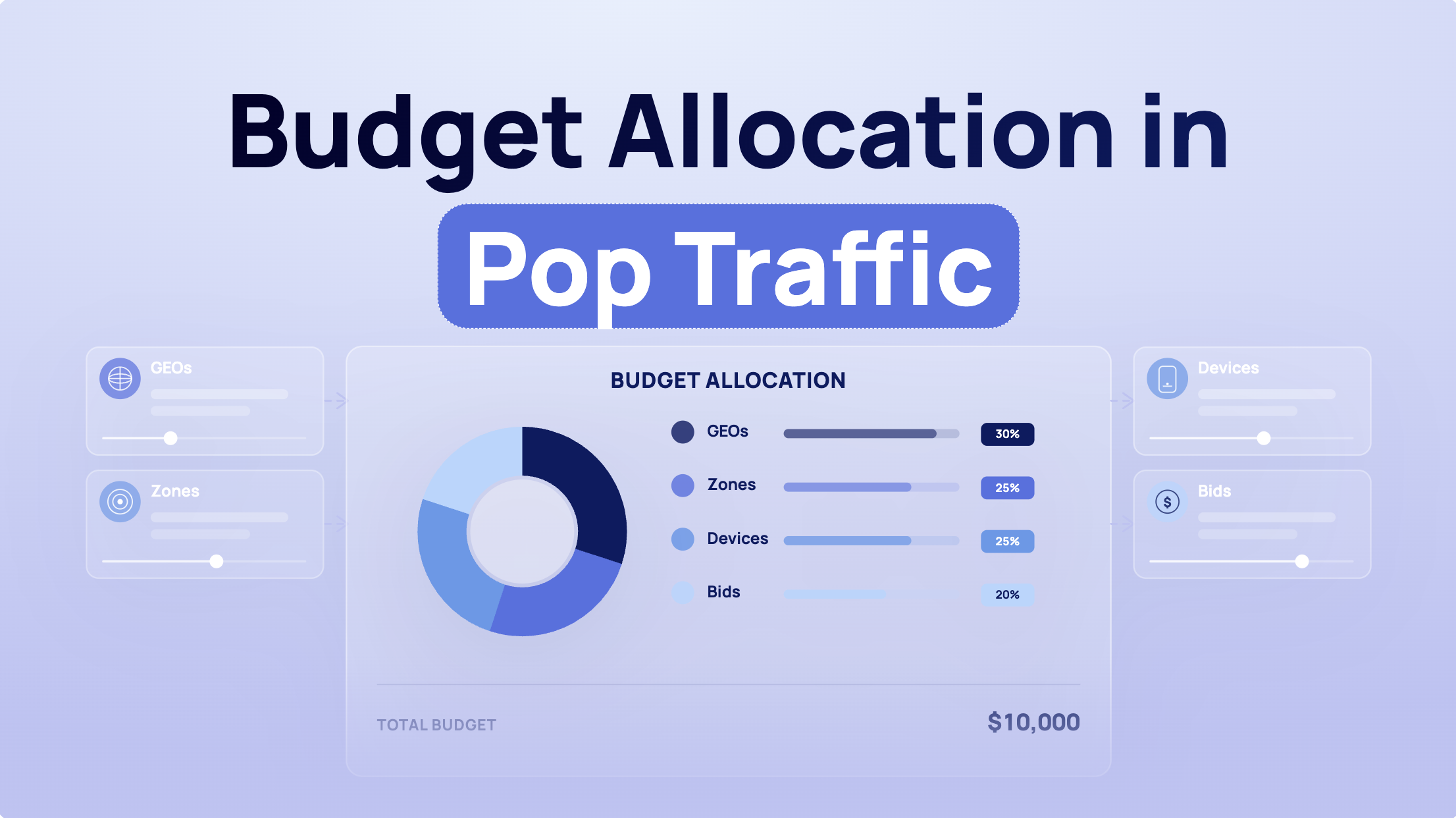
You loaded the account, launched three pop campaigns, and by lunch half the money was gone. CPM looked fine. Traffic poured in. The problem was uglier than bad bids: you never decided which dollars were buying data and which were supposed to scale.
Budget allocation in pop traffic is not the deposit. It is the cycle that keeps one source from eating itself: TEST → VALIDATE → SCALE → REBALANCE.
What budget allocation means inside one pop traffic source
Skipping the data-buying stage is how good offers get killed early. I’ve done it with iGaming during football days as well as utilities, and the result is always the same: broad traffic spends fast, weak zones hide inside the noise, and the scaling budget gets burned before anything is actually validated.
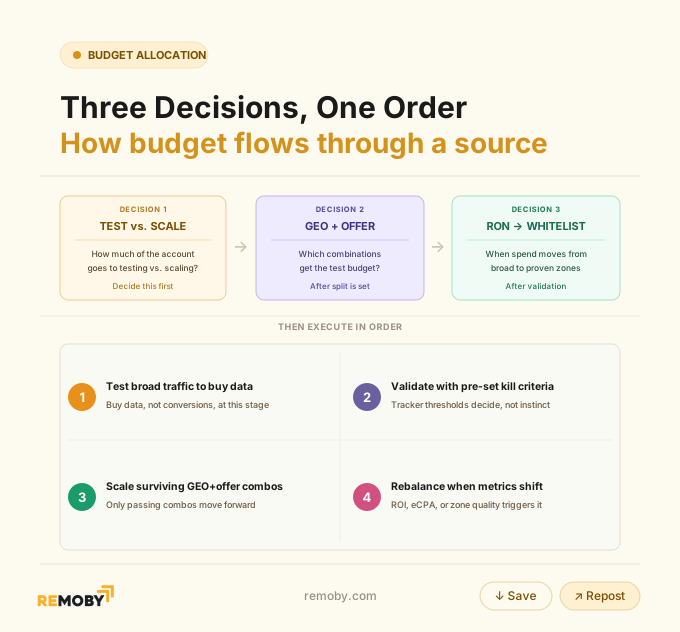
Inside one traffic source, budget allocation comes down to three decisions, made in order. First, decide how much of the account goes to testing versus scaling. Next, choose which GEO+offer combinations get that test budget. Then decide when spend moves from a broad run-of-network (RON) campaign to a whitelist campaign built from proven zones optimization.
That order matters. The deposit funds the process. It does not tell you what stage the money belongs to.
A workable way to think about it:
- Test broad traffic to buy data.
- Validate with pre-set kill criteria from your tracker.
- Scale only the GEO+offer combinations that survived.
- Rebalance when ROI, eCPA, or zone quality changes.
Early spend buys information. Later spend exploits it. Let the same budget pool do both jobs at once and the account gets messy fast.
I learned this after treating a fresh deposit like permission to scale. It wasn’t scale. It was three underfunded tests pretending to be scale (that lesson was more expensive than it needed to be).
The structure sounds clean on paper. The harder part is deciding where the first split actually happens.
How to split pop traffic budget across campaigns, GEOs, and zones
Budget allocation across campaigns, GEOs, and zones in pop traffic should start with GEO, then one offer per campaign, while zones stay broad at launch and get filtered only after data appears. GEO sets your cost baseline and traffic-fit reality. Campaign structure keeps attribution clean. Zones get validated after the auction shows what inventory you are actually winning, not before.
This is the part newer buyers get backwards. They open a source, pick an offer, then start thinking in zones too early. Bad move. GEO comes first because it sets two things everything else inherits: offer fit and CPM baseline. A cheap GEO buys data faster. An expensive GEO needs more room to breathe.
Inside that GEO, keep one offer per campaign. Mixing offers wrecks zone-level attribution. If one zone converts on offer A and dies on offer B, you learn nothing except that your reporting is now muddy.
Then launch broad. Run-of-network (RON) means a campaign across all available zones so you can buy data first. After launch, the auction surfaces the zones worth keeping. That is when whitelist and blacklist logic starts to matter, not before.
Pre-allocating by zone before traffic runs is a common mistake in onclick traffic, and not a subtle one. You are deciding with imaginary data. Better sequence:
- Lock the GEO.
- Launch one offer per campaign.
- Let RON collect zone data.
- Cut, monitor, or promote zones after thresholds are met.
Get the hierarchy right first. The deposit question comes next.
Once the hierarchy is right, the next problem shows up fast: whether the account balance is even enough to fund a real test.
How much should you spend to test one GEO+offer in pop traffic?
Test budget for one GEO+offer combination in pop traffic should be treated as a full validation unit.
A realistic working range is $1,000–$2,000 per GEO+offer before a scale-or-kill verdict, based on practitioner experience and Remoby guidance. A $500 minimum deposit on a network like Remoby is enough to start, not enough to pretend you are already scaling.
That number upsets people because they want a cheaper answer. I get it. Nobody likes hearing that a real pop test needs room. But if you underfund a GEO+offer, you do not save money. You buy weaker data.
The cleaner framework is phase-based:
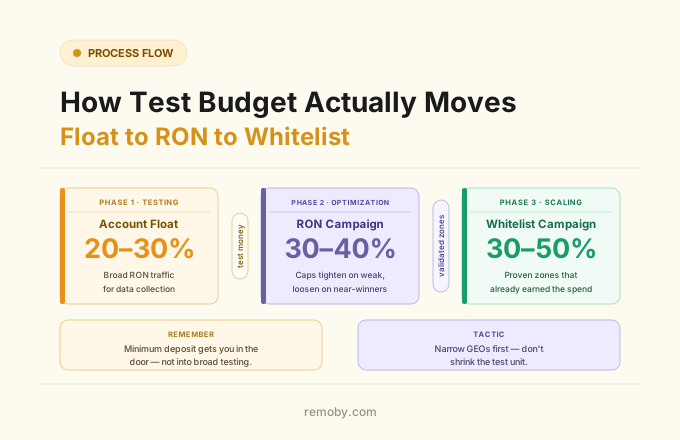
- Phase 1: testing. Keep 20–30% of the total budget here for broad data collection.
- Phase 2: optimization. Hold 30–40% for campaigns under evaluation, where caps tighten on weak traffic and loosen on near-winners.
- Phase 3: scaling. Leave 30–50% for whitelist-heavy campaigns that already proved they deserve more spend.
Short version: the minimum deposit gets you in the door. It does not fund broad tests across multiple GEOs and then whitelist scaling on top.
A test budget is supposed to survive long enough to answer a question. For one GEO+offer unit, that means enough spend to collect usable zone data, enough time to survive day-of-week variation, and enough separation between testing money and scaling money.
If you are wondering how much budget to test pop traffic campaigns, narrow the number of GEOs first instead of shrinking the test unit until it stops being meaningful.
A funded test still fails if pace is wrong. Pop volume doesn’t wait for you to think.
GEO budgeting and daily caps: how to pace spend without burning the budget
Daily caps in pop traffic should be sized to make the test last long enough to gather comparable data.
During testing, a practical rule is to set the campaign daily cap at roughly one-fifth to one-seventh of the phase test budget, giving the campaign several days to collect signals before you act. Campaign budget pacing means controlling how evenly that spend lands through the day.
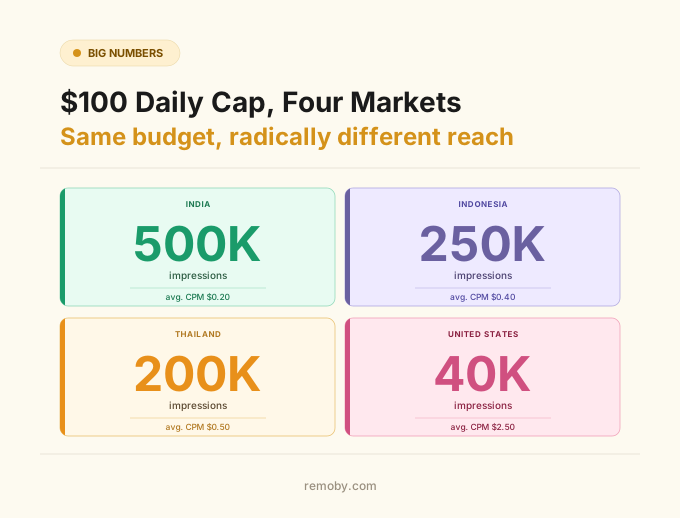
Pop inventory is huge. Data-buying speed changes sharply by GEO: a low-CPM market can deliver far more impressions from the same daily cap than an expensive one. Same traffic source, completely different data-buying speed.
Here is the arithmetic with an illustrative $100/day cap (CPM figures from Remoby data):
| GEO | Avg CPM | Approx. impressions from $100/day | What that means |
|---|---|---|---|
| Pop CPM for India | $0.58 | ~172,000 | Fast data collection, broad zone discovery |
| Pop CPM for Thailand | $6.61 | ~15,000 | Slow data collection, weaker confidence from the same cap |
| Pop CPM for Indonesia | $1.91 | ~52,000 | Mid-cost test pace |
| Pop CPM for United States | $4.54 | ~22,000 | More expensive data, needs more patient budgeting |
| Verdict | Cheap-CPM GEOs buy learning faster; expensive GEOs need larger test allocations or longer evaluation windows. |
That is the real lesson behind splitting pop traffic budget by GEO. The same dollar amount does not buy the same certainty.
Campaigns without caps can burn a day’s budget in minutes, especially under SmartCPM, the auction model where you set a max CPM but pay only enough to beat the next bid. When that happens, your test is often just one traffic burst from a narrow slice of inventory. The dashboard looks active. The data is trash.
Tighten caps when a campaign burns through spend in the first 24–48 hours with no conversions. Loosen them when zones are landing close to target eCPA and you need faster accumulation to confirm the pattern. During testing, campaign-level capping is usually enough. Zone-level caps matter later, when one outlier zone hogs spend without carrying its weight.
Pacing keeps bad data from arriving too fast. The next call is tougher: when the data is finally enough to cut, and when you’re only getting impatient.
When to cut, whitelist, blacklist, or move budget in pop traffic
Whitelist and blacklist decisions in pop traffic should use tracker-based thresholds set before launch, not gut feel from the source dashboard. A practical zone rule is to wait for at least 100 LP clicks, then judge based on spend and conversions: 0 conversions after 2x target eCPA spend is a cut signal, 3+ conversions puts a zone in promotion territory, and zones around 130–200% of target eCPA stay in monitor mode until more data arrives. A whitelist gets more budget. A blacklist gets excluded.
Discipline usually breaks here. Buyers say they use kill criteria, then freestyle as soon as a zone looks ugly on day one. Pop traffic punishes that. Day-of-week variation is real, and early bursts lie.
Use your tracker, tools like Voluum, Binom, or Keitaro, not the traffic source dashboard, as the source of truth. The source shows spend and volume. Your tracker shows whether conversions and ROI actually belong to that campaign.
A clean operating sheet:
| Zone state | Signal | Action |
|---|---|---|
| Promote | 3+ conversions, eCPA within 130% of target, stable across 3 days | Move to whitelist campaign and raise allocation |
| Monitor | 1–2 conversions or eCPA at 130–200% of target | Keep live with controlled cap |
| Cut | 0 conversions after 2x target eCPA spend | Blacklist |
| Hard cut | eCPA above 250% of target after 5+ conversions | Remove from scaling path |
| Verdict | Use one wait rule before acting: usually 3 days, or 2 days for zones burning $50+/day. |
At GEO level, apply a looser lens. Spend around the equivalent of 1x target eCPA and look for 3 or more conversions before deciding the GEO is alive enough to keep funding. That prevents one ugly early zone from killing a whole country test.
Budget migration happens here too. Start broad on RON. As zones prove themselves, launch a dedicated whitelist campaign and move the scaling budget there. Keep the original broad campaign alive on a smaller cap, because it is still buying fresh zone data. That broad campaign is not dead weight. It is your discovery engine.
I’ve made the classic mistake of cutting the broad campaign the moment the first whitelist looked good. Two days later the whitelist fatigued and I had nothing feeding it. (that one stung)
Once you understand the migration, the tempting shortcut is to skip structure and fix everything with bids. That usually ends badly.
Budget allocation vs bid optimization in pop traffic
Budget allocation usually matters more first than bid optimization in pop traffic because structure decides whether your data is trustworthy. Reallocating spend can improve ROI by concentrating budget on validated GEOs and zones, while keeping test money separate from scale money. Bid changes come earlier only when bids are so low that the campaign wins mostly bottom-tier inventory and every zone looks bad for the same reason.
If the budget is spread too thin, caps are choking delivery, or one campaign is mixing multiple offers, raising bids fixes nothing. You still cannot read the traffic correctly.
Here is the cleaner comparison:
| Lever | What it fixes | Use first when | Main risk |
|---|---|---|---|
| Budget allocation | Data quality, test coverage, spend control | Campaign has messy structure or starving tests | Slow learning if too conservative |
| Bid optimization | Inventory access and auction competitiveness | Bid is too low to reach usable traffic | Paying more for the same bad structure |
| Verdict | Fix allocation first. Raise bids first only when delivery quality is broken by underbidding. |
Reallocation can help without bid changes. It can improve efficiency, protect burn, and make zone signals clearer. What it cannot do is unlock scale when the winning inventory pool is too shallow. That is the limit.
This article covers budget distribution inside one pop traffic source. Source split across several platforms is a different budget problem. Offer selection and zone-level bid tuning belong in separate clusters.
The buyer who keeps test money separate from scale money usually looks slower in week one. By week three, that’s the account still standing.
FAQ for budget allocation in Pop campaigns
Budget allocation is how you distribute spend inside the account so each dollar has a job. In pop traffic, that means splitting money between testing and scaling, across GEO+offer combinations, and between broad RON discovery and whitelist campaigns.
Budget allocation is important because pop campaigns can spend fast enough to hide bad decisions. A clean budget split protects test data, stops unvalidated campaigns from eating the account, and makes whitelist scaling possible later.
Budget allocation strategy works best when it follows campaign stage, not a fixed formula. Test first, validate with tracker data, scale whitelist traffic in controlled steps, then rebalance when ROI or eCPA shifts.