Updated: September 15, 2026
|
12 min read
Updated: September 15, 2026
|
12 min read
Programmatic media buying vs direct: how to choose the right path

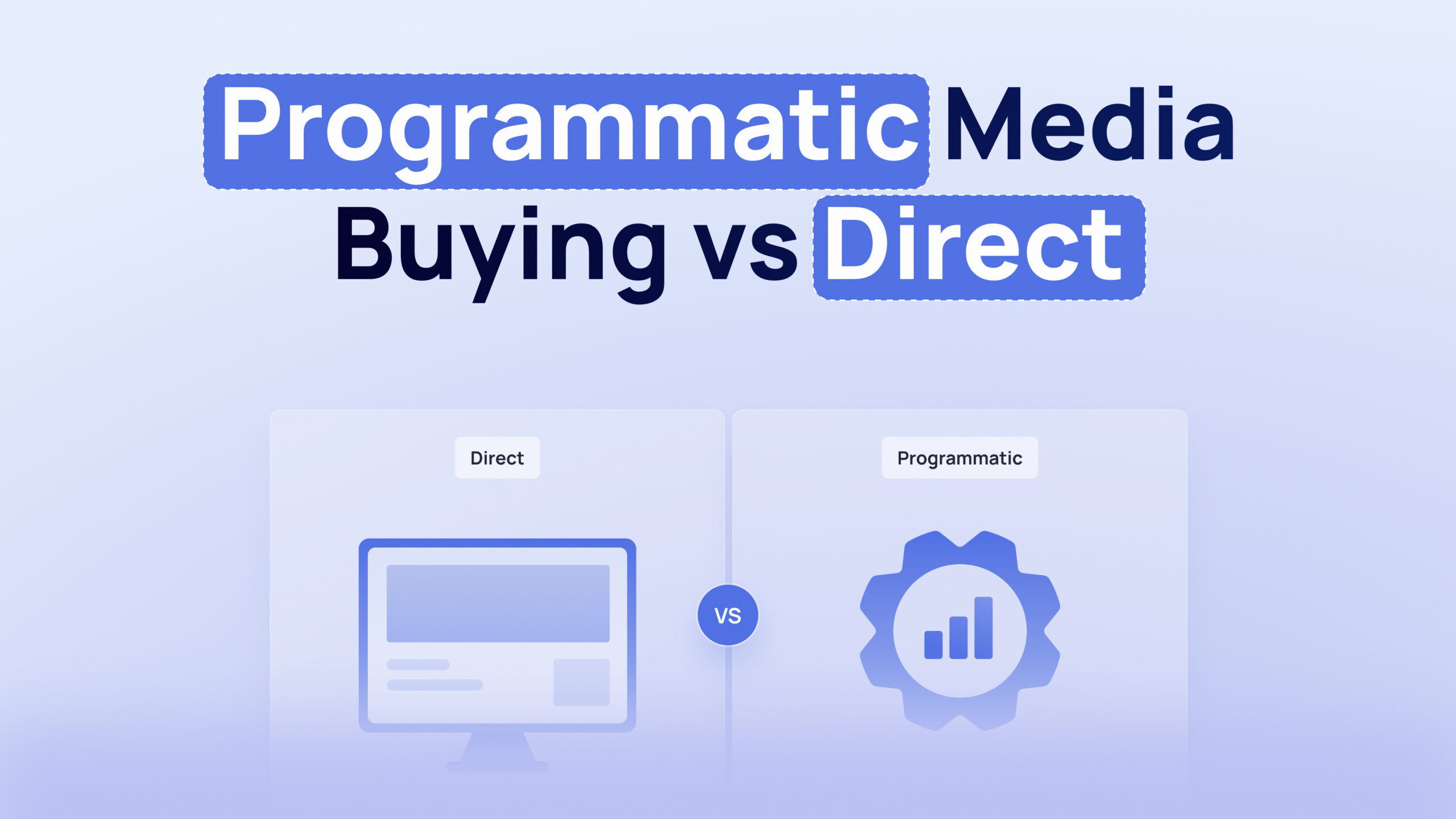
Programmatic media buying vs direct stops being a theory question the moment you need to defend working media, launch speed, placement control, and team bandwidth in the same meeting. This guide assumes the media buying basics; here we only decide the path.
Difference: Programmatic Media Buying and Direct Buying
Programmatic media buying uses DSP-driven bidding, audience rules, and algorithmic pacing to buy impressions across many publishers at once. Direct buying uses negotiated inventory, fixed placement terms, and an IO to buy with a publisher or network. The practical split is scale and optimization versus placement certainty. A retargeting campaign across 300 sites fits programmatic; a homepage takeover on one publisher fits direct.
If the mechanics are new, start with what is programmatic advertising – deal types and the DSP/SSP flow.
How programmatic buying works through DSPs, auctions, and automated optimization
Most buyers assume the win goes to the highest bid. In practice, auction dynamics, bid shading, floor logic, supply-path selection, and frequency controls shape what you actually buy.
A DSP like Google Display & Video 360 or The Trade Desk lets you buy biddable media across open exchange inventory, PMPs (private marketplaces), and PG (programmatic guaranteed) deals from one seat. That gives you reach, faster test cycles, and cleaner audience layering across GEOs, zones, and funnels. It also adds take rate layers: DSP fee, data, verification, and more operator time.
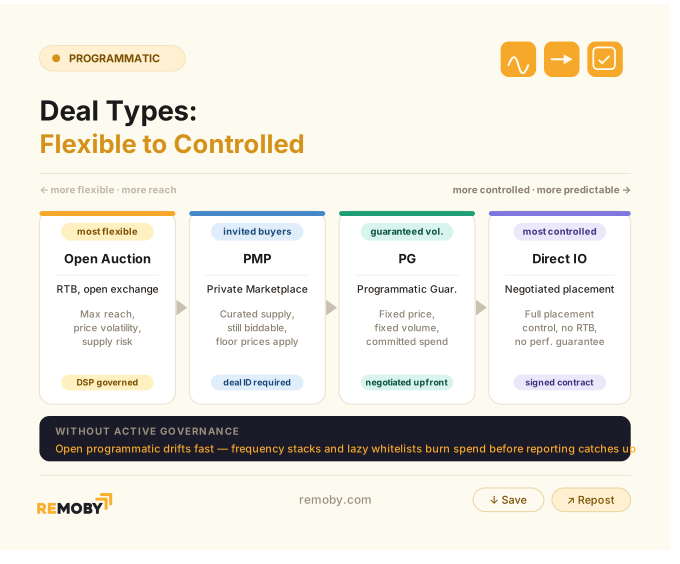
Without active governance, open programmatic drifts fast. Frequency stacks, weak supply paths, and lazy whitelists burn spend before reporting catches up (this is where most implementations break).
I once spent two days chasing a placement-quality problem that looked like fraud. It wasn’t. The campaign had inherited an outdated audience exclusion, so the DSP kept widening supply to hit pace.
The workflow feels automated. The optimization burden definitely is not.
How direct buying works through publisher negotiation, IOs, and fixed placements
A failure mode shows up fast here: buyers treat direct like “old media” and assume they lose all flexibility. They do lose some. They often gain net efficiency.
A direct buy routes through publisher emails, rate cards, negotiated fixed CPMs, placement terms, makegoods, and a reporting cadence that usually lands weekly or bi-weekly. If you know the publisher, the placement, and the audience fit, direct removes a lot of fee drag. That matters more than people admit on sub-$50k flights and single-publisher campaigns (the docs will not tell you this).
Direct also fits custom integrations that programmatic rarely handles well: sponsored content, homepage takeovers, native units, or niche B2B placements where supply is thin. For a buyer running a tightly defined funnel bundle, the value is predictability, not velocity.
The inventory is reserved. The harder question is how much flexibility you gave up to get that certainty.
Programmatic Media Buying vs Direct Buying Comparison Table
If you need one slide for stakeholders, use this matrix and argue from constraints rather than channel loyalty.
| Factor | Programmatic | Direct buying |
|---|---|---|
| Reach | Multi-publisher scale across exchanges and deals | Single publisher or curated publisher group |
| Targeting | Strong audience, behavioral, contextual, and data-driven controls | Placement-led targeting based on publisher audience |
| Inventory control | Medium in open exchange; high in PMP and Programmatic Guaranteed deals | High control over exact placements and inventory |
| Launch speed | Fast once DSP seat, creatives, and tracking are configured | Slower due to negotiations, approvals, and trafficking requirements |
| Optimization cadence | Real-time to daily optimization | Weekly, periodic, or manual optimization cycles |
| Reporting granularity | High visibility at audience, placement, device, and creative level | Typically more delivery-focused and less granular |
| Fee load | Higher due to DSP fees, data costs, ad verification, and technology layers | Lower technology overhead but often higher direct media commitments |
| Best use case | Retargeting, audience expansion, prospecting, rapid testing, scalable performance | Homepage takeovers, sponsorships, custom integrations, guaranteed premium inventory |
| Verdict | Best for scale, targeting precision, and continuous optimization | Best for guaranteed visibility, premium placements, and brand-specific executions |
Choose when optimization and cross-publisher reach matter more than fee drag.
The comparison looks clean on paper. The edge usually appears when budget size and operating bandwidth enter the room.
How to Choose Programmatic VS Direct
Programmatic media buying wins when the campaign objective depends on audience finding, fast iteration, and cross-publisher coverage. Direct wins when the campaign objective depends on where the ad appears, not what the bidder can infer.
Decision matrix: best fit by campaign objective and operational constraint
If you need a quick selection rule, map the campaign against these constraints:
- Choose programmatic for retargeting, broad awareness, multi-GEO testing, and any setup where audience logic matters more than exact placement.
- Choose direct IO for takeovers, custom integrations, regulated campaigns, and thin-supply inventory where you already know the publisher list.
- Choose PMP when premium inventory matters but you still want bid control, audience layering, and 2-3 optimization passes per week.
- Choose PG when you promised fixed volume, fixed flighting, and a known publisher property.
- Choose preferred deal when relationship access matters, but you do not want full reservation.
One matrix beats ten channel debates.
When Programmatic Media Buying Is the Better Choice
Programmatic media buying fits campaigns that need broad reach, retargeting, fast launch, and ongoing optimization across many publishers. Programmatic outperforms direct when audience precision, frequency control, and rapid budget reallocation matter more than fixed placement certainty. Typical fits include lower-funnel retargeting, multi-publisher prospecting, and time-sensitive launches where manual negotiation would slow the media plan.
Ready to launch with Remoby?
Best-fit scenarios: retargeting, broad reach, multi-publisher scale, and fast optimization
Programmatic media buying on a $100k open-programmatic flight usually needs daily checks once scale rises, but that operational cost buys speed. You can cut weak zones, split by GEO, and move budget toward the whitelist inside the same flight.
That is why programmatic consistently fits:
- retargeting pools that need frequency control across publishers
- awareness campaigns where broad reach matters more than named placements
- launches with short timing windows
- offer testing across multiple audiences before locking budget into premium inventory
On push and pop traffic, networks such as PropellerAds, Adsterra, and Remoby (push and pop network with direct publisher relationships in Tier-2 and Tier-3 GEOs) can function like a hybrid SmartCPM + RTB system when buyers want auction flexibility without fully open exchange chaos. Same principle: you pay for optionality.
Programmatic gets you into market fast. The next decision is whether that flexibility still makes sense once inventory quality becomes non-negotiable.
When Direct Buying Is the Better Choice
Direct buying fits campaigns that need guaranteed placement, lower non-media overhead, stronger publisher control, or custom execution. Direct usually beats programmatic when budget is small, inventory is tightly defined, or brand safety cannot rely on filters alone. A homepage takeover, sponsorship, regulated vertical campaign, or single-publisher buy all point toward an IO before they point toward open auction.
Best-fit scenarios: premium takeovers, custom integrations, regulated campaigns, and single-publisher buys
What goes wrong without direct is predictable: you buy “premium-adjacent” supply through a DSP, then spend the week excluding placements that never should have been in scope.
Direct wins for homepage takeovers, publisher newsletters, sponsored sections, niche trade publications, and social or iGaming campaigns where the approved publisher list is short. Even with verification vendors, programmatic keeps some residual placement risk (Media Quality Report: 20th Edition).
Why direct IO can outperform programmatic on smaller budgets or tightly defined inventory
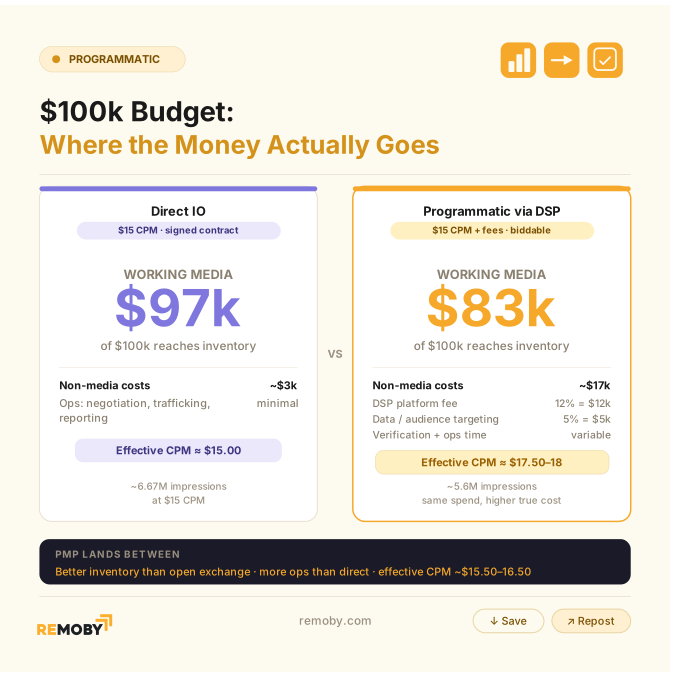
On a $100k campaign, non-media cost in programmatic often lands at $20k-$35k, leaving 65%-80% as working media. A comparable direct IO can keep non-media cost around $1.5k-$3k, with 95%+ reaching media.
That gap gets brutal on smaller budgets. If the plan is a $30k single-publisher buy, adding a 10%-15% DSP fee plus data and verification often destroys the efficiency case before optimization starts. ANA’s 2023 Programmatic Media Supply Chain Transparency Study also showed large transparency losses across the open web supply chain, including roughly $20 billion of the $88 billion studied failing to reach a publisher.
The CPM comparison is useful. The all-in cost comparison is where the real verdict usually lands.
What Is the Difference Between a PMP, a Preferred Deal, Programmatic Guaranteed, and a Direct IO?
PMP, preferred deal, PG, and direct IO sit on a spectrum from flexible auction buying to fixed reserved buying. PMP gives invited buyers auction access to selected inventory. Preferred deals offer first-look access at a fixed price without hard reservation. Programmatic guaranteed locks price, volume, and flighting through DSP plumbing. Direct IO does the same through publisher negotiation and manual workflow.
Where each deal type sits on the spectrum from open auction to fully negotiated direct
Most people group all “premium programmatic” together. That hides the only distinction that matters: who controls volume.
PG is effectively a direct buy running through DSP pipes. PMP stays biddable. Preferred deals sit in the middle and work best when the relationship matters but full reservation does not.
If your campaign needs premium inventory and variable optimization, PMP usually gives the cleanest trade. The OpenDirect 2.1 specification for programmatic guaranteed trading is useful background on how reserved programmatic workflows differ from standard auction buying.
Should You Use a PMP, Programmatic Guaranteed, Preferred Deal, or a Direct Buy?
PMP suits campaigns that need premium publisher access with ongoing optimization. Programmatic guaranteed suits campaigns that need reserved delivery and DSP workflow. Preferred deals suit campaigns that want first-look access without full commitment. Direct buy suits campaigns where relationship control, custom terms, or non-standard placements matter more than automation. The deciding variable is not prestige; it is whether the planner needs guaranteed volume or flexible bidding.
Choose PMP for premium access with auction-based flexibility
If you need premium inventory but still want audience layering, bid control, and active pacing, choose PMP. It demands stewardship: bid strategy, caps, and at least 2-3 optimization passes weekly.
Choose programmatic guaranteed for reserved inventory with automated workflow
Programmatic guaranteed wins when sales promised a fixed impression count on a known property. PG is set-and-steward, not buy-and-optimize.
Choose preferred deals or direct IO when relationship control matters more than auction flexibility
Preferred deals help when access matters more than reservation. Direct IO wins when placement terms, creative integrations, or makegoods need a human agreement.
How CPMs, Platform Fees, and Team Time Change the Real Cost of Programmatic vs Direct
Effective CPM changes once DSP fees, data, verification, trafficking, and optimization labor enter the model. A $15 direct IO can beat a $13 programmatic buy if the DSP takes 12%, data adds 5%, and the team spends 20-30 hours steering the flight. Real cost is media CPM plus take rate plus labor, not the bid price shown in-platform.
Cost inputs to compare: DSP fees, data, verification, trafficking, and optimization labor
Self-serve enterprise DSP fees often land around 10%-15% of media spend and can negotiate down to 7%-10% at high volume; managed-service layers often push total fee load higher ([Understanding DSP Fees: A Comprehensive Guide](https://www.linkedin.com/pulse/understanding-dsp-fees-comprehensive-guide-platform-costs-lambos-pbtde)). Add data at roughly 3%-8% and verification at $1k-$3k on a $100k flight.
Worked example: calculating effective CPM across programmatic, PMP, and direct IO
Programmatic media buying can look cheaper until you compare equivalent premium inventory:
Which Buying Method Gives More Control?
Direct buying and programmatic guaranteed give the most control over placement quality and inventory predictability because the publisher, placement, and delivery terms are defined upfront. PMP gives partial control through curated access and deal IDs. Open programmatic gives the least certainty, even with allowlists and verification. The trade-off is clear: more control usually means less flexibility and less opportunistic scale.
How premium inventory, guaranteed placement, and publisher control affect quality outcomes
If the campaign cannot tolerate adjacency mistakes, do not outsource the decision to a broad auction. Fixed placement beats probabilistic filtering every time.
Trade-offs across fraud exposure, transparency, viewability expectations, and predictability
Open exchange gives breadth but carries the highest residual fraud and transparency risk; direct and PG reduce that risk by shrinking the path. PMP improves quality without fully removing auction variability.
How Reporting Granularity Differs Between Programmatic Buying and Direct Placements
Reporting granularity is deeper in programmatic because the DSP exposes placement, audience, time, and bidding data continuously. Direct placements usually report on delivery, pace, and aggregate performance at a slower cadence. The practical effect is speed: programmatic gives more levers to optimize daily, while direct gives fewer levers but less reporting overhead. Lean teams often prefer that trade.
Optimization cadence, reporting depth, and workflow burden by buying model
Programmatic creates more data than many teams can use well. For a 1-2 person team, open exchange at scale often exceeds governance capacity; 3-5 PMP deals stay manageable; multiple direct IOs need the least daily attention.
Team bandwidth and staffing requirements for direct IO, PMP, and open programmatic
A lean team can steward direct placements with weekly checks. PMP needs recurring optimization. Open programmatic needs daily discipline, or the blacklist grows after the damage.
The reporting looks richer in the DSP. The real question is whether your team can turn that granularity into better buying decisions before the flight ends.
Scenario-Based Verdicts for Common Campaign Types
The right path changes by campaign shape, not by channel ideology.
- Retargeting and broad awareness: programmatic.
- Homepage takeover and custom native integration: direct IO.
- Multi-publisher premium reach with room to optimize: PMP.
- Regulated campaign: direct or PG.
- Time-sensitive launch: programmatic unless publisher lock matters.
- Mixed-funnel plan: direct for hero placements, programmatic for retargeting and scale.
Once the path is set, the next filter is how to choose an ad network inside it.
How to Use Programmatic and Direct Together in One Campaign
Use direct for the inventory you cannot afford to miss, then use programmatic media buying to fill reach, frequency, and retargeting gaps. That structure keeps premium placements stable while the DSP handles audience discovery and waste reduction.
A practical setup looks like this:
direct IO or PG for flagship placements, PMP for curated expansion, open programmatic for lower-funnel retargeting
That is usually the cleanest way to protect brand safety without giving up optimization range.
Ready to launch with Remoby?
FAQ for programmatic media buying vs direct
Programmatic media buying and direct buying can run together in one campaign. The common structure uses direct or PG for premium placements and brand-sensitive inventory, then uses programmatic for reach extension, retargeting, and faster optimization across additional publishers.
Programmatic media buying is the better choice when the campaign needs audience targeting, cross-publisher scale, rapid launch, frequent optimization, or retargeting logic. Direct buying is less efficient when the planner does not need a specific publisher placement and needs the budget to move quickly between zones, GEOs, and audiences.