Updated: July 28, 2026
|
10 min read
Updated: July 28, 2026
|
10 min read
Pop Traffic and Sports Events: A Guide for Media Buyers

Cheap CPM during a big match is usually the wrong signal. The real question in pop traffic sports events buying is whether the spike is adding usable intent, or only more concurrent users on the wrong zones at the wrong minute.
How football match days affect pop traffic volume and user behavior
Football match days affect pop traffic volume and user behavior by concentrating huge audiences into the same short windows, especially on Video on Demand and live score sites monetized with pop placements. Volume rises sharply before kickoff, thins during active play, spikes again at halftime, and then loses intent fast after full-time. The change is not only about scale. It is concurrent scale with shifting attention.
The mechanic is straightforward. Major tournaments and top-league fixtures pull users onto sports pages at the same time. Those pages often monetize aggressively because the session is short, competition for impressions rises, and the publisher knows attention is event-driven. In pop, that creates match-day volume fast. It also makes zone quality less stable than many buyers expect.
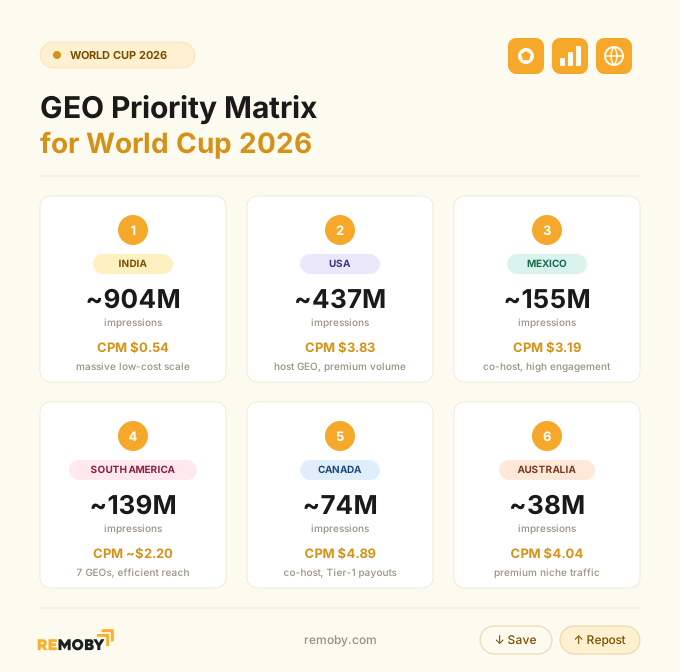
The matrix above shows how volume, optimal CPM (check our real-time CPM by GEO), and strategy line up for each of these markets.
In Remoby, we see that it is uneven where that match-day volume actually lives. India alone is projected to serve around 904M pop impressions across the tournament at an optimal CPM near $0.54, which makes it the obvious testing ground for scale. The three host GEOs behave differently:
- the USA combines heavy volume with premium pricing
- Mexico and Canada trade lower volume for engaged, high-intent host-country audiences
- South America sits in between, with seven GEOs adding roughly 139M impressions at efficient rates
- and Australia rounds out the map as a small but expensive premium pocket.
Match-window framework for football match-day pop traffic
GEOs and match-day time windows usually produce the strongest football match-day pop traffic sports events spikes in high-football-intensity regions and in the 60 to 30 minutes before kickoff, then again during halftime. LATAM and parts of West Africa often give the best balance of volume, CPM pressure, and registration intent, while Tier 1 Western Europe tends to get more expensive faster during major fixtures.
The framework matters because match-day volume is not one spike. It is five different auctions with five different user states.
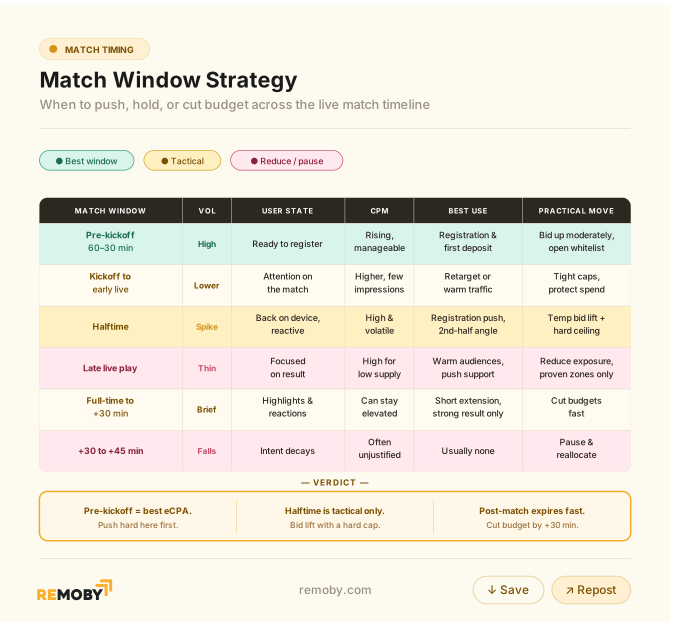
I’ve seen buyers force scale into live play because the sports GEO looked hot on paper. The traffic was real. The users were busy watching the match. eCPA did exactly what you’d expect once attention left the LP.
Expert input here was unusually consistent. Pre-kickoff tends to carry the best eCPA because users still have enough attention to move through a funnel bundle. Halftime gives a real spike, but it is a 15-minute window, so it suits registration pushes better than FTD-focused flows. (worth modeling before the call, not after).
The phase tells you the channel. The harder part is making the campaign obey the phase.
How to optimize pop traffic campaigns during major football matches
Media buyers should optimize pop traffic campaigns during major football matches with phase-based dayparting, hard CPM ceilings, budget pacing by window, aggressive zone cleanup, device segmentation, and separate LP angles by match state. Match-day campaigns usually lose money when one campaign tries to absorb every spike with one bid, one cap, and one creative.
This operating sequence holds up under pressure:
- Before kickoff, split campaigns by phase and device. Match-day traffic is heavily mobile, so blended desktop and mobile averages hide the real mobile eCPA. Keep separate zone reports from the start.
- Set a CPM ceiling before the first spike. Cap spend once CPM reaches about 120% to 130% of your pre-match baseline. Above that, many pop campaigns are paying for urgency, not performance.
- Allocate budget by window, not by day. A workable structure is 40% pre-kickoff, 30% live play, 15% halftime, 15% post-match reserve, with that last bucket usually reallocated if the match does not create a strong reaction window.
- Use whitelist placements for scale, not broad expansion. When choosing CPM rates on Remoby, be careful: match-day expansion can flood the campaign with cheap volume from weak zones (find out how to blacklist zones >>).
- Raise halftime bids only with purpose. For registration campaigns, a 15% to 20% bid lift can make sense if CR during that slot supports it. For FTD-focused flows, holding steady is often safer because the deposit path is too long for a short break.
- Apply live-play frequency control. One impression per user per 30 minutes is a solid protection rule when the auction gets thin and repetitive.
- Use pre-landers. It’s a way to pre-heat your audience and tease it before users land on your product page.

One rule controls the rest: treat match-day volume as scheduled volatility.
A lot goes wrong without that structure. Buyers overbid at halftime, budgets burn through three noisy zones, and the remaining spend lands in post-match inventory with collapsed intent. The dashboard still shows clicks. The margin is already gone. (most teams skip this conversation entirely)
You can set the perfect bid ceiling and still lose money if the GEO is wrong for the event.
Best GEOs and offer fit for football match-day pop traffic
LATAM and West Africa usually give the cleanest football match-day pop traffic trade-off. Tier 1 Western Europe often does not.
If you buy like every football market behaves the same, match day gets expensive fast. Brazil, Mexico, and Colombia tend to hold up well for pop traffic sports betting match-day campaigns because football attention is broad, mobile usage is strong, and CPMs sit well below Tier 1 pressure levels. Brazil in particular can over-index during national team fixtures and Copa Libertadores windows.
Nigeria and Ghana are worth real testing for Premier League and Champions League traffic. The audience is mobile-dominant, registration behavior can be solid, and the bid landscape is less punishing than Germany, France, or Italy during headline matches. Check our Traffic Chart with real-time CPMs to make sure you’re not overpaying.
Tier 1 Western Europe flips the trade-off. Buyers see premium traffic and assume premium value. What often arrives is premium CPM inflation with operator-heavy competition and weaker room for arbitrage. That does not mean never buy it. It means reduce exposure unless your funnel, payout, and brand angle can absorb a more expensive first touch.
Offer fit follows the same logic:
- Pre-kickoff: sportsbook registration, welcome bonus, lineup-based angle
- Halftime: second-half registration push, quick claim angle, short-form LP
- Live play: better for warm audiences or push support than cold pop
- Post-match: results, highlights, or reactivation angles, not broad deposit asks
The creative mistake here is subtle. Buyers keep the same prelander across every phase, then blame the zone. Match state changes the pitch. “Bet before kickoff” and “register for the second half” are different offers in practice, even if the backend offer is identical.
Once GEO and offer are aligned, the remaining question is whether the rising CPM is still being paid back by conversion efficiency.
Is pop traffic worth buying during live football matches if CPMs rise quickly?
Pop traffic during live football matches is worth buying only when conversion efficiency holds up well enough to offset higher CPMs and lower attention. In most cold-traffic cases, live play is the weakest margin window because impression supply tightens, bids rise, and users are less willing to leave the match to finish a registration or deposit flow. The exception is warm traffic, short forms, or strong in-match hooks.
The trap is paying a live-play premium for pre-match behavior. During live play, traffic drops, CPM rises, CR falls, and FTD rates usually soften because users will not abandon the game to finish the funnel.
Use this decision frame:
- Scale if CPM is within your pre-set ceiling and CR is holding close to pre-match levels.
- Cap if volume rises but eCPA drifts outside target while registration rate still looks salvageable.
- Pause if CPM breaks ceiling and the funnel needs too many steps for the user state.
For a short LP and registration KPI, halftime can still work. For FTD, live play often fails the payback test. That is the part many dashboards hide. You see more spend, maybe even more raw conversions, while downstream quality decays. (the math changes here, and not in your favor).
Above the ceiling I’d rather lose impressions than overpay. That sounds cautious until you compare it with buying the same user at a worse minute on a worse zone.
If live play is usually weaker for cold Pop ads, the natural comparison is Engagement ads.
Pop ads vs Engagement ads for football match-day campaigns
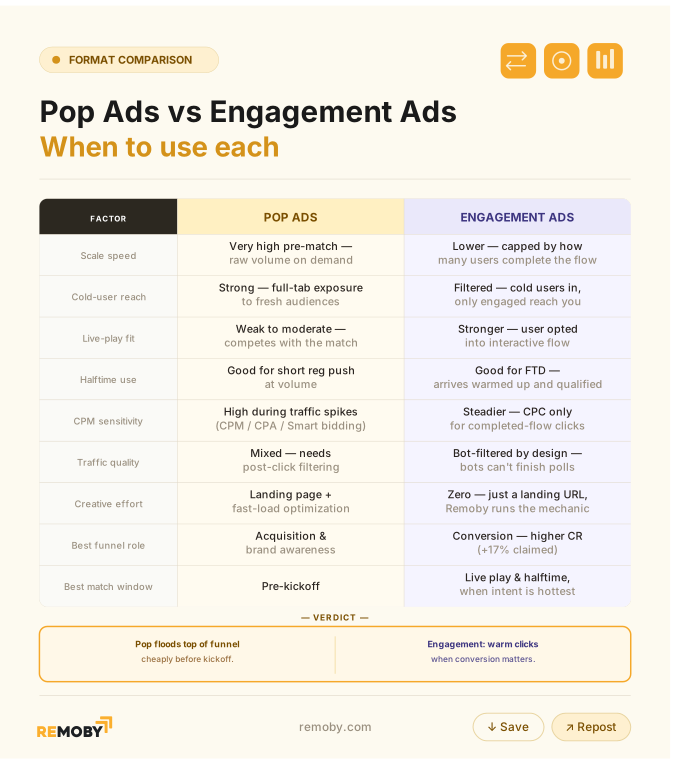
During a big football match, attention arrives in waves, and pop and Engagement Ads cover different parts of that curve. Pop is the volume play: in the hour before kickoff, when millions of fans are checking lineups, streams, and odds, pop delivers full-tab reach at a scale push subscriber bases can’t match — no creative production, just a fast landing page and aggressive bids. That makes it ideal for filling the top of the funnel with registrations before the whistle, while CPMs are still climbing and cold users are most willing to open a new tab.
Engagement Ads take over where pop’s weakness shows — during live play, when raw impressions compete with the match itself. Because the format pre-qualifies users through an interactive flow in a background tab, the clicks that reach your offer at halftime or during a lull in play are already warmed up, bot-filtered, and paid for on CPC rather than spike-inflated CPMs.
For iGaming buyers that means a stable cost per qualified click precisely when intent peaks, and a higher CR on FTD-focused landings.
Another option is to run the two formats together: pop builds the audience before kickoff, Engagement Ads convert it while the game is on.
Pop traffic vs Push traffic for football match-day campaigns
Pop traffic usually outperforms push traffic for sports betting offers around football matches when the job is cold-user reach at scale before kickoff. Push usually wins during live play and often at halftime because the audience is already opted in, sports-adjacent, and easier to reactivate in short windows.
That split is more useful than arguing which format is better: pop or push. It depends on the phase and the funnel.
Why match-day pop campaigns lose money
Most match-day losses do not come from bad creative or weak offers. They come from treating the event as one block and letting the campaign self-optimize inside a window it was never built to handle.
The failure patterns that show up most consistently:
Cheap-volume traps. Low CPM outside a whitelisted zone usually signals weak placement quality, not a deal. On match day, broad targeting floods campaigns with inventory that converts poorly and inflates raw click numbers.
Overbidding at halftime. Halftime is a real window, but it is 15 minutes. Buyers who lift bids aggressively without a hard ceiling often pay match-day peaks for post-match intent. The window closes before the funnel clears.
Poor mobile segmentation. Match-day traffic skews heavily mobile. A campaign running blended device targeting often subsidizes desktop traffic at mobile prices, or the reverse. Neither improves eCPA.
Live-play budget burn. Leaving full spend running during active match time is the most common margin error. CPM rises, CR drops, and the spend lands exactly where attention went offline. (I’ve seen this kill a campaign’s weekly margin in 45 minutes)
Post-match overspend. Campaigns that do not auto-reduce after full-time keep burning on intent that expired at the whistle. Most match-day pop traffic post-full-time does not justify the CPM it commands in a still-elevated auction.
Zone cleanup is the control mechanism most teams apply too late. Waiting until Friday to clean zones from Tuesday’s match-night burn is not analysis. It is documentation.
FAQ for buying traffic during football matches
Bid changes should follow match phase, not a flat event rule. Before kickoff, raise bids moderately to secure volume while CPM is still below peak. At halftime, increase only 15% to 20% above baseline and keep a hard ceiling. After full-time, cut bids sharply and reduce spend to a short test window. If CPM holds above 120% to 130% of pre-match baseline, stop bidding up and protect eCPA.
Scaling works when pre-kickoff zones are holding CR, device splits are clean, and CPM is still inside your planned range. Keep budgets capped when volume is coming from new placements faster than you can clean them, or when live-play traffic is eating spend without improving registrations. If you cannot explain the spike by phase, do not pay for it.
Match-day mistakes that hurt eCPA are overbidding at halftime, failing to segment mobile from desktop, expanding into cheap volume too early, letting live-play budgets burn on unproven zones, and leaving campaigns running after full-time because the click volume still looks healthy. Zone cleanup is not optional on pop traffic sports events spikes. It is the whole margin-control layer.
Spend after full-time should usually be reduced immediately, not gradually. Keep only 20% to 25% of live-play pace for up to 30 minutes, then pause. Extend only when the match creates a real reaction window such as a late winner, an upset, or penalties. In most cases, high-intent users are gone within 30 to 45 minutes.
Pop traffic outperforms push before kickoff when cold-user acquisition at scale is the goal and CPM is still within range. Push outperforms pop during live play and halftime when the audience is already warm and the funnel step is short. Running both in parallel, with pop front-loading reach and push handling in-match intent, usually produces better overall eCPA than committing to one format for the full event. The spike was never the opportunity by itself. The opportunity was the window before CPM outran attention. If pre-kickoff intent is holding, pop earns its place. Once the match starts, every extra bid needs a reason.