Updated: July 28, 2026
|
11 min read
Updated: July 28, 2026
|
11 min read
Digital Media Buying: A Performance Marketer’s Framework


The dashboard says CPA is under control. The tracker says something else. The gap usually isn’t luck — it’s mechanics.
Digital media buying only becomes useful when you treat it like an execution system tied to CPA, ROAS, and signal quality, not a list of channels. If you’re new to the discipline, start with the media buying basics – this framework assumes them.
What Digital Media Buying Means in Performance Marketing
Digital media buying in performance marketing is the execution layer that turns outcome targets into traffic decisions across search, social, display, video, retail media, push, pop, and programmatic. The buyer does not purchase reach for its own sake. The buyer purchases inventory, bids, and placements that can clear a CPA, CAC, or ROAS threshold. Example: a giveaway offer with a $5 CPA target needs traffic sources and bid ceilings that can realistically hit that number.
Define digital media buying as outcome-driven execution tied to CPA, ROAS, and CAC
Most people describe buying as “placing ads.” In practice, digital media buying means deciding what traffic can survive your economics. If target CPA multiplied by expected CR gives you a CPC or CPM ceiling below market reality, that channel is out before launch. That reverse math matters more than any platform feature list.
Is the signal actually in the data? Or am I bidding into noise? Is this channel failing, or did the economics never work?
What metrics matter most when evaluating digital media buying performance
A 2% CTR can still be bad traffic. CPA, ROAS, and CAC tell you whether the funnel bundle works; CR, EPC, and payback lag tell you why. For active buying, I also watch postback match rate, subID cleanliness, and click-to-conversion lag. Those are not reporting details. They decide whether a whitelist deserves more spend or whether you are optimizing against broken attribution.
The numbers look clear until you ask which event actually deserves to steer the bid.
Ready to launch with Remoby?
Digital Media Buying vs Media Planning, Media Selling, and Programmatic Buying
Digital media buying differs from media planning and media selling because it owns execution against a performance target, while planning sets the strategy and selling monetizes inventory from the publisher side. Programmatic buying is one method inside digital media buying, not the whole job. Example: a media planner picks search plus paid social, a buyer sets bids and exclusions, and the seller provides the inventory or audience supply.
Where planning ends and buying begins
Planning picks the lane. Buying drives the car. Once a CPA target, GEO, funnel stage, and budget floor are set, the buyer chooses bids, placements, exclusions, pacing, and deal type. On small teams those roles blur, but the decision boundary stays the same: planning answers where to play; buying answers what to pay and when to cut.
The role split is unpacked in media planning vs media buying.
How programmatic fits as a buying method rather than the whole discipline
Programmatic is not the strategy. It is the pipe. You can buy open exchange inventory through a DSP, lock direct inventory through programmatic guaranteed, or run hybrid setups. A pop inventory platform like Remoby shows the point: the buying method changes auction behavior and transparency, but your success still comes from conversion economics and source-level control.
Once you separate method from objective, channel choice stops looking random.
Start With the Business Goal: Map CPA and ROAS Targets to KPIs and Constraints
CPA target mapping starts with reverse math: allowable acquisition cost must translate into a realistic bid ceiling, a primary conversion event, and enough weekly volume to train or evaluate the channel. If the channel cannot produce roughly 30 conversions a week — and 50+ on pop or push — the buyer either changes the event, raises budget, or eliminates the source. Example: a $5 CPA giveaway on pop usually needs about $200–$300/day to become readable (industry benchmark).
Turn revenue goals, margin, and payback windows into allowable CPA or target ROAS
If margin is thin, you do not have a channel problem. You have a ceiling problem. Work backward from contribution margin, refunds, and payback window, then set allowable CPA or target ROAS. The reverse math is laid out in how to calculate campaign ROI – cost inclusion, revenue inputs, and attribution windows.
Ecommerce can tolerate a 7-30 day attribution window; pop and push CPA campaigns usually need fast feedback. That changes which sources can even enter the test. Google Ads’ guidance on Target ROAS bidding is useful here because it shows how automated bidding depends on conversion value quality and volume.
Translate outcome targets into campaign KPIs, conversion events, and guardrails
Without a clear event hierarchy, platforms optimize to the easiest action, not the most valuable one. Set one primary event for bidding, one validation event for finance, and one guardrail metric like first-deposit rate, approved lead rate, or repeat purchase rate. (this is where most implementations break)
Set channel eligibility based on conversion volume, sales cycle, budget, and signal quality
Channel eligibility gets decided before creatives go live:
- Calculate bid ceiling from target CPA and expected CR.
- Estimate if budget can generate 30 weekly conversions per channel.
- Reject channels with long lag or weak postback fidelity.
- Prioritize by signal quality: search/retail/push first, social next, display/video/pop for scale.
That removes half the bad tests upfront.
Ready to launch with Remoby?
Choose Channels by Role, Intent, Signal Quality, and Scale
The wrong channel-role match burns budget faster than bad creatives. Search captures demand, social shapes it, display and video widen reach, retail closes product intent, and pop/push can generate cheap volume when your tracker and whitelist discipline are strong.
Decision table: when search, social, display, video, retail media, and programmatic fit
| Channel | Best role | Signal quality | Budget fit | Main risk |
|---|---|---|---|---|
| Search | Demand capture (bottom funnel) | High | Medium+ | Limited scale and rising CPC in competitive auctions |
| Paid social | Demand creation + retargeting | Medium | Medium+ | Creative fatigue and reliance on modeled attribution |
| Display/programmatic | Mid-funnel scaling and retargeting | Medium-low | Medium+ | Low transparency without placement and whitelist control |
| Video on Demand | Reach and assisted conversions | Low-direct | Medium+ | Weak last-touch performance and harder ROI attribution |
| Retail media | High-intent product conversion | High | Medium+ | Strong dependence on product feed quality and platform rules |
| Pop/push | Fast testing, arbitrage, rapid scaling | Medium (if subID tracking is clean) | Low–medium | High variance in traffic quality across sources |
| Verdict | Assign channels by funnel role, not by habit | Signal quality defines optimization depth | Scale comes from combining roles, not one channel |
Match channel role to demand capture, demand creation, retargeting, and scale
Most buyers want every channel to close. Reality is messier. Search and retail usually deserve the strictest CPA targets. Social and display often deserve blended ROAS or assisted-conversion reviews. Pop should rarely get judged on isolated last-click alone at scale because it often lifts brand search and direct visits.
A channel can lose on last-touch and still feed the winners you’re protecting.
Choose the Buying Model: CPC vs CPM vs CPA vs Direct, Programmatic, and Hybrid
Buying model choice depends on signal quality, funnel stage, and how much control you need over inventory. Use CPC when click intent already carries value, CPM when source selection matters more than platform automation, CPA when the platform sees enough clean conversions, and hybrid/direct setups when auction noise hides the profitable supply.
For example, pop often performs better on manual CPM at zone level than network CPA bidding because the network rarely has enough per-zone conversion density to optimize reliably. A deeper breakdown by risk transfer and tracking requirements: CPC vs CPM vs CPA pricing models.
Comparison table: buying models, pricing logic, strengths, limits, and best-fit scenarios
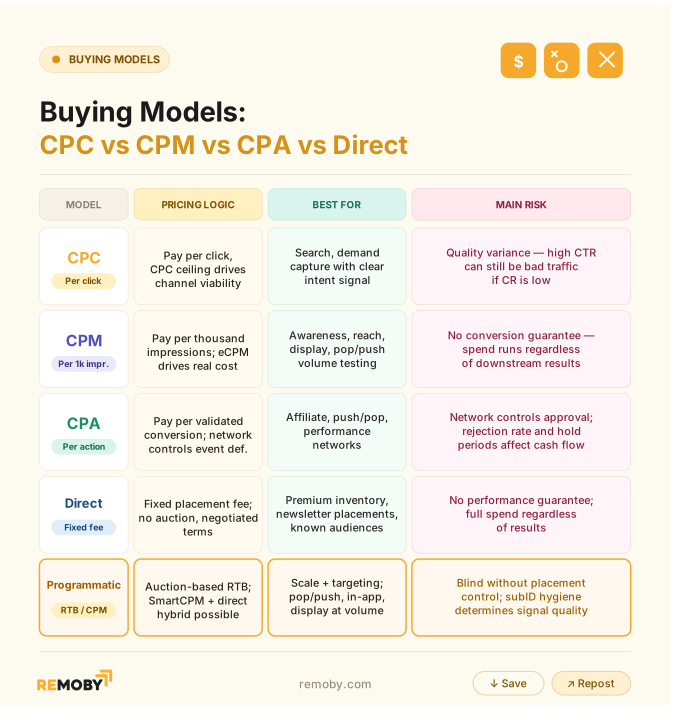
Use signal quality, funnel stage, and conversion economics to choose the model
I spent two days debugging a “bad source” once. The token fired, the macro did not — one character off. That mistake looked like traffic fraud until the postback log exposed it.
When tracking is clean, the rule is straightforward: low-volume top-funnel traffic wants manual control; dense bottom-funnel traffic can tolerate automation. On pop, manual zone CPM bidding beats network-side CPA bidding most of the time because your subID data sees source differences before the algorithm does (industry benchmark).
Set Measurement Rules Before Scaling
Measurement rules before scaling a digital media buying campaign include validated conversion tracking, fixed attribution settings, defined reporting windows, postback reconciliation, deduplication logic, and minimum volume thresholds. A campaign should not scale until network-reported conversions match tracker data within about 5%, subIDs arrive cleanly, and the scaling window contains enough conversions to trust the trend. Example: 12 conversions with a 20% postback gap is not scale-ready, even if platform CPA looks strong.
Pre-scale checklist: conversion tracking, attribution settings, reporting windows, postback validation, and deduplication
If you scale before validating the plumbing, you usually scale the error. Use this checklist before budget increases:
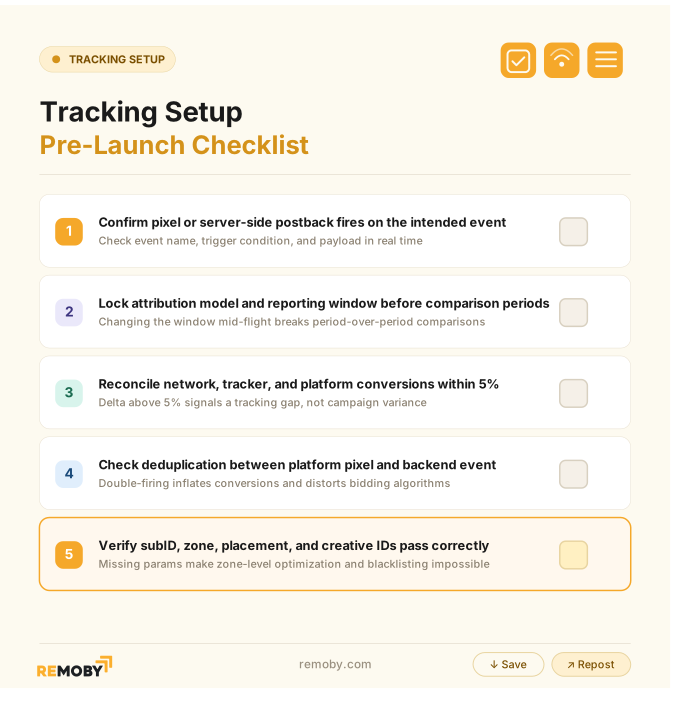
Minimum data thresholds before increasing budget or changing bids
Fewer than 20 conversions is noise for most decisions. Between 20 and 30, hold unless CPA is deeply offside. At 30 weekly conversions per channel you can start reallocating. On push and pop, wait for 50+ before hard blacklist or whitelist moves unless a zone has 3,000+ impressions and zero conversions (industry benchmark).
Attribution limits, view-through interpretation, reporting lag, and incrementality caveats
Platform-reported social CPA often runs 15-30% above backend truth once modeled conversions and view-through are separated; pop often looks 10-20% better after postback fixes because under-reporting is common (industry benchmark). Switching attribution models midstream can move reported performance by 40%+ overnight. Treat those as new datasets, not trend lines. AppsFlyer’s documentation on attribution models and retargeting double attribution is helpful if you need to define those rules before scale.
Clean data arriving is only half the story. The harder problem is what gets credit after it arrives.
Ready to launch with Remoby?
Build a Weekly Optimization Workflow
A practical weekly workflow reviews pacing, CPA stability, placement quality, creative decay, and budget concentration in that order. Hold campaigns in learning or under 20 conversions, cut sources that stay 25% above target for five days, rotate creatives when CTR drops 30% from baseline, and reallocate only after the winner holds under target long enough to deserve more spend. Example: on social, frequency above 4 on cold traffic often signals audience exhaustion before CPA fully breaks.
Weekly cadence for pacing checks, bid adjustments, exclusions, creative rotation, and budget shifts
Run the week like this:
- Monday: verify spend pacing, broken links, missing postbacks.
- Midweek: adjust bids, blacklist zones, pause keywords 40% worse than average.
- Friday: shift 20-30% of budget from losers to stable winners, refresh fatigued creatives.
Short loop, better decisions.
Decision triggers for holding, scaling, cutting, or reallocating spend
If you have one winning channel and three noisy tests, concentrate spend first. Under $10k/month, one channel usually beats a fragmented media mix. From $10k to $50k, run two channels max with roughly 60-70% in the primary lane. Above that, add scale channels with minimum readable budgets of about $1,500 a week each (industry benchmark).
Allocate Budget Across Channels by Budget Tier
Budget allocation should protect efficiency channels first, then fund scale and testing lanes with what remains. Limited budgets need focus, not diversification theater.
How limited, moderate, and scale budgets change channel mix and risk tolerance
Under $10k/month, pick one channel with fast feedback — often search, push, or pop. Between $10k and $50k, pair capture with one expansion lane. At $50k+, use three to four channels because you can finally afford learning waste without killing pacing.
Protect efficiency channels first, then fund scale channels and testing lanes
Most teams do this backward. They spread spend across five platforms, get 11 conversions everywhere, then call the offer “unscalable.” Protect the baseline funnel first. Only then fund your testing lane, usually 10-15% of budget.
Once budget gets disciplined, retail media stops being an automatic yes and becomes a math problem.
When Retail Media Fits the Plan
Retail media deserves budget when marketplace intent is strong enough to beat your blended account economics, not because the channel is fashionable.
Use retail media when marketplace intent, closed-loop sales data, or category competition justify spend
Amazon Ads and Walmart Connect usually fit when retail ROAS exceeds blended account ROAS by 50%+, when your product already has strong review density, or when category discovery happens inside the marketplace. Treat it as an incremental layer, not a replacement for search, social, push, or pop.
Common Digital Media Buying Mistakes That Waste Spend
Waste usually starts before the first click: wrong event, wrong buying model, wrong role for the channel.
Mistakes in measurement, bidding, pacing, attribution, and channel-role mismatch
The recurring failures are familiar: trusting platform numbers without server-side validation, changing attribution windows mid-campaign, judging assist channels on last-touch only, and scaling before 30-50 conversions. Another common one: using automated CPA bidding where volume is too thin to train. That looks efficient for two days, then the burn starts.
Worked example: from CPA goal to channel mix, buying model, and optimization plan
A $5 CPA target for a giveaway offer will eliminate more channels than it includes. That is useful, not restrictive.
Example scenario: set the target, pick channels, define measurement, and plan weekly optimizations
Say you run a giveaway offer through Voluum, the campaign tracker, and test Google Ads search plus PropellerAds pop. Search fails the bid-ceiling math in the target GEO. Pop stays in because $200-$300/day can generate enough data. You buy on CPM, pass subID and zone tokens, wait for 50+ conversions, blacklist zones above 3,000 impressions with zero conversions, and reduce budget 30% on any source running 25% above target for five days. That is a digital media buying framework, not a hope-based test.
Ready to launch with Remoby?
FAQ for Digital Media Buying
3 top questions for media buying beginners
Metrics that matter most are CPA, ROAS, CAC, CR, and conversion lag. Outcome metrics tell you if the channel earns budget. Diagnostic metrics like CTR, EPC, postback match rate, and deduplication tell you whether the reported result is real enough to trust.
Digital media buying is the discipline of choosing channels, bids, deals, and optimization rules against an outcome target. Programmatic advertising is one execution method inside that discipline, usually through exchanges, DSPs, or guaranteed pipes. The IAB overview of digital media buying and planning (https://iabcertification.com/digital-media-buying-planning/) is a useful reference if you want the role boundaries defined more formally.
Validation before scaling includes postback accuracy within 5%, fixed attribution settings, clean subID data, deduplication rules, and enough conversions in the decision window. If any of those fail, scale turns a measurement issue into a spending issue. The system usually is not broken. The signal was there the whole time — hidden behind bad ceilings, weak event choices, or data you trusted too early.