Updated: June 8, 2026
|
14 min read
Updated: June 8, 2026
|
14 min read
What is programmatic advertising: definition, how it works, and when to use it

A campaign launches fast, spends cleanly for six hours, then CR falls off a cliff because the bid stream widened into junk placements. That is usually the moment people ask what is programmatic advertising and realize the answer is not “the strategy,” but the transaction layer sitting underneath it.
What Is Programmatic Advertising?
Programmatic advertising is the automated buying and selling of digital ad inventory through software platforms instead of manual back-and-forth with publishers. Programmatic buying automates the transaction, bid decision, and delivery path, while the buyer still controls targeting, budget, exclusions, and creative testing. A DSP buying app traffic from multiple SSPs in milliseconds is programmatic; a negotiated homepage takeover is not.
Most confusion starts because people treat programmatic like its own channel. It is not. You can buy display, video, in-app, push, or pop inventory programmatically if the supply exists there. The important shift is not format. The shift is how the impression gets priced, routed, and won.
Citing Statista data, 80% of US digital ad spend was programmatic in 2024. That number matters less as trivia and more as an operating reality: if you buy at scale, you already compete inside automated pipes whether you think about them that way or not. eMarketer also tracks continued growth in worldwide programmatic ad spending, which reinforces how dominant this buying method has become.
Is programmatic advertising a channel or a way to buy media?
What most buyers assume: programmatic equals display banners on big exchanges. Reality: programmatic is a buying method across digital inventory, not a standalone channel. If your team buys in-app through a demand-side platform, that is programmatic. If your team negotiates a fixed placement with one publisher, that is direct. Same funnel goal, different execution path.
That distinction matters when you review performance. A bad result usually comes from the wrong supply path, weak exclusions, or lazy audience logic — not from “programmatic” as a category. Buyers who mix those up end up blacklisting formats when they should be fixing seat setup, bid strategy, or publisher access.
Is Programmatic Advertising the Same as Media Buying?
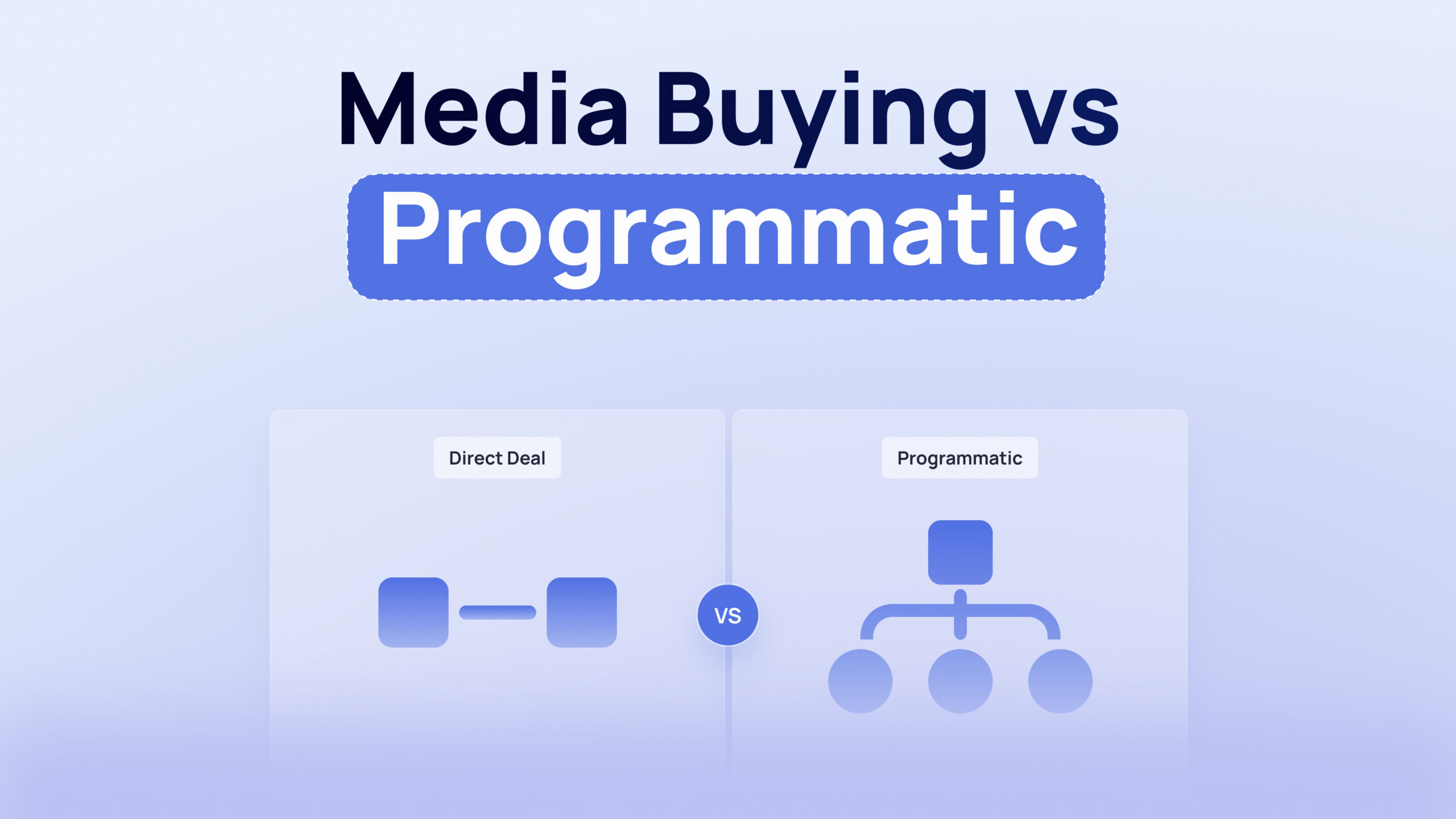
Programmatic advertising is not the same as media buying. Media buying is the broader discipline of deciding where budget goes, what inventory to purchase, how to pace spend, and how to hit campaign goals. Programmatic advertising is one execution method inside that discipline. Direct buying is another. A buyer still does media buying even when software handles the auction.
This is the part most explainers skip. Media buying covers planning, negotiation, traffic allocation, testing logic, whitelist and blacklist management, pacing, postback quality checks, and reporting. Programmatic covers how you purchase eligible impressions once that strategy exists.
What is the difference between media buying and programmatic advertising?
The failure mode is easy to spot: teams think turning on a DSP replaces the buyer. It does not. Media buying decides the offer, GEO split, burn rate, KPI, and inventory mix. Programmatic decides which impression to bid on within those rules.
If a campaign on Google Display & Video 360 burns through budget on broad mobile web and misses CPA, that is still a media buying problem first. Someone chose the wrong supply, wrong frequency, or wrong conversion window. The machine only executed the plan.
Media buying as the umbrella: direct/manual and programmatic as two execution methods
The clean mental model is this: media buying sits at the top, and direct/manual plus programmatic sit under it. One relies on negotiation, insertion orders, and fixed placements. The other relies on platform rules, auctions, and automated delivery.
In practice, experienced teams use both. A trading desk can lock premium inventory through direct IO, then use programmatic for prospecting, retargeting, and spillover volume. That is not inconsistency. That is normal campaign architecture (and where most junior setups leave money on the table).
How Programmatic Advertising Works in Media Buying
Programmatic buying works by automating the purchase of impressions through DSPs, ad exchanges, and SSPs while leaving campaign strategy with the buyer. The system handles bid requests, auction logic, and ad serving in milliseconds. The buyer still sets goals, exclusions, audience logic, budgets, and measurement rules. A campaign can use automation for execution without outsourcing judgment.
The practical implication: automation removes repetitive transaction work, not planning. That sounds obvious until you watch a campaign die because nobody checked which publishers started winning after the first learning window.
The basic flow: advertiser, DSP, ad exchange, SSP, and publisher
A bid request usually moves through five steps:
- An advertiser sets rules inside a demand-side platform such as The Trade Desk or Google Display & Video 360.
- A publisher makes an impression available through a supply-side platform such as PubMatic.
- An ad exchange passes that opportunity into the bid stream.
- The DSP evaluates the impression against targeting, bid caps, and predicted value.
- The winning ad renders if the bid clears.
That is the plumbing behind the placement.
What matters for performance is not only who won, but where the impression traveled. The same publisher can reach you through multiple SSP paths, with different fees, transparency, and win rates. That is why supply path optimization shows up once spend gets serious. If you are still asking what is programmatic advertising, this bid-stream plumbing is the operational answer behind the definition.
What automation handles and what still requires human media buying strategy
The bottom line first: automation is great at repetition and terrible at intent. It handles pacing, bid submission, auction participation, and rule-based optimization. It does not decide whether your prelander is wrong for the GEO, whether your exclusion list is stale, or whether your creative mismatch is killing EPC.
What the buyer still owns:
- Goal setting and KPI hierarchy.
- Audience segmentation and recency logic.
- Creative testing and offer alignment.
- Whitelist, blacklist, and zone management.
- Budget reallocation across channels and deals.
Automation follows the rails you build.
That is why the line “programmatic runs itself” keeps wrecking accounts (yes, again). Only the transaction is automated. Strategy stays manual.
Programmatic Advertising vs Direct Media Buying
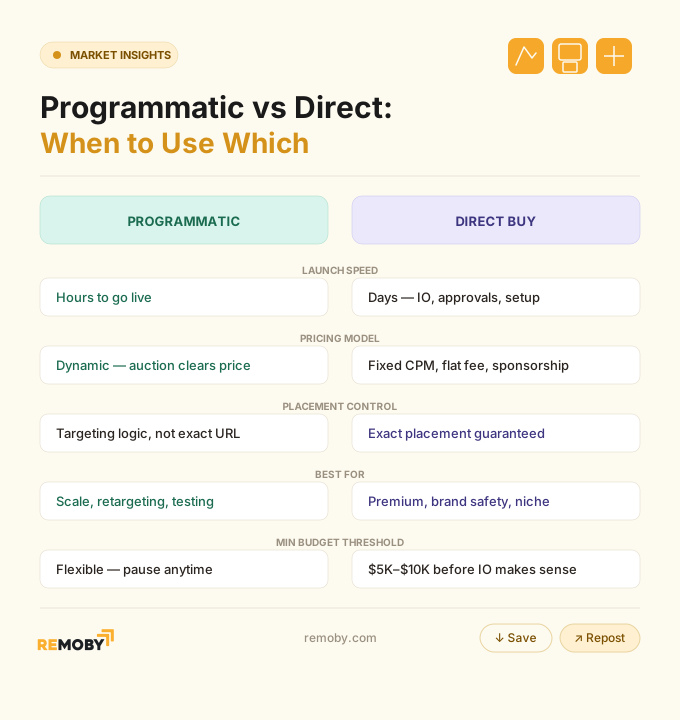
Programmatic buying differs from direct buying in how inventory gets purchased, priced, and optimized. Programmatic uses software, auction or deal-based access, and ongoing bid-level adjustment across many publishers. Direct buying uses negotiation, insertion orders, fixed terms, and guaranteed placements with specific publishers. Programmatic usually wins on speed and scale; direct usually wins on placement certainty and custom access.
For performance buyers, that difference shows up fast in workflow. One opens a lot of inventory with flexible pacing. The other locks in terms before spend starts.
Comparison table: Direct/Manual vs Programmatic vs Hybrid
| Criteria | Direct/Manual | Programmatic | Hybrid |
|---|---|---|---|
| Workflow | Negotiation, IO signing, manual trafficking | DSP execution, algorithmic bidding, automated optimization | Direct deals for core placements + DSP for scale and testing |
| Speed to launch | Slower (setup, approvals, contracts) | Fast (hours to launch) | Medium (depends on direct component) |
| Pricing | Fixed CPM, flat fee, or sponsorship-based | Dynamic CPM via auction or fixed PMP deals | Combination of fixed and dynamic pricing |
| Control | Maximum control over exact placements and context | High control over targeting and bidding logic, less over exact placements | High overall control if roles of each layer are clearly defined |
| Targeting | Contextual and publisher-driven | Audience, behavioral, and data-driven | Combined: context + audience signals |
| Transparency | High on placements and environment | Varies (depends on supply path, SSP, deal type) | Highest when direct is used for core and programmatic for expansion |
| Optimization cadence | Slower, manual adjustments | Real-time optimization via algorithms and rules | Split: manual for direct, real-time for programmatic layer |
| Inventory access | Limited to negotiated publishers | Broad access across exchanges and SSPs | Broad + guaranteed premium inventory |
| Best use case | Sponsorships, premium placements, guaranteed SOV | Scaling, retargeting, prospecting, rapid experimentation | Full-funnel strategies, launches, brand + performance mix |
| Verdict | Best when placement certainty and brand safety are critical | Best for flexibility, scale, and data-driven optimization | Best when combining control with scalable performance |
Workflow, speed, targeting, pricing, transparency, optimization, and inventory access
Open auction CPMs often land at $0.50–$4 across many verticals, while finance and healthcare inventory can reach $8–$12. On pop and push traffic, CPMs around $0.20–$1.50 are common on performance-focused supply. That pricing tells you one thing: open exchange gives cheap testing reach, but not guaranteed quality.
PMP usually carries a 30–80% premium over open auction for the same publisher, and programmatic guaranteed often sits around $10–$25 on mid-tier inventory and $30–$60+ on top-tier placements . The premium buys cleaner supply or guaranteed access. It does not buy magic.
Direct IO pricing often looks similar to programmatic guaranteed, but the package can include bonus impressions, sponsored modules, newsletter spots, or category exclusivity that the open exchange cannot offer. If you need homepage takeover inventory or fixed interstitials, direct wins because nobody can snipe that placement in an auction.
Ready to launch with Remoby?
Types of Programmatic Deals
Most people talk about programmatic like it is one market. It is really a stack of deal types with different trade-offs on cost, access, and control.
Open auction
If you need scale fast, open auction is usually the first stop. Inventory is widely available, launch is fast, and you can rotate creative, blacklist zones, and test audiences with minimal friction.
That makes open auction the default play for performance pop, affiliate funnels, and lead gen. The expert input here was blunt: for pop and pure performance, open auction usually wins because real-time whitelist and blacklist control matters more than premium supply access. A buyer running Remoby (push and pop network with direct publisher relationships in Tier-2 and Tier-3 GEOs), PropellerAds, and Clickadu side by side will feel that difference in a day.
Private marketplace
What most teams assume: PMP fixes everything open auction gets wrong. Reality: PMP narrows supply and improves curation, but it still needs active buying logic.
PMP works best when you want cleaner in-app or premium publisher access without giving up DSP control. A common pattern in app install is to collect data in open auction, then shift around 40% of spend into PMP deals with verified in-app SSPs once you know which supply converts. That cuts junk volume without killing scale. For a concise breakdown of these deal structures, see open marketplace vs private marketplace vs programmatic guaranteed.
Programmatic guaranteed
Programmatic guaranteed makes sense when you need reserved impressions on specific inventory, but still want automated pacing and delivery. It gives you certainty on availability, not a discount.
That distinction matters. Programmatic guaranteed can lock an automotive launch into fixed placements at a $12–$18 CPM, but it does not guarantee safe article adjacency by contract. Pre-bid controls and reporting still matter (this is where legal teams usually discover the fine print).
When to Use Programmatic Advertising, Direct Buying, or a Hybrid Approach
Programmatic advertising is the better choice when a campaign needs fast launch, scalable reach, flexible budget control, or audience-based optimization across many publishers. Direct buying is the better choice when a campaign needs guaranteed placements, contractual placement terms, custom integrations, or niche inventory that never enters the bid stream. Hybrid works when a campaign needs both certainty and scale.
The decision usually comes down to what you cannot compromise on. If that answer is speed, flexibility, and broad testing, go programmatic. If that answer is exact placement or legal control, go direct.
Which campaigns are better suited to direct buys, programmatic deals, or a mix of both?
A few campaign patterns show the split clearly:
- E-commerce retargeting: open auction. Fresh audience pools matter more than fixed inventory, and paying guaranteed CPMs rarely improves results.
- App install in Tier 1: open auction first, then PMP. Use the first wave for data, then clean supply once fraud patterns show up.
- Automotive launch with a hard date: programmatic guaranteed. You need impressions delivered on schedule.
- B2B SaaS on a niche vertical site: direct IO. If the publisher has no programmatic pipe, the auction does not exist.
- Brand campaign with performance tail: hybrid. Lock critical placements, then scale the rest programmatically.
Different goals need different rails.
Quick decision rules by budget, scale, targeting needs, and placement requirements
Direct IO usually needs at least $5K–$10K on a single placement before the negotiation overhead makes sense. Below that, the setup friction often costs more than the control you gain.
Use these rules:
- Choose programmatic if budget certainty is low and you need pause flexibility.
- Choose direct if legal needs written placement commitments.
- Choose PMP if open exchange volume is there but quality is unstable.
- Choose hybrid if one part of the funnel needs certainty and another needs scale.
That framework catches most buying decisions.
A practical split from trading-desk workflows is 60–65% programmatic and 35–40% direct, with heavier direct allocation on brand-heavy plans and 80%+ programmatic on pure performance campaigns.
Where Direct Buying Still Wins
Direct buying still wins whenever the placement itself carries the value, not only the audience behind it. That includes homepage takeovers, category exclusivity, sponsored content modules, newsletter placements, and endemic publisher inventory outside the main open exchange.
Guaranteed premium placements, custom integrations, niche inventory, and contractual brand adjacency
If you need guaranteed share of voice, direct beats every auction path. A competitor cannot outbid you out of a fixed homepage skin or a reserved interstitial.
It also wins when legal or brand teams need contractual adjacency terms. Brand safety tools in programmatic are useful, but they are not contractual. That is a real difference, not semantics.
The other overlooked edge is long-tail supply. Outside the US and Western Europe, a lot of niche inventory still does not sit inside clean programmatic pipes. For some endemic publishers, direct IO is the only route in.
Main risks and limitations of programmatic: fraud, privacy constraints, brand safety, and operational complexity
The failure mode here is thinking automation removes risk. It does not; it changes where the risk sits. Fraud shows up in bad app IDs, recycled placements, or suspiciously cheap supply. Privacy constraints reduce available user-level signal. Brand safety settings filter risk, but they do not replace direct publisher control. AppsFlyer summarizes common ad fraud data insights that make this operational risk concrete.
Operationally, programmatic also creates more moving parts. More SSP paths, more deal IDs, more reporting variance, more cleanup. If the team lacks time to police placements, direct can outperform a messy open-exchange setup even at a higher CPM.
Misconceptions About Programmatic Advertising
Programmatic advertising is not the same as real-time bidding. Real-time bidding is one buying method within programmatic advertising, usually used in open auction environments where each impression goes through a live auction. Programmatic also includes private marketplace deals and programmatic guaranteed arrangements, which use automation without an open auction for every impression.
That misconception matters because strategy changes by deal type. If you treat every programmatic path like open exchange, you will over-optimize for cheap clearing prices and underinvest in access quality.
Real-time bidding is one type of programmatic buying, not the whole category
What most buyers assume: RTB and programmatic are interchangeable. Reality: RTB is the auction mechanic inside part of programmatic, not the entire umbrella.
Open auction uses RTB. PMP often uses deal-based access with tighter rules. Programmatic guaranteed skips live competition for reserved inventory. Same broad buying ecosystem, different transaction logic. If someone asks what is programmatic advertising, the clean answer is that RTB is only one subset of what is programmatic advertising in practice.
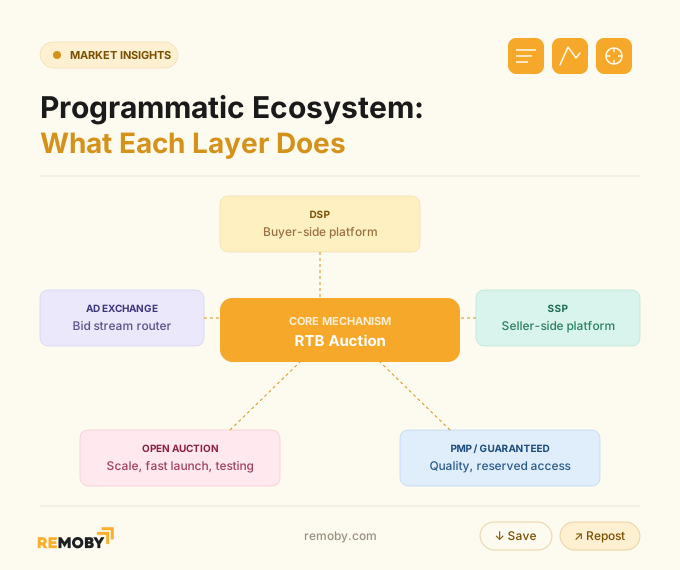
Programmatic does not eliminate strategy or guarantee better outcomes by default
A bad setup can lose money faster in programmatic than in direct because it scales mistakes. Broad targeting, weak creatives, stale exclusions, or soft conversion signals can all look fine at launch and then torch your burn rate once the algorithm expands (worth checking in your own seat).
Good buyers know the pattern: day one looks efficient, day three fills with low-intent placements, day five you are deep in zone reports wondering why win rate improved while revenue fell. The platform did exactly what you told it to do.
How AI, Privacy, and Fraud Are Shaping Buying Decisions
Three forces now shape method choice more than sales decks admit: AI-assisted bidding, privacy loss, and fraud pressure. AI helps with pacing and bid prediction, but weaker identifiers make audience targeting less stable, which increases the value of contextual and publisher-level decisions. Fraud pressure pushes more buyers toward PMP, curated supply, and direct relationships when open exchange quality slips.
That is one reason hybrid plans keep getting more common. Buyers use automation where it still has signal, then lock critical placements where they need certainty.
Ready to launch with Remoby?
FAQ: Programmatic advertising
Find out more about programmatic advertising from this short FAQ list.
Yes. Programmatic is one execution method inside media buying. Direct buying is another. Media buying stays the larger job because someone still has to choose channels, define the funnel, set KPIs, allocate budget, and judge whether the traffic is actually worth scaling. In plain terms, what is programmatic advertising if not one way to execute a broader media buying plan?
No. Programmatic started in digital display, but the buying logic extends across app, video, connected TV, audio, and other digitally transacted inventory. The common thread is automated purchasing through software, not the specific format.
A hybrid approach combines direct placements with programmatic execution in one plan. A buyer might reserve high-impact placements through IO, then use open exchange or PMP for retargeting, frequency smoothing, or additional scale. It is common when one method cannot cover both control and reach.