Updated: August 15, 2026
|
12 min read
Updated: August 15, 2026
|
12 min read
Pop ads frequency capping: how to choose the right cap

A pop campaign can fail while bids, zones, and CPM all look fine. The hidden variable is repetition. Set the cap too loose and you burn the audience. Set it too tight and the campaign starves before noon. That tension sits underneath almost every good or bad pop run.
What is frequency capping in popunder advertising?
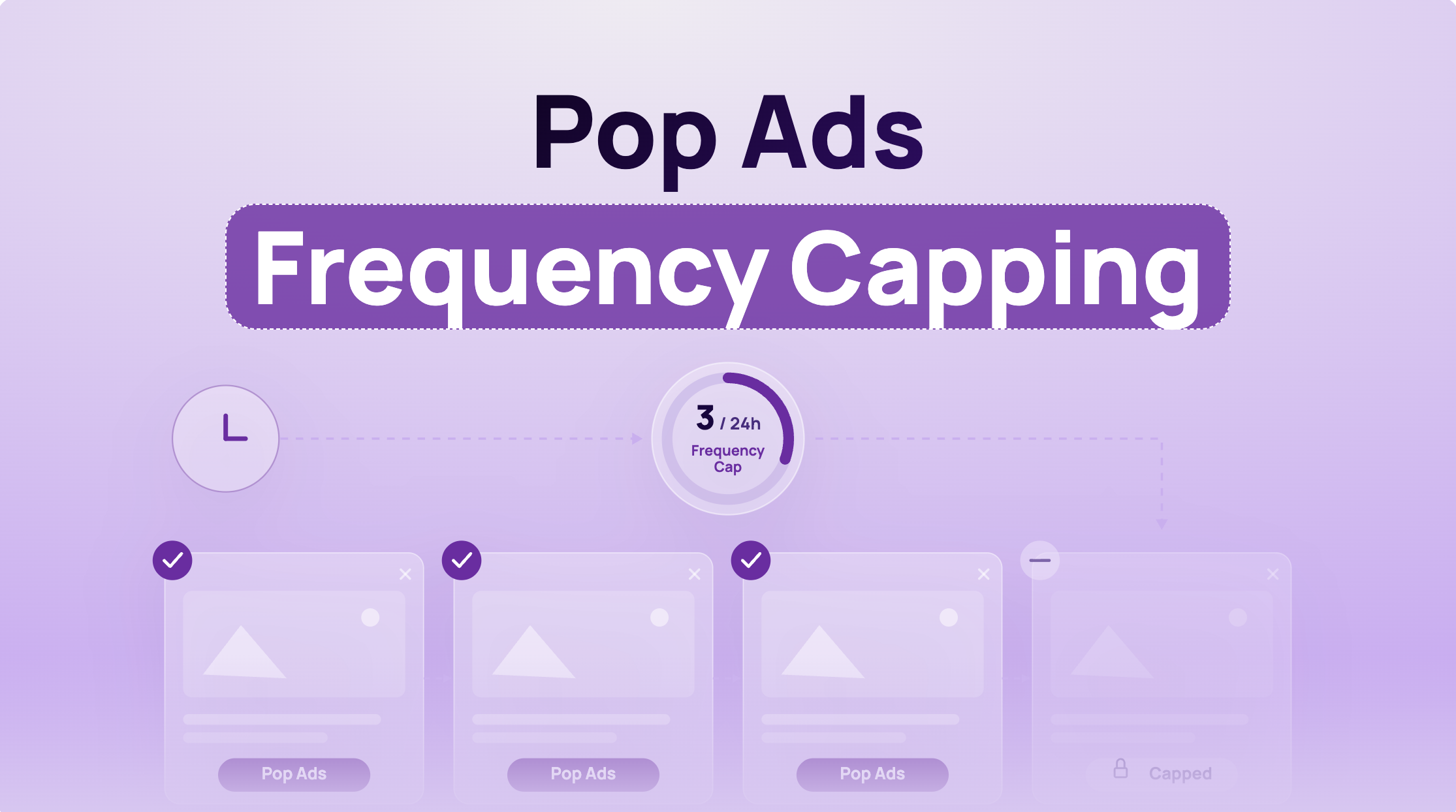
Frequency capping in popunder advertising is a campaign setting that limits how many times one unique user gets a popunder within a defined time window. A 1/24 cap means one popunder per user every 24 hours. The setting controls overexposure, protects spend quality, and decides how much budget goes to fresh reach versus repeat exposure.
In pop campaigns, this matters more than the UI suggests. An impression here is not a banner floating in a corner. It is the landing page getting served through an intrusive format. That changes the economics fast. Repeating to the same user rarely acts like extra inventory. It usually acts like paying again after the same user already declined.
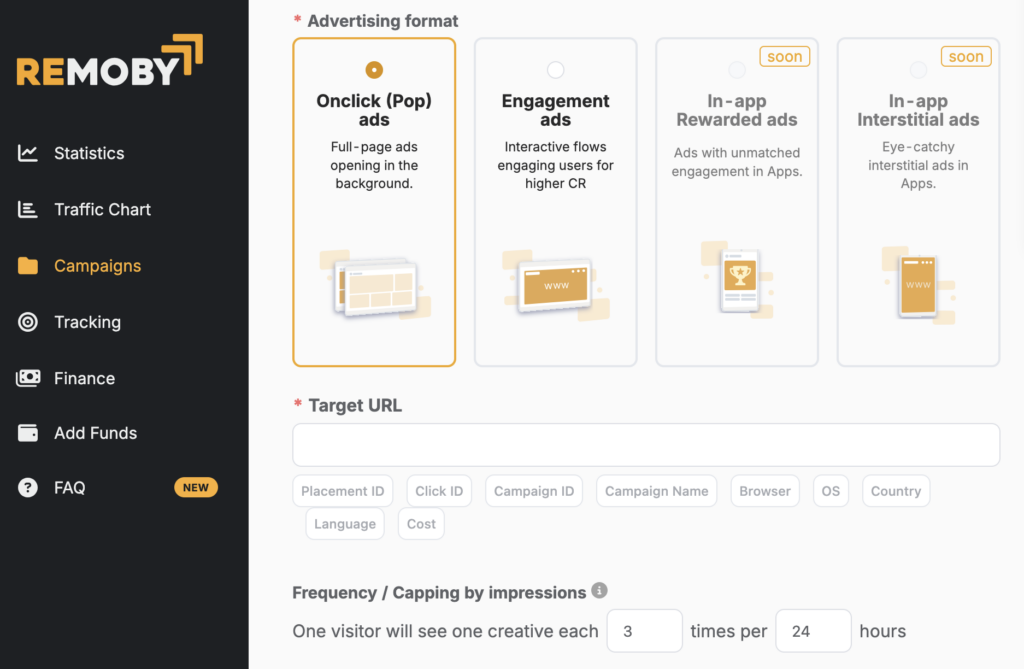
On Remoby, the platform default is 3 impressions per 24 hours at campaign setup.
Treat that as a starting line, not an answer. The cap you set is the limit. Delivered frequency is what the campaign actually serves. Buyers expect those numbers to match more often than they do.
The setting looks small, however the delivery pattern it creates is not as such.
Why popunder campaigns need low frequency capping
Repeated exposure burns money faster in pop than in most formats. The reason is mechanical, not philosophical. A popunder may interrupt the session, so the second and third exposure reach a user who already made a decision once.
That is why low caps are standard for intrusive formats. In pop, frequency capping is mainly a spend-quality control. You are deciding whether to pay again for a user who already ignored the lander.
Audience burnout matters here. Burnout means users get hit often enough that they stop reacting. In a narrow GEO + OS + browser setup, burnout arrives quickly because the same pool absorbs the whole traffic pour. Buyers often read the symptom backward. They see weaker CR on good zones and assume the source degraded. Sometimes the source is fine, but repeat pressure changed.
If you run onclick traffic with no respect for recency, diminishing returns show up before the dashboard explains them. The hard part is that lowering repetition solves one failure and creates another.
How do you choose the right popunder frequency cap for a campaign?
Popunder frequency capping works when it balances three variables: conversion lag, audience size, and daily budget. Short-lag offers can tolerate more repetition because users decide quickly. Narrow targeting and small pools need lower caps to avoid burnout, but if the cap gets too tight, delivery starves. Start with a sane cap, then judge it by delivered frequency, unique reach, and conversion behavior.
The useful framework is a triangle: cap, targeting, budget.
The narrower the targeting, the more pressure you place on the cap. Every filter, GEO, carrier, browser, OS, shrinks the pool. If the pool gets small and your budget stays aggressive, a high cap funnels spend into repetition. If the pool gets small and the cap gets too low, the campaign cannot find enough fresh users and volume stalls.
Conversion lag belongs inside that same decision. Giveaway and app install offers often convert within minutes to 2 hours. Social offers often stretch to a few hours or a day. iGaming registration can happen in 30 minutes to 6 hours, while FTD lag often runs far longer. Finance lead gen often needs 1 to 5 days as users compare options. The recency window should respect that behavior. Hitting a long-lag user again too soon rarely moves the funnel forward.
Here is the practical matrix.
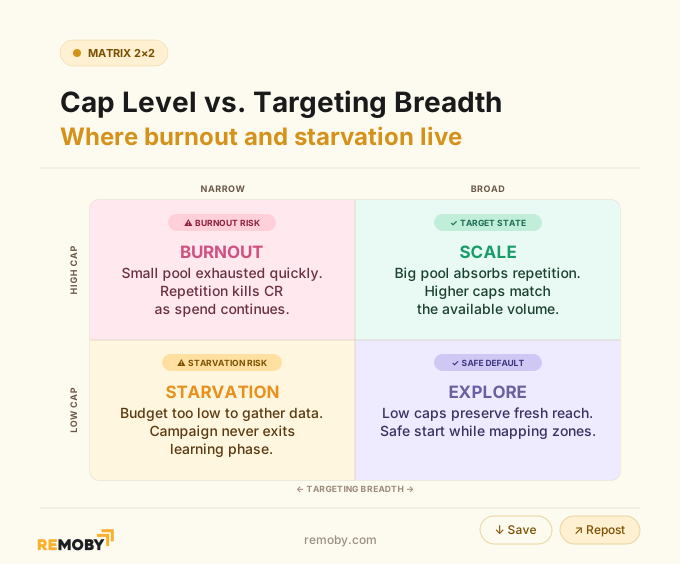
The choice sounds strategic until you realize the time window changes the behavior more than the number alone. The full-scale table looks like this:
| Campaign context | Starting cap direction | Why it fits | What would justify a change |
|---|---|---|---|
| Broad GEO, broad device mix, larger daily budget | Looser within the allowed range | Big pool absorbs repetition better | Tighten if eCPA rises and CR weakens after repeated exposure |
| Narrow GEO + OS + browser | Lower | Small pool burns out quickly | Loosen if spend stalls despite competitive bid |
| Short-lag impulse offer | Higher recency tolerance | Extra exposure can catch the user at the right moment | Tighten if second and third impressions stop adding conversions |
| Long-lag offer | Lower recency tolerance | Users need time before returning | Loosen only if reach is too constrained and fresh-user volume dries up |
| Aggressive daily cap + short active hours | Lower | Same budget compresses into fewer hours | Loosen only after checking delivered frequency |
| Low budget, exploratory whitelist test | Lower | Preserve fresh reach while mapping zones | Raise if the campaign never exits learning volume |
Ready to launch with Remoby?
What is the difference between hourly and daily frequency capping for popunder ads?
Hourly frequency capping lets the same user re-enter the campaign several times in a day, while daily frequency capping spreads exposure across more unique users. A cap like 1/12 allows another popunder after 12 hours. A 1/24 cap waits a full day. Multi-impression daily setups, such as 2 or 3 per 24 hours, sit in the middle and trade broader reach for more repetition.
Numbers that look similar can still create very different traffic patterns.
A 1/24 cap protects reach. It works well when you want each user to get one clean shot before the refresh cycle opens again. A 1/12 cap doubles the chance to re-hit the same user within the day. That can help short-lag, impulse-led funnels, but it also pushes spend away from fresh users sooner. A 1-3 per 24h structure behaves differently again. It is less about clock time between impressions and more about letting the system spend more of the budget inside the same audience slice.
| Cap structure | How it behaves | Best fit | Main risk |
|---|---|---|---|
| 1/24 | Maximizes fresh-user reach across the day | Broad prospecting, long-lag funnels, fragile CR | Volume can starve on narrow targeting |
| 1/12 | Reopens the user sooner | Shorter lag, faster decisions, stronger landers | Repetition climbs quickly in small pools |
| 2-3/24h | Allows multiple exposures without hourly recycling | Pop campaigns that need more pace than 1/24 | Burnout if budget and targeting are tight |
| Hourly-style recency | High repetition, high pace | Rarely an advertiser-first choice in pop | Saturation arrives fast |
This is the real answer to hourly vs daily popunder frequency capping. The label matters less than the recency window it creates against your pool size.
The cleaner starting point still isn’t the winning cap. Real campaigns earn that number after launch.
Starting cap recommendations and post-launch tuning
A low starting cap wins more often in pop. For onclick traffic, the guidance is 1-3 impressions per 24 hours, with the platform default of 3/24h as a reasonable start on Remoby. For its Engagement Ads format — interactive flows rather than a straight popunder — caps can run slightly higher, but still within single digits per 24 hours, because the format tolerates repeat interaction better.
That gives you a place to start, not a rule to defend. If you want the best frequency cap for pop traffic, start from the format, then the pool, then the lag.
A workable tuning loop looks like this:
- Launch with a sane cap, usually low for popunder.
- Hold bids, targeting, lander, and budget logic steady.
- Compare delivered frequency, unique reach, and conversion behavior by impression bucket.
- Ask whether CR still holds on the second and third impression.
- Adjust only the cap, then let the new pattern stabilize.
That last step gets skipped too often. Frequency effects on CVR usually need 3-5 days to settle after a cap change. Day-one reactions mostly show delivery shape, not audience response. See the campaign optimization guide where reach and repetition meet pacing, and use your tracker data by frequency as the source of truth.
Acting on day-one data after a cap change is how buyers end up optimizing the transition instead of the campaign.
How do you know if a popunder frequency cap is too strict or too loose?
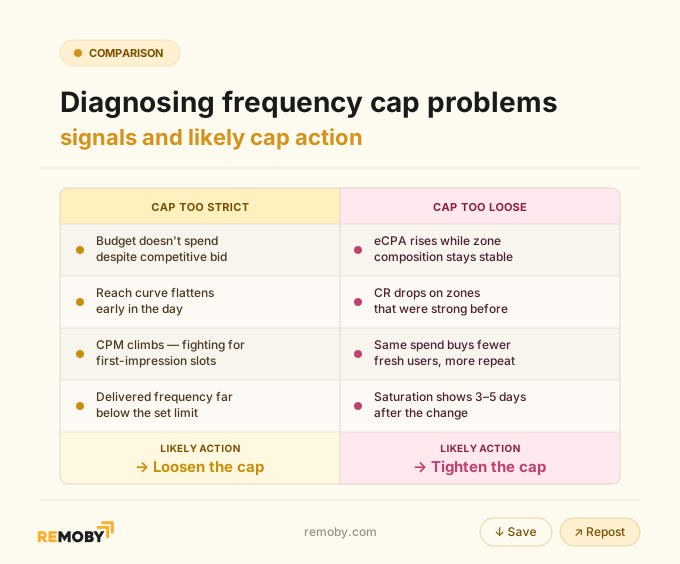
Popunder frequency capping is too strict when delivery stalls before budget is spent, unique reach flattens early, and the campaign underdelivers despite a competitive bid. Popunder frequency capping is too loose when impressions keep flowing but eCPA rises, CR weakens on previously stable zones, and more of the spend goes to repeated users without extra conversion gain.
The easiest way to miss this is to treat all delivery problems as bid problems.
If a campaign underdelivers by 20-30% while the bid is already competitive, check the cap before touching bids or tearing apart targeting. That symptom shows up constantly in narrow whitelists and tight carrier filters. The campaign is not losing auctions. It is running out of eligible fresh users.
Signals the cap is too strict:
- Budget does not spend even though the bid sits in range
- Reach curve flattens early in the day
- CPM climbs as the campaign fights harder for first-impression inventory
- Delivered frequency stays far below the limit because the setup cannot recycle users fast enough
Signals the cap is too loose:
- eCPA rises while zone composition stays mostly stable
- CR drops on zones that were strong before
- The same spend buys fewer fresh users and more repeat exposure
- Saturation appears 3-5 days after the change, not always immediately
I spent two days once looking for a bid issue that did not exist. The campaign was short 25% on spend. The fix was loosening the cap, not paying more for the same inventory. One setting, wrong diagnosis.
A real example makes this less abstract. In one Tier-2 LATAM Giveaway run, a buyer started at 1/day and saw about 0.45% prelander-click CR — but the campaign could not spend past roughly 60% of its daily budget on a narrow whitelist. The cap moved to 3/day on the same zones. Within three days the campaign reached full spend and daily conversions grew by about a third, while per-impression CR dipped to 0.35% — second and third impressions convert worse, and that is expected. By day six, per-impression CR slid toward 0.25% and eCPA crossed target as saturation kicked in. The campaign settled at 2/day and held target eCPA for the next two weeks.
How to build the right pop traffic prelander
Once you can read those symptoms, the FAQ stops being theory and becomes campaign triage.
How to test a popunder frequency cap change without skewing results
Testing a popunder frequency cap change without skewing results requires isolating the cap as the only variable, running tests across comparable day-of-week windows, and waiting at least 3-5 days before reading outcomes. Change one thing at a time. If bids, landers, and targeting shift alongside the cap, the result is noise, not a signal.
A clean testing protocol:
- Freeze all other campaign variables before changing the cap.
- Pick a test window of at least 3 full days, matched to the same days of the prior period where possible.
- Track delivered frequency and unique reach alongside eCPA and CR. A cap change that improves eCPA but collapses reach is not a clear win.
- Do not read day-one numbers. Delivery pipelines take time to reflect a frequency rule change across the full pool.
- Wait for at least 50-100 conversions per test window before comparing periods — at typical pop CR that means tens of thousands of unique users.
- If the cap change is large, such as moving from 1/24 to 3/24h, consider an intermediate step to avoid a sudden shift in spend distribution.
Trackers such as Voluum or Keitaro can break down CR and eCPA by impression number when the traffic source passes frequency data. That breakdown is the cleanest signal available before committing to a permanent cap setting. See the tracking software guide for setup detail.
Adjacent settings that change the right cap
Dayparting compresses the practical effect of any cap. A campaign running 8 active hours on a 1/24 cap effectively runs a tighter cap than the number implies, because the delivery window forces all repetition into a shorter burst. If dayparting is narrow, the cap probably needs to sit lower than you would choose on a full-day schedule.
Targeting breadth directly determines how fast the pool exhausts. Every added filter, carrier, browser version, connection type, reduces the eligible audience. A cap that works fine on a broad Tier-2 national campaign can starve on a city-level + Android-only + WiFi-only cut of the same GEO. The pool math changes, so the cap needs to change with it.
Daily budget size decides how many cycles the cap runs before the spend ceiling cuts delivery. A high daily budget on a narrow pool hits frequency limits fast, then either recycles users or goes dark depending on the cap. A low budget on a broad pool often never reaches the cap at all, which means the cap is not the binding constraint and tuning it will not change much.
These three settings interact. Adjust one without checking the others and a reasonable cap on paper can create an unreasonable delivery pattern in practice.
Common frequency capping mistakes in pop campaigns
The most expensive mistake is acting on early data. A cap change on day one looks like a delivery result. By day four it looks like an audience result. Those are different things, and the day-one read is almost always wrong.
The second mistake is assuming network parity. The same 3/24h cap does not behave identically across traffic sources. How each platform defines a unique user and the composition of its user pool differ, so transferring a cap setting between networks transfers the number, not the behavior.
The third mistake is diagnosing cap problems as bid or lander problems. Underdelivery, flat reach, and CPM drift all look like auction issues. The cap is rarely the first thing buyers check. It should be.
A subtler mistake: setting a cap without checking the delivered frequency report. The cap is a ceiling. If delivered frequency is running at 1.1 when the cap is 3, the cap is not the constraint and changing it will not move anything. Read the actual delivery first, then decide whether the limit is relevant.
Ready to launch with Remoby?
FAQ for frequency capping in pop campaigns
1/24 is a good starting cap for many popunder campaigns because it forces spend toward fresh users and avoids early burnout. It fits especially well when targeting is narrow or the funnel has longer conversion lag. It stops being a good start when volume starves and the campaign cannot spend at a competitive bid.
1/24 vs 1/12 comes down to whether the second exposure still adds conversion probability inside the same day. Use 1/24 when reach preservation matters more. Test 1/12 when the offer converts on impulse and users often need a second touch within hours. Compare matching day-of-week windows before reading the result.
Metrics to watch first are delivered frequency, unique reach, spend pace, eCPA, and CR by impression bucket. Those tell you whether the cap changed distribution, not only outcome. If the campaign has not accumulated at least 50 conversions in each test window, the read is still noisy.
A tighter cap starts hurting reach when the campaign cannot spend its budget despite adequate bids and stable targeting, or when reach flattens early in the active window. This happens faster when dayparting compresses delivery into fewer hours. An 8-hour schedule makes the same 24-hour cap behave more aggressively than a full-day schedule.
User-level counting varies by network. Each platform defines and counts a unique user differently under the hood, so the same numeric cap does not always create the same delivered frequency across sources. Do not assume one network's 3/day behaves like another network's 3/day. See the pop and Engagement Ads format cluster for format context.
![Pop Ads CPM in Indonesia [2026]](https://remoby.com/wp-content/uploads/2026/08/Screenshot-2026-08-03-at-16.38.38-768x431.png)
![Pop Ads CPM in Mexico [2026]](https://remoby.com/wp-content/uploads/2026/07/Screenshot-2026-07-30-at-16.06.45-768x432.png)
![Pop Ads CPM in the United States [2026]](https://remoby.com/wp-content/uploads/2026/07/Screenshot-2026-07-28-at-11.23.44-768x399.png)
![Pop Ads CPM in India [2026]](https://remoby.com/wp-content/uploads/2026/07/Screenshot-2026-07-30-at-17.09.10-768x432.png)