Updated: July 28, 2026
|
11 min read
Updated: July 28, 2026
|
11 min read
Last-Click Attribution in Pop Traffic: When It Works and When It Doesn’t

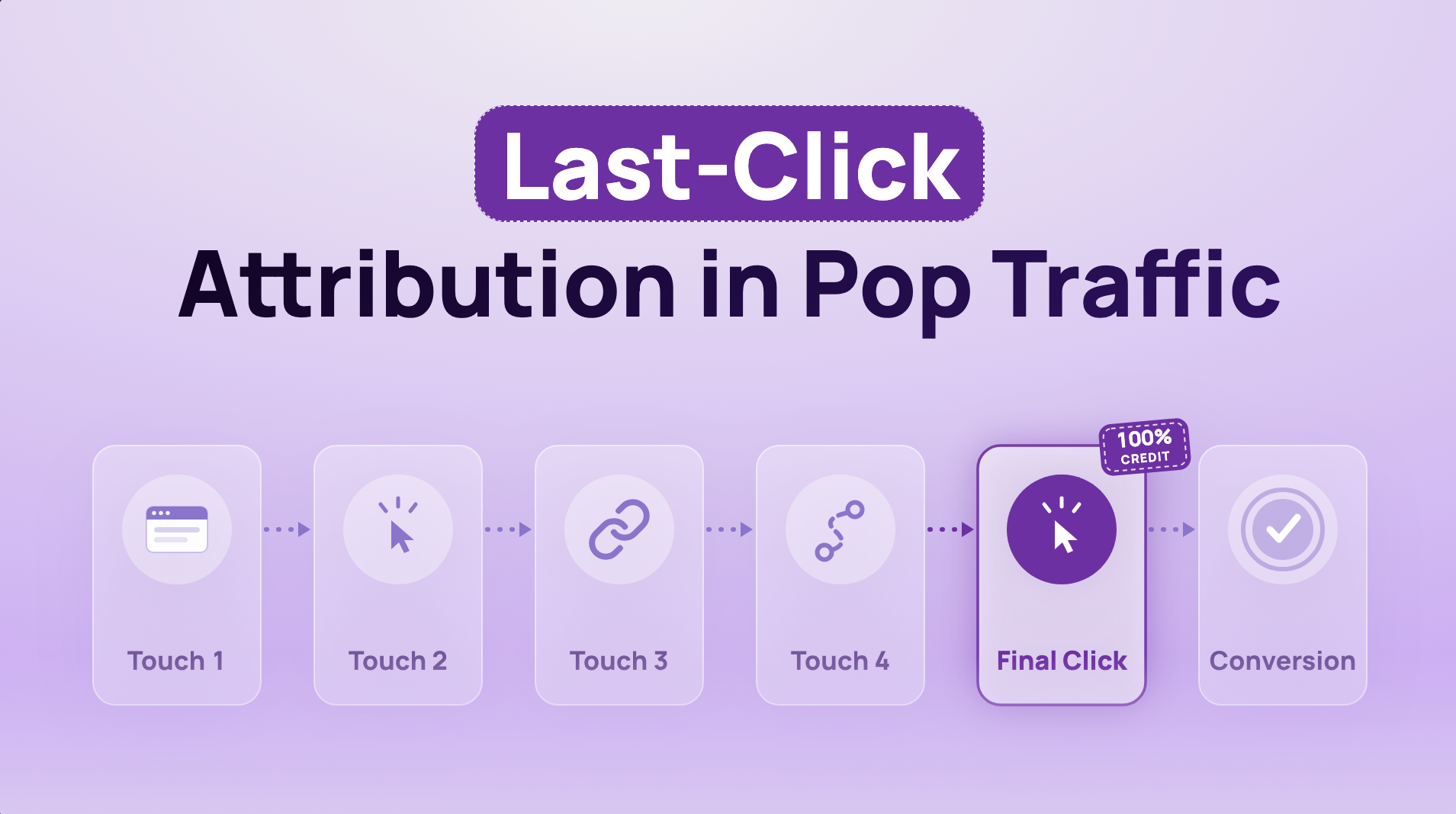
The report says one zone converts and another one doesn’t. The path underneath says something else. In pop, last-click attribution pop traffic works well until the moment the click ID stops surviving the journey, or the wrong touch starts getting all the credit.
What last-click attribution means in pop ad campaigns
Last-click attribution assigns the conversion to the final tracked click before the user converts. In a pop setup, that usually means the last click ID that reached the offer and came back through the postback.
A user opens a pop, hits your pre-lander CTA, lands on the offer, and registers. The tracker credits the conversion to that last recorded click, not to any earlier touch in the path.
That sounds obvious until you look at real offer flow. In pop, the “click” that gets credit is not the pop impression itself. It is the tracked event your system can actually tie to a click ID. With redirect tracking, the tracker logs the visit and 302-redirects the user to the lander with the click ID in the URL. AppsFlyer describes the generic rule the same way in its last-touch model: the final eligible touch before conversion gets the credit. Pop tracking follows that rule, but the pathing is shorter and more fragile because landers, rotators, and redirect chains can drop the ID long before the conversion returns.
In practice, last-click attribution in pop ad campaigns is the default because it keeps optimization clean. You can cut zones, move bids, and read CR by placement fast. The problem is not the model itself. The problem is assuming the dashboard event and the user journey are the same thing.
How last-click attribution works for pop ads
Last-click attribution works by creating a click ID at the tracker, passing that ID through the pop path, and matching the conversion postback to the last stored click. In a pop campaign, the sequence is usually tracker redirect, pre-lander load, CTA click, offer visit, then S2S postback. For example, if click ID abc123 reaches the offer and the advertiser sends back abc123 on registration, the tracker credits that conversion to the final click carrying abc123.
Here is the path in plain terms.
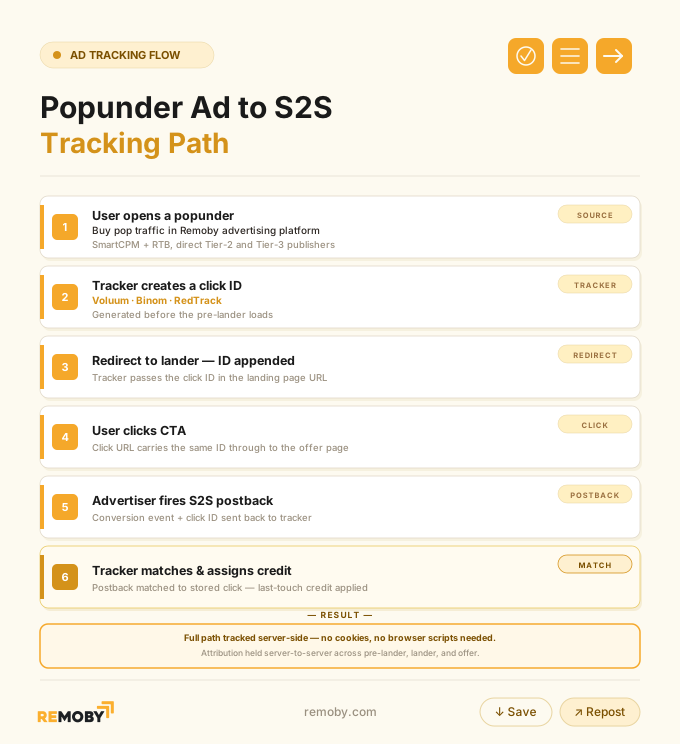
That is the clean version, but the hidden failure usually sits in step 4.
Click ID persistence is where setups break. If the user bounces from the lander and returns later by typing the domain directly, the original ID is gone unless you stored it at click time. The tracker minted it already. Keeping it alive is your job, not the tracker’s default behavior.
I once spent two days on a “bad zone” problem that turned out to be a bad macro. The token was present. One URL-encoding mistake stripped the parameter on the second redirect. The zone was fine, but the attribution wasn’t.
When buyers argue about first-click and last-click, this is the part they usually skip: both models fail if the identifier does not survive the route.
First-click vs last-click attribution for pop ads
First-click attribution is better for diagnosis. Last-click attribution is better for daily buying. In pop, the right model depends on path length, repeat visits, and whether your pre-lander or rotator actually influences who converts.
If the campaign is pop to lander to offer in one session, last-click usually wins because it maps to the conversion event you are optimizing. If the user path includes repeat entries, delayed FTDs, or three-plus rotator hops, first-click starts showing value last-click hides.
Here is the practical comparison behind first-click vs last-click attribution for pop ads:
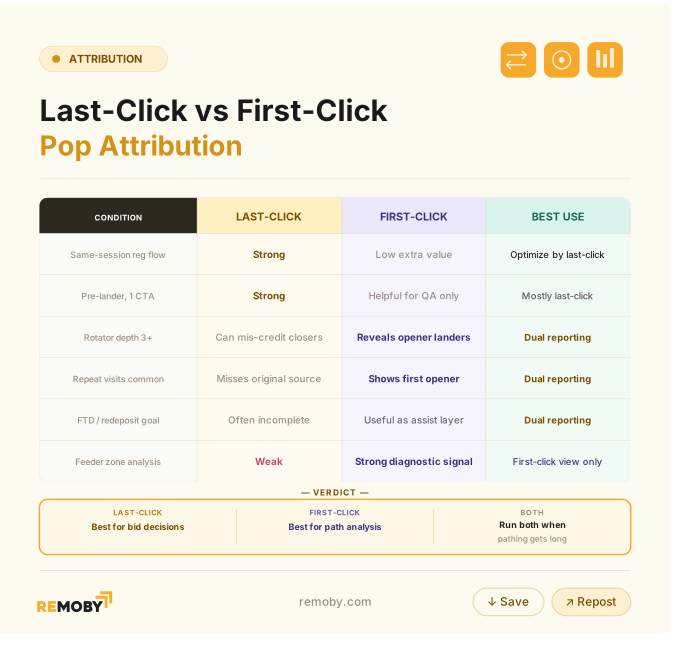
First-touch and last-touch are different answers to different questions. That is the useful way to read it here.
Last-click answers “what closed.” First-click answers “what started the user moving.”
On pop, those are often not the same source once funnel leakage and session breaks show up.
The hard part is not choosing a philosophy. The hard part is knowing when the short path you built is no longer the short path users actually take.
When last-click attribution is reliable in pop campaigns
A median click-to-FTD lag above 24 hours is a warning sign to add first-touch logging. Below that, and especially inside one session or one hour, last-click is usually solid for optimization.
That runs against the usual “last-click is outdated” story. In pop, many paths are intentionally compressed. Popunder ads open, user scans the lander, hits the CTA, reaches the offer, converts. If your payout is straight registration, your pre-lander is stable, and the zone-level CR matches advertiser feedback, last-click is not a compromise. It is the cleanest operating model.
It is reliable when three conditions hold:
- One-session pathing dominates. The user converts without leaving and returning later.
- The click ID survives every hop. Redirect chain, lander, offer URL, and postback all carry matching values.
- Your optimization target is near the click. Registration is closer. FTD is farther away.
Premium GEOs make this concrete.
According to Remoby’s stats, US pop traffic runs close to $4.09 CPM, Philippines near $4.56, Mexico around $4.14 — all lower-volume relative to spend, all buying pricier impressions.
That price tends to correlate with fewer resold hops between the tracker and the offer: fewer places for the click ID to get dropped or overwritten. On registration offers in these GEOs, last-click reporting usually holds up against what the advertiser reports on their end.
This is why many buyers keep last-click alone on short offer flows in iGaming registration funnels. You can read whitelist and blacklist changes fast. You can compare zone CR cleanly. You do not add diagnostic signals that slow down decisions.
RedTrack reflects this operational reality with a campaign-level first/last-click switch rather than full native multi-touch attribution. Voluum and Binom can store custom values for first-touch, but they do not natively do full multi-touch either. Manual engineering starts making sense only when the path earns the extra complexity.
Last-click stays trustworthy right up to the point where users stop behaving like one-session users.
Ready to launch with Remoby?
Where last-click attribution misleads in pop campaigns
Repeat visits and delayed conversions distort last-click reporting because the final tracked click often belongs to the touch that closed the conversion, not the touch that created demand. In pop campaigns, that hides feeder zones, over-credits retargeting or return sessions, and can make you cut sources that actually open the funnel. Imagine: a cheap zone drives the first lander visit on desktop, but a later mobile visit gets the FTD and takes the credit.
Last-click starts lying by omission here. It does not invent conversions. It assigns them too late in the journey.
The most common distortion patterns are these:
- Repeat direct return. User sees your lander, leaves, comes back later without the stored click ID. The conversion posts against a later source or does not match at all.
- Rotator reshuffle. User hits lander A first, then returns and lands on B or C. Last-click says B closed. It cannot show that A did the prospecting.
- Cross-device movement. Desktop lander opens the path, mobile deposit closes it. Last-click follows the closer if only the final session keeps the ID.
- Feeder zones. Cheap placements produce low last-click FTD but high first-touch assist. Cut them without checking first-touch data and your stronger closing zones often dry up within a week.
This is the exact profile of the highest-volume, lowest-CPM GEOs
As per Remoby’s stats, India at roughly $0.60 CPM on 796M+ monthly impressions, Indonesia at $1.89 on 636M+, Egypt at $1.44, Bangladesh at $3.17.
The volume makes them look like natural feeder candidates and the CPM makes them cheap to test, but a large share of that traffic reaches the offer through resold, multi-hop paths — meaning the click ID has often changed hands more than once before the postback fires. Cutting these on last-click FTD alone is cutting on the weakest possible signal.
On one Tier-2 iGaming campaign, two zones looked dead on last-click FTD, so bids got cut to the floor. After first-touch logging went into cv1, those zones turned out to be opening a large share of later FTDs across returning sessions. Pulling them hurt the closer zones within a week.
That pattern matters more on FTD than on registration. The farther the payout sits from the original click, the easier it is for the last touch to steal the whole story. (worth testing in your own pathing)
Pixel-only tracking makes this worse too. If the conversion pixel fails, the surviving data skews toward whatever browser and session state still allowed the pixel to fire.
Once you accept that some zones open and others close, the real choice is no longer first-click or last-click. It is whether you want one report for action or two reports for truth.
Decision matrix and tracking setup for pop campaigns
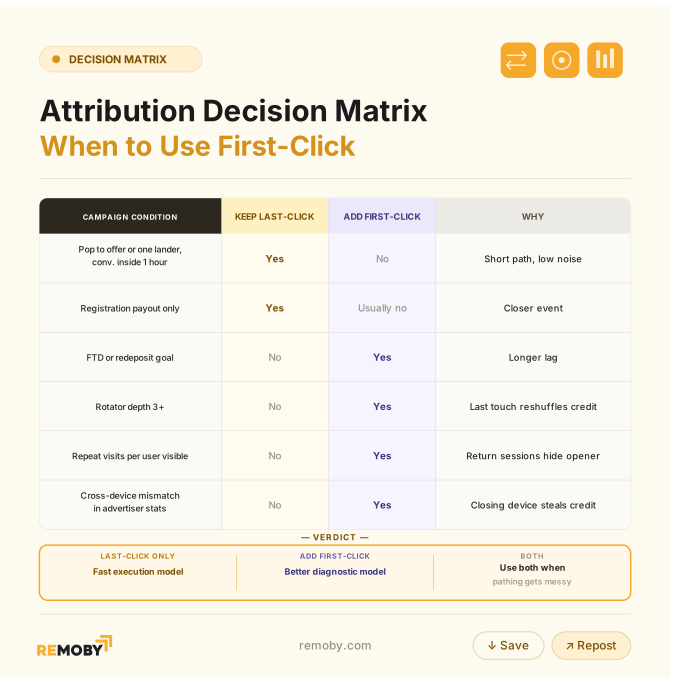
Dual reporting is the right move when pop campaigns use pre-landers, rotators, repeat visits, or FTD events with visible lag. Last-click should stay the optimization layer, while first-click stays a diagnostic layer stored in custom parameters.
Keep bids and zone cuts tied to last-click CR, but review first-touch FTD assist rate before killing cheap feeder traffic.
Save this decision matrix not to fail your future pop campaigns.
Tracking flow for click IDs and S2S postbacks
To track both first-click and last-click attribution using click IDs and postbacks for pop traffic, use one stored value for first touch and one rolling value for last touch.
- Generate the click ID at the tracker on the inbound pop click.
- Write the incoming click ID to local storage on first visit and never overwrite it.
- Store the current click ID separately as the latest touch.
- Pass both values through the CTA to the offer if the advertiser supports custom parameters.
- Fire one S2S postback for the conversion event.
- Map last-click to the tracker’s normal conversion field and first-click to a custom slot like
cv1, a custom token, or a sub parameter. - Deduplicate by click ID plus event name.
That is enough for dual reporting without pretending you built true multi-touch.
Tracker notes for Voluum, Binom, and RedTrack
- Voluum: use a custom conversion variable such as
cv1to keep the first-touch ID, while the regular visit ID handles last-click. - Binom: use a custom token for first-touch storage and keep last-click in the standard click record.
- RedTrack: use a sub parameter for first-touch, or use its native first/last-click switch when you need one model at campaign level rather than dual storage.
None of these tools gives full multi-touch attribution out of the box. You build the extra layer yourself. Official tracker documentation covers postbacks and custom tokens, but not a complete pop-specific dual-attribution pattern end to end.
The setup is not complicated. The discipline is. One missing parameter turns a clean matrix into fake certainty.
Common attribution errors in pop campaigns
Most attribution errors in pop setups trace back to four failure points: dropped parameters in redirect chains, duplicate postbacks from advertiser retries, pixel-only tracking that undercounts against server-side data, and mismatched event names that create phantom conversions.
Dropped parameters happen when a click ID macro is not URL-encoded and a redirect chain strips the value. The tracker receives a blank or malformed ID and either creates a new visit record or fails to match the postback. One URL-encoding mistake turns a working setup into an invisible leak. The zone dashboard looks fine. The attribution is fractured.
Duplicate postbacks usually come from advertiser retry logic. If the network retries a failed postback and your tracker does not deduplicate by click ID plus event name, the same conversion posts twice. CR suddenly looks high on one offer. It is not a win. Group by click ID and check.
Pixel-only tracking is not reliable for pop traffic because browsers increasingly block third-party pixels, some pop landers load inside constrained rendering environments, and session state clears between the lander visit and the conversion event. Inherited setups often undercount by 20% to 40% against advertiser stats when they rely on pixels alone. S2S postbacks handle the match server-side and avoid that loss. If you care about zone-level decisions, that gap is not rounding error.
How attribution choice feeds the profit math – read in how to calculate campaign ROI blog.
Mismatched event names mean the advertiser fires a postback with an event label that differs from what the tracker expects. The conversion arrives but does not register in the correct campaign view. This one is easy to miss because the postback technically succeeds.
Ready to launch with Remoby?
FAQ for Last-Click Attribution
First-click and last-click tracking in a pop campaign uses two stored identifiers: the first click ID captured on lander load and the latest click ID updated on later visits. The tracker matches the last ID through the normal postback, while a custom field stores the first-touch ID for reporting. Keep first touch in cv1 or a sub parameter, then compare first-touch assists against last-click conversions. Use S2S tracking, not a conversion pixel, for the actual event match.
Tracking mistakes that break attribution in pop campaigns usually come from dropped parameters, duplicate postbacks, and mixed event names. Unencoded click ID macros can disappear inside a redirect chain, and advertiser retries can fire the same conversion twice. If CR suddenly doubles on one offer, group conversions by click ID and check whether the same event posted twice. Follow one test click through every hop in dev tools. If the query string changes between redirects, you found the leak.
Pixel-only tracking is not reliable enough for pop traffic because browsers block third-party cookies, some landers load in constrained environments, and session state clears before the conversion fires. S2S postbacks match the conversion on the server side and avoid most of that loss. Inherited pop setups often undercount by 20% to 40% against advertiser stats when relying on pixels alone. At that level of undercount, zone decisions based on pixel data are based on a distorted sample.
First-click attribution reveals value when the opening touch and closing touch come from different sessions, different devices, or different zones. In pop traffic, that usually happens with feeder zones, longer FTD funnels, and rotators that reshuffle landers across returns. A cheap placement with weak last-click FTD can still be the first touch behind a strong share of later deposits. Use first-touch data to avoid cutting traffic that starts the funnel, not to set bids or payouts directly. The dashboard was never wrong in the narrow sense. It credited the last surviving click exactly as instructed. The mistake was trusting that report to describe the whole pop journey when the click ID, the session, and the user path had already split apart.
![Pop Ads CPM in India [2026]](https://remoby.com/wp-content/uploads/2026/07/Screenshot-2026-07-30-at-17.09.10-768x432.png)