Updated: September 15, 2026
|
29 min read
Updated: September 15, 2026
|
29 min read
Best CPA networks in 2026: a fit-first guide

The network with the highest EPC on the card is often the worst first choice. Best CPA networks are not ranked by headline payout. They are filtered by how fast you get paid, how your traffic source is reviewed, and how much of your CR survives the network’s quality model.
Quick Comparison of the Best CPA Networks in 2026
Most affiliates compare logos. The money is in the operating terms. A network that advertises weekly payments but puts your first payout on net-30 changes your testing budget, your burn rate, and how long you can stay in a zone before the data settles. That matters more than a pretty EPC screenshot.
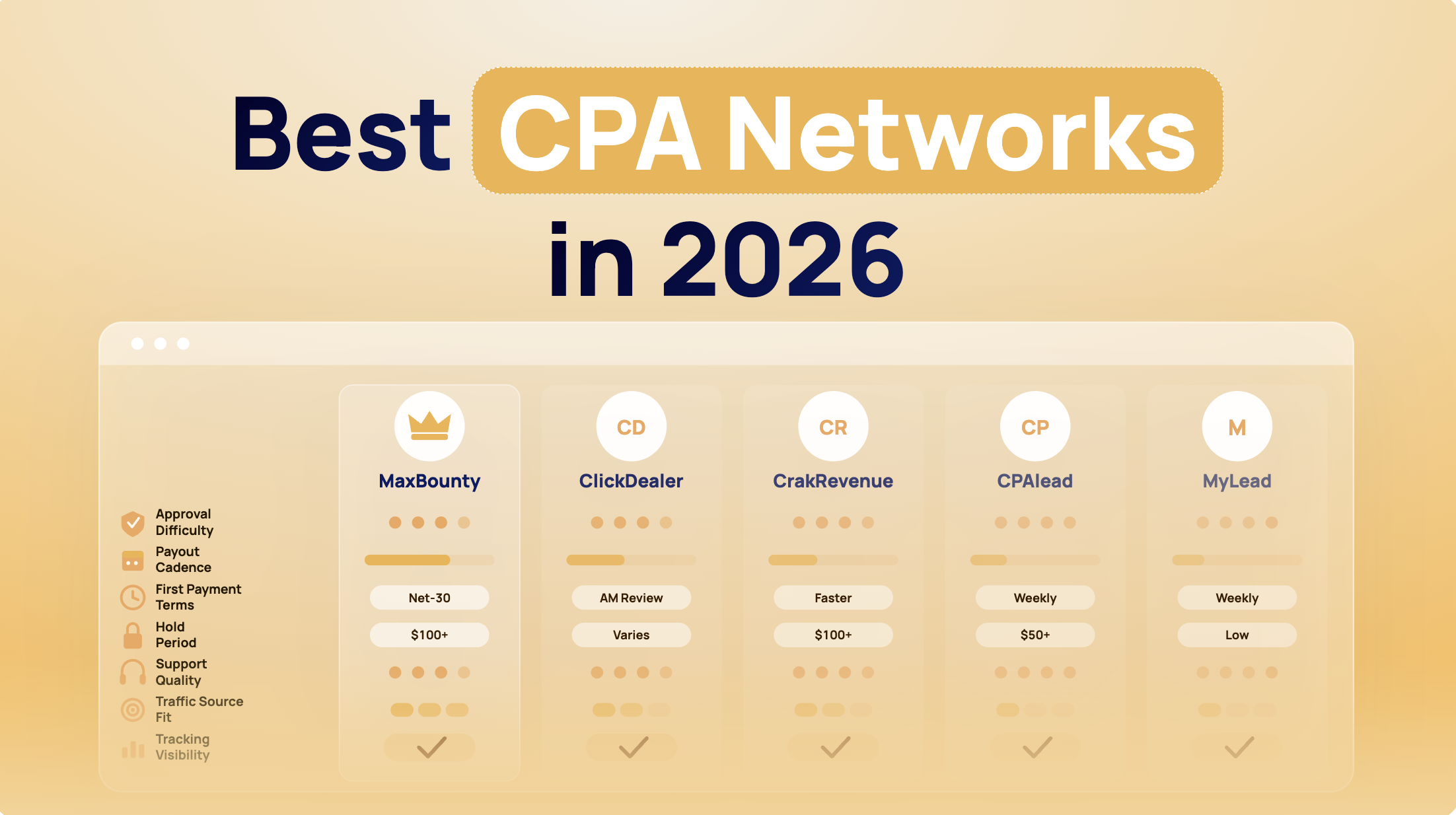
Comparison table fields: approval difficulty, payout cadence, first-payment terms, hold period, support quality, traffic-source fit, and tools
The useful comparison is operational, not cosmetic. Below is a working shortlist built around approval friction, payment timing, traffic-fit, and trust signals from public terms, platform materials, and practitioner patterns.
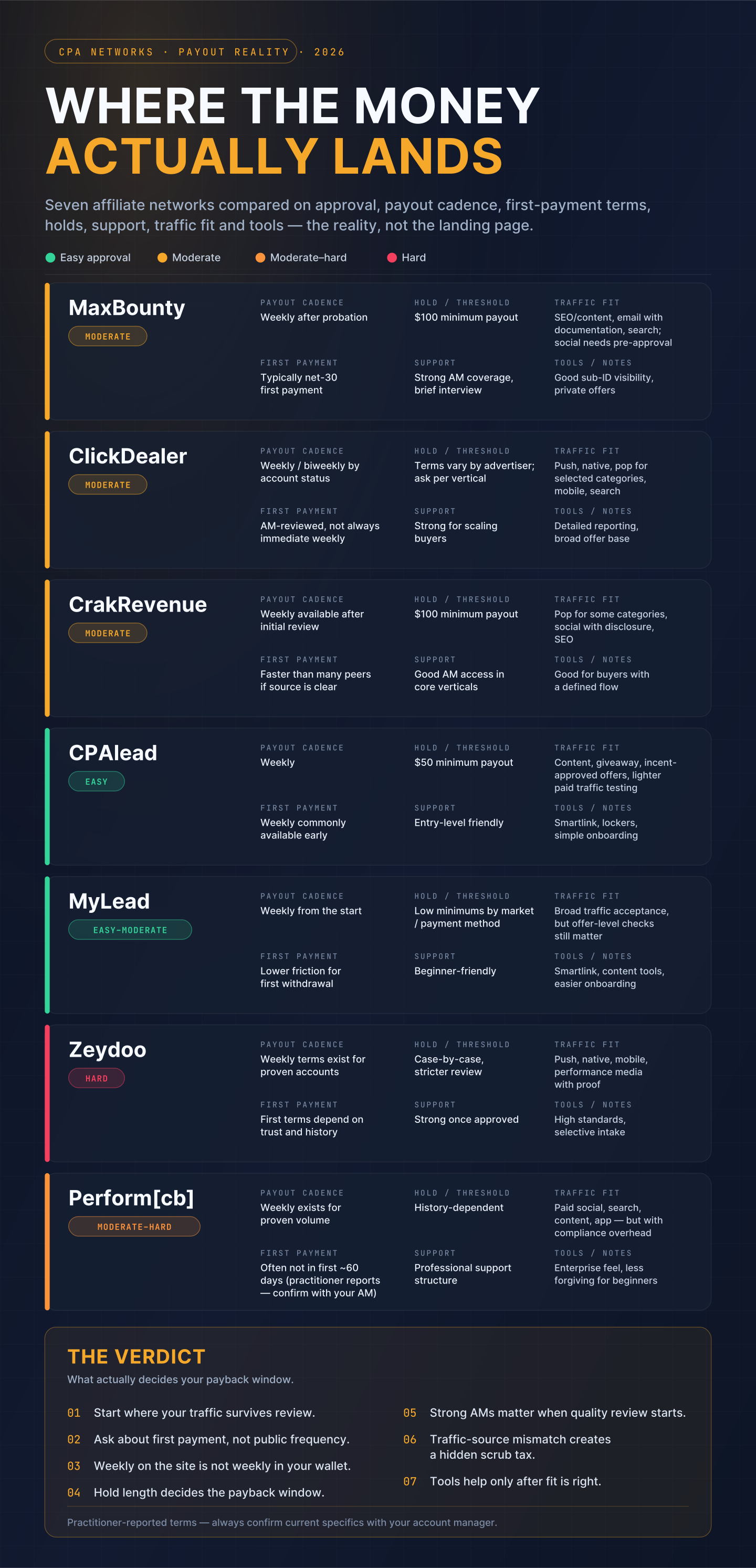
The table gets you a shortlist. The harder part is knowing why the same pop flow can print on one network and get filtered on another.
Fast shortlist: safest beginner picks, strongest weekly-pay options, and best traffic-source matches
If you are new, approval friction should be your first filter.
CPAlead and MyLead sit at the low-bar end of the market based on application difficulty and broader source acceptance. MaxBounty is still beginner-accessible, but only if you can explain your traffic plan clearly on a phone or Skype call. Zeydoo is the opposite. Cold applications there get rejected regularly if you cannot show volume history and proof of performance.
A practical shortlist looks like this:
- Safest beginner picks: CPAlead, MyLead, then MaxBounty if you can handle an interview.
- Stronger weekly-pay options: MyLead, CPAlead, CrakRevenue. MaxBounty can get there after probation. Perform[cb] is less predictable early — practitioner reports place reliable weekly terms past the first ~60 days, so confirm before counting on it.
- Best for SEO and content traffic: MaxBounty, Perform[cb], MyLead.
- Best for push and native traffic: ClickDealer, Zeydoo, CrakRevenue.
- Best traffic-source match for pop: ClickDealer and CrakRevenue for declared categories; some buyers also test a network that fits Tier-2 strategy such as Remoby on the traffic side before choosing where the CPA flow should land.
- Best for small-volume first tests: CPAlead and MyLead.
The phrase CPA networks that pay weekly needs a warning label.
Public weekly cadence often applies only after an initial hold, AM approval, or clean payment history.
The shortlist is easy. Ranking the trade-offs is where most first applications go wrong.
Ready to launch with Remoby?
How We Tested and Ranked These CPA Networks
A high EPC without traffic fit is expensive noise. The ranking here weights seven variables in this order: traffic-source compatibility, approval friction, first-payment reality, hold period, support quality, tracking visibility, and trust. Offer count matters, but less than people think. Ten clean offers you can actually run beat 500 you cannot get approved for.
Fit-based criteria: traffic-source compatibility, approval friction, payout timing, offer quality, support, tracking, and trust
If you buy traffic, the first question is not “who pays the most.” It is “who accepts this source without retroactive friction.” MaxBounty and Zeydoo are the most restrictive in this group for Facebook and wider paid social. Both typically require pre-approval, ad account disclosure, creative angles, and the landing page before volume starts. Incent traffic is prohibited network-wide on both. Email needs opt-in documentation. ClickDealer and CrakRevenue are more permissive, but only when disclosure happens upfront. If you sign up with SEO and then pour paid social later, retroactive approval is rarely granted. (the math changes here)
The criteria used in the ranking were:
- Traffic-source compatibility. Can the network take your actual source, not your intended source?
- Approval friction. Interview, AM review, revenue proof, and vertical knowledge requirements.
- Payout timing. Public cadence and actual first-payment terms.
- Offer quality. Not raw count. Relevance by vertical, GEO, and flow.
- Support. AM response speed, problem ownership, and whether you get source-specific guidance.
- Tracking visibility. Sub-ID logging, cap visibility, postback reliability, and conversion detail.
- Trust. Payment reputation, documented policies, and scrub transparency.
Short version: fit beats popularity.
The visible ranking factors are easy to score. The costly one is still ahead: when the network’s quality model disagrees with your traffic pattern.
Are high EPC CPA networks always the best choice for a new affiliate?
High EPC CPA networks are not always the best choice for a new affiliate. High EPC reflects a mix of payout, conversion rate, and traffic quality, but it does not show approval friction, hold length, scrub exposure, or whether the network suits the traffic source. A paid social beginner can lose money on a prestigious network with strict review while earning sooner on a lower-EPC network with faster approval and cleaner validation.
For newer buyers, EPC is usually downstream of three things:
- whether your source is accepted without manual quality friction
- whether your cap and flow match the network’s vertical strength
- whether the first payment arrives before your test budget is exhausted
That is why highest paying CPA networks with reliable payments is a better search intent than “highest EPC.”
Reliability changes the payback window.
I have seen rev-share logic creep into CPA decisions here: people chase the prettier dashboard number and ignore the time it takes to collect it.
A strong EPC can still be the wrong deal. The next question is what a CPA network is actually doing between your click and your payout.
What Is a CPA Network and How Does It Work?
If you treat a CPA network like a simple marketplace, you will miss where margin gets lost. The network is the layer matching advertiser demand, affiliate traffic, tracking, compliance review, and payout operations. That middle layer is why two identical offers can behave differently across platforms.
How CPA offers, tracking, payouts, and affiliate managers fit together
A CPA network sits in the path of money and validation. You send traffic to an offer or smartlink, the advertiser or internal system validates the event, the postback records it (you might need good affiliate tracking software for that), and the network releases earnings after the hold. Your AM is not decoration in that chain. They decide access to private offer inventory, payout bumps, cap exceptions, and sometimes whether a disputed conversion gets reviewed or ignored.
Where this matters in practice:
- A search buyer cares about compliance notes and prelander rules.
- A pop buyer cares about whether short-session users get over-filtered.
- A content affiliate cares about payment reliability and low thresholds.
The weak point is often not tracking accuracy. It is the approval logic attached to the conversion after the postback fires (operators know this — most affiliates never ask).
The click can be tracked perfectly and still not become usable revenue. That distinction matters even more when you compare CPA networks to broader affiliate platforms.
Why CPA-specific selection criteria differ from general affiliate programs
Most people assume a network comparison works the same across all affiliate models. It does not. A general affiliate network often suits longer attribution windows, merchant-brand alignment, and content-led conversion paths. A CPA setup is harsher. You are usually dealing with tighter compliance, more source restrictions, faster lead validation, shorter payback expectations, and more sensitivity to scrub.
That changes the buying decision. A beginner comparing best CPA networks for beginners 2026 should care less about merchant brand names and more about three practical things: how hard the approval call is, whether the hold delays reinvestment, and whether the network accepts the actual funnel bundle you want to run.
Once you separate merchant partnerships from CPA operations, another confusion disappears too: where ad networks belong when you own the traffic instead of brokering the conversion.
CPA Network vs Affiliate Network vs Ad Network: What’s the Difference?
The distinction matters because each model pays you on a different bottleneck. A CPA network pays on validated actions. A broader affiliate network often pays on sales or merchant-defined outcomes across brand programs. An monetization platform pays you for monetizing traffic directly.
The advertiser-side version of this comparison – affiliate networks vs ad networks.
When a CPA network is the better fit than a general affiliate network
If your flow depends on paid traffic, fast testing, and offer rotation, a CPA network is usually the better fit. General affiliate platforms are often slower to move, stricter on brand usage, and less built around arbitrage economics. CPA networks also make more sense when you need:
- source-specific AM guidance
- private offers after quality proof
- quick cap changes by GEO or device
- cleaner postback support into Voluum, Binom, RedTrack, or Keitaro
The trade-off is that scrutiny is higher. Lead quality review, source disclosure, and traffic restrictions show up earlier than on many merchant programs.
The model is clear when you are paid for actions. It gets less obvious when you decide to monetize the traffic itself instead of forwarding it.
Where ad networks fit if you monetize traffic directly
Ad networks belong on the supply side of the decision. If you own or buy traffic and choose to monetize impressions or clicks directly, you are no longer selecting for offer approval terms. You are selecting for fill, CPM stability, and GEO-depth. For pop that means comparing platforms like PropellerAds, Adsterra, and Remoby rather than comparing MaxBounty or CPAlead.
This matters because some buyers mix the two questions. An ad network answers where to buy or monetize the traffic. A CPA network answers where to send the flow after the click. Confusing those layers leads to bad attribution of performance, especially in Tier-2 pop where the traffic source and the CPA network can each reject value for different reasons.
Choosing the right category is easy. Choosing the right terms inside a category is where hold periods and first-payment conditions start deciding survival.
How to Choose a CPA Network (and Spot Red Flags)
CPA network selection starts with payment terms, source acceptance, and trust, in that order. A beginner survives bad creative. A beginner usually does not survive a 30-day first-payment delay on undercapitalized tests, unclear traffic rules, or an AM who disappears when the scrub starts.
Ready to launch with Remoby?
How should I compare hold periods, payout cadence, and support when choosing my first CPA network?
Hold periods, payout cadence, and support should be compared as one cash-flow system, not three separate features. Hold length tells you when revenue unlocks, payout cadence tells you how often cash is released, and support tells you whether problems get resolved before the next cycle. A network with weekly payments but a net-30 first payout and weak AM coverage is slower in practice than a biweekly network with clear terms and fast issue handling.
Use this sequence before you apply:
- Ask the first-payment terms specifically. Do not stop at “weekly.”
- Ask the minimum payout and whether thresholds vary by payment method.
- Ask whether holds are network-wide or offer-level.
- Ask what happens when leads are pending quality review.
- Test AM responsiveness before approval with one traffic-specific question.
That one screen tells you more than an offer wall does.
The payment schedule on the site is the public version. The account-level version is what funds or kills the next test cycle.
How to evaluate approval difficulty, manager responsiveness, and traffic restrictions
Approval difficulty is usually obvious only after you fail it once. MaxBounty is moderate because the interview is real, but the bar is traffic clarity and vertical understanding, not revenue proof. ClickDealer is also moderate, with AM review and usually a brief call. Zeydoo is hard because it expects traffic plans, volume history, and proof from another network. CPAlead is easy. MyLead is easy to moderate.
A fast pre-screen helps:
- Send the exact traffic source, GEOs, verticals, and funnel type.
- Ask whether Facebook, email, incent, or pop needs pre-approval.
- Ask whether this applies network-wide or only to certain offers.
- Note how precise the AM answer is.
If you ask me, the main red flag is “We’ll see after you start sending”. It usually means hidden friction later.
I’ve seen rev share deals collapse because nobody pulled D60 retention before signing. The CPA version of the same mistake is sending traffic before the source rules are written down.
Source acceptance is only half the risk. The other half is whether reported conversions keep matching your tracker after week one.

Trust and reliability checklist: payment reputation, policy transparency, payment proof, and scrub-risk red flags
Trust shows up when the numbers stop looking clean. MaxBounty and ClickDealer carry above-average community reputations for scrub transparency: payout terms are documented, hold policy changes are usually communicated, and sub-ID level conversion logs are available. To be clear, that is a reputation assessment built from public terms and affiliate-forum feedback, not audited data — and it does not mean no friction. It means the friction is easier to inspect.
Use this checklist before scaling:
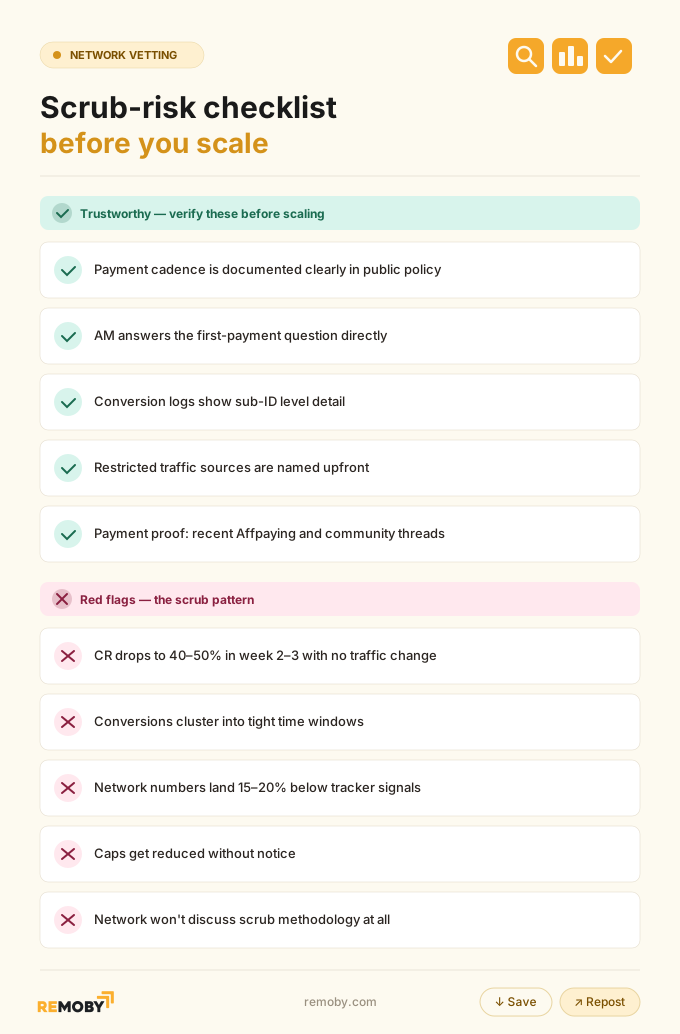
If a network will not discuss scrub methodology at all, treat the answer as high. That is not paranoia. It is a margin assumption.
The obvious red flags are public. The expensive ones happen during onboarding, when the network decides whether your small-volume traffic is worth its time.
How to Get Approved by a CPA Network: Application Tips
A weak first application usually fails before the call starts. Networks are not grading your ambition. They are grading whether your traffic is compliant, repeatable, and understandable. New affiliates get rejected less for low volume than for vague answers.
What onboarding calls, traffic questions, and compliance checks usually involve
If you get a call from MaxBounty or ClickDealer, expect practical questions, not theory. They will ask where traffic comes from, which vertical you know, whether you use a tracker, how you handle compliance, and what offer types you want. For Facebook or paid social, the stricter networks often want the ad account context, creative angle, lander, and whether the source was pre-approved.
For email, expect opt-in questions. For pop or native, expect disclosure on GEOs, volumes, and whether the flow uses a prelander. For incent traffic, assume offer-level approval even on permissive platforms like CPAlead and MyLead.
The good sign is specificity. The bad sign is being approved with no questions at all for a source that normally receives scrutiny.
The call is not the hard part. The hard part is presenting a small traffic base in a way that sounds structured rather than inexperienced.
Realistic first-application setup for beginners with small or new traffic sources
Beginners do better when they apply with one believable use case, not five. If your volume is small, say so and narrow the plan. “SEO content in finance and software offers from one site” is stronger than “all traffic types, all verticals.” The same goes for paid traffic. “Testing push in Tier-2 with a tracker and capped budget” sounds controlled. “I want to scale everything” sounds unserious.
A realistic first setup:
- Pick one traffic source.
- Pick one or two verticals.
- Prepare your tracker, even if volume is small.
- Describe your flow clearly: source, prelander, offer type, GEO.
- Ask for one starter offer and one smartlink option.
That gives the AM something workable.
This is also where traffic-source matching stops being abstract. The illustrative scenario in the case-example section later in this guide walks through the same pop traffic moving from a 0.4% to a 1.8% CR after nothing changed except which network’s quality model judged it. The numbers there are directional, but the mechanism is the one to screen for during your application: when your traffic type matches the network’s quality model, you stop paying a hidden scrub tax.
The application gets you in the door. The next decision is which network deserves the first traffic pour when the terms finally become real instead of advertised.
To make that choice more practical, the category breakdown below keeps the same fit-first logic and applies it to beginner entry, traffic sources, payouts, and verticals.
Best CPA Networks by Category: For Beginners, Highest Paying, and Top Verticals
Traffic-source fit decides this section, not brand prestige. SEO and content traffic usually work better on networks that tolerate longer conversion paths and clearer compliance review, while paid social works better on networks that pre-approve creatives, landers, and account context before volume starts. MaxBounty and Perform[cb] tend to fit structured content and search flows. ClickDealer and CrakRevenue usually fit faster paid-media testing better, provided the source is declared upfront.
Best CPA networks for beginners in 2026
Beginner approval friction is lowest on CPAlead and MyLead in 2026. Both are easier entry points because applications are lighter, interviews are uncommon, and small-volume affiliates can start without proving prior revenue. MaxBounty is still workable for a first network, but only if the applicant can explain traffic source, vertical, and funnel clearly on a call.
For a new affiliate, “easy approval” only matters if it leads to a usable first test. CPAlead and MyLead usually clear that bar because the AM is not expecting a polished media-buying operation on day one. That does not mean no rules. Incent still needs offer-level approval, and email or social flows can still trigger checks. It means the network is less likely to reject you for being new.
MaxBounty sits one level higher. The short phone or Skype interview is real. The good news is that revenue proof is not the gating factor. Traffic clarity and vertical knowledge are. If you say, “I run SEO on one finance content site and want two starter offers,” that can pass. If you say, “I do all sources and can scale anything,” it usually does not.
A practical beginner order looks like this:
- Start with CPAlead if you want the least onboarding friction.
- Start with MyLead if low thresholds and weekly withdrawals matter most.
- Apply to MaxBounty once you can explain one source and one flow cleanly.
- Leave Zeydoo until you have screenshots, source history, and a repeatable whitelist.
Best CPA networks for SEO and content traffic
SEO and content traffic usually fit networks that tolerate slower user intent and cleaner editorial funnels. MaxBounty, Perform[cb], and MyLead tend to work better here because content affiliates can document source quality, explain compliance, and run users into offers that do not depend on aggressive front-end filtering. Paid social buyers need a different relationship with the AM and a different review process.
Content traffic often gets miscompared to push or pop on EPC alone. That is the wrong lens. Search and editorial flows need offers that survive a longer consideration path, plus networks that do not interpret delayed conversions as low intent. That makes MaxBounty useful for content publishers who can handle a screening call. Perform[cb] also fits structured publishers, especially when compliance documentation is part of the workflow. MyLead is more forgiving if the volume is smaller or the site is still early.
The weak fit is a network that is strong in fast-form-submit media but impatient with SEO lag. You see it when the AM keeps steering you to giveaway or utility flows that do not match the audience. CR looks fine for a few days, then the conversion path deteriorates because the offer-network pairing was wrong, not the content itself. (operators know this — most affiliates never ask)
If you are comparing best CPA networks for SEO and content traffic, ask two things before applying: which verticals their search publishers actually run, and whether private offers exist after quality proves out. A content site usually wins more from a stable offer and a payout bump than from rotating ten public offers every week.
The content angle can be clean and the tracker can be accurate. The harder question is whether paid social gets treated by that same network as an asset or a compliance problem.
Best CPA networks for Facebook ads and paid social traffic
Paid social review is stricter than most new affiliates expect. Networks that fit Facebook ads and broader paid social usually want the source declared in advance, the lander reviewed, and the creative angle disclosed before the first spend. ClickDealer, CrakRevenue, and Perform[cb] are often better fits for disciplined social buyers than networks that advertise broad acceptance but tighten once quality checks begin.
This is where many lists blur “accepted” and “approved.” MaxBounty and Zeydoo are among the most restrictive here. Pre-approval is commonly required for Facebook and social traffic, and that review can include account context, landing page, and creative angle. If you buy first and explain later, the answer is often no.
ClickDealer and CrakRevenue are looser, but only under one condition: source disclosure has to happen upfront. If you signed up saying SEO and then push paid social traffic later, retroactive approval is rarely granted. Perform[cb] fits teams that can handle more compliance overhead and want stronger tools once volume is proven.
I have watched paid social buyers lose a week of spend because they treated source disclosure like a formality. The traffic converted. The network relationship did not.
Social can pass review and still be the wrong margin profile. Faster traffic sources expose that problem even more clearly.
Best CPA networks for push, native, pop, and mobile/app traffic
Most affiliates assume push, native, and pop belong on the same shortlist everywhere. In practice, the fit splits by how the network reads short-session behavior.
ClickDealer and CrakRevenue are usually the first serious options for declared pop and native categories because their AM teams are more used to fast-session traffic and mobile-heavy funnels. Zeydoo can be strong for proven media buyers, but the intake is selective and cold applications get filtered early. For mobile/app style flows, Perform[cb] can work when the buyer has clean compliance and enough volume to justify the setup.
The failure mode is predictable. A network says it accepts pop, but the quality model still expects behavior that looks more like search or content. The postback fires, your tracker logs intent, and then the network reviews the same user path as suspicious because bounce is high and session length is short. That is where scrub starts hiding inside “quality review.”
I have seen the same pop flow go from unusable to scalable without changing the zone, the prelander, or the cap. The only change was the network. Short sessions were treated as normal instead of low quality. (the math changes here)
For buyers testing Tier-2 pop, one useful split is to separate where you buy traffic from where you place the CPA flow. PropellerAds and Adsterra are traffic-side decisions. A network that fits CPA-first Tier-2 strategy such as Remoby can also belong on that traffic side. The CPA network decision comes after, when you decide which AM and quality model will judge the same user behavior.
[IMAGE: MATRIX_2X2 | Four-quadrant matrix mapping traffic-source speed against network review strictness for push, native, pop, and mobile/app flows.]
Once the source gets faster, payout timing starts to matter almost as much as CR.
Best CPA networks for email submits and lead-gen offers
A flat payout on lead-gen looks safe until compliance hits after the first payout cycle and the same list quality gets re-scored lower.
Email and lead-gen are less about headline rate and more about documentation. MaxBounty and Zeydoo are restrictive here because opt-in proof is commonly required, and that requirement is not cosmetic. If the list source is vague, the account will feel approved right up until the review queue expands.
CPAlead and MyLead are more permissive with newer affiliates, but permissive does not mean careless. Offer-level rules still matter, especially on incent or giveaway-style flows. CrakRevenue can be a workable middle ground when the traffic source is clear and the lead path is simple.
Ready to launch with Remoby?
For anyone searching best CPA network for email submits, the useful filter is this:
- choose the network that states email rules in writing
- ask whether suppression, opt-in proof, and source disclosure are checked pre-launch or post-launch
- avoid offers where the AM cannot tell you what a valid lead actually looks like
Bad email economics rarely fail on day one. They fail when the first hold closes and accepted leads start getting reclassified.
The list can be compliant and the front-end EPC can still lie. Weekly payment terms are where that becomes visible.
Best weekly-pay and low-hold CPA networks with strong trust signals
Weekly payments are only meaningful when first-payment terms, hold length, and AM responsiveness line up. CPAlead, MyLead, and CrakRevenue are usually the clearest weekly-pay starting points for new or mid-volume affiliates, while MaxBounty can become weekly after probation. Perform[cb] may offer weekly terms for proven accounts, but practitioner reports suggest that rarely applies inside the first ~60 days — treat that as a heuristic rather than a documented policy, and confirm first-payment terms directly. Public payout cadence is less important than when cash actually reaches you.
The phrase CPA networks that pay weekly gets abused because public cadence and account reality are often different. New accounts are frequently put on net-30 for the first payment even when the site says weekly. Ask that question directly.
Trust signals here are operational:
- first-payment answer is specific, not vague
- threshold is public or clearly stated by the AM
- hold policy is documented and changes are communicated
- sub-ID logs are visible when disputes start
- payment proof is recent on Affpaying and forum threads
If you want CPA networks with low hold and weekly payouts, MyLead and CPAlead are the easiest places to start. CrakRevenue is stronger once initial review clears. MaxBounty is trustworthy, but a beginner with tight cash flow should model the probation period before sending spend.
Weekly on paper is easy to compare. Weekly after a quality review is the number that decides whether the campaign gets another traffic pour.
The 15 Best CPA Networks in 2026 (Full Reviews)
A long list is only useful if each network comes with a poor-fit warning. Without that, every review reads positive and none of them help you choose.
Mini review template: best for, poor fit for, approval friction, payouts, traffic rules, and standout tools
Use the same template for every network, or the comparison collapses into opinions:
- Best for which source and vertical.
- Poor fit for which buyer profile.
- Approval friction level.
- First-payment reality and hold.
- Traffic rules that trigger manual review.
- One standout tool or relationship advantage.
That structure forces the trade-off into view.
Core seven reviewed in depth: MaxBounty, CPAlead, ClickDealer, Perform[cb], and other leading options
Here is the condensed version.
| Network | Best for | Poor fit for | Approval friction | Payouts and hold | Traffic rules / tools |
|---|---|---|---|---|---|
| MaxBounty | SEO, content, disciplined search buyers | Vague beginners, undeclared social | Moderate, short interview | Weekly after probation, first payment often net-30, $100 minimum | Strong AMs, private offers, good logs |
| CPAlead | New affiliates, giveaway and utility flows, small tests | Buyers needing enterprise-level AM depth | Easy | Weekly, $50 minimum | Smartlink, lockers, broad acceptance but offer-level checks remain |
| ClickDealer | Push, native, pop, scaling buyers | Applicants hiding source changes | Moderate, AM review and brief call | Weekly/biweekly by account status | Good reporting, broad vertical coverage |
| Perform[cb] | Structured media teams, app and social buyers with compliance | Beginners needing fast access | Moderate to hard | Weekly exists for proven accounts, often not early (practitioner reports) | Professional tooling, tighter review |
| CrakRevenue | Declared pop categories, lead-gen, buyers wanting weekly after review | Undocumented email or undeclared paid social | Moderate | Weekly after initial review, $100 minimum | Faster operator-side clarity than many peers |
| MyLead | Beginners, smaller publishers, low-threshold cash flow | Buyers expecting deep strategic AM work immediately | Easy to moderate | Weekly from the start, low minimums | Broad source acceptance, simple onboarding |
| Zeydoo | Proven performance buyers, push and mobile specialists | Cold beginners | Hard | Weekly terms case by case | Selective intake, strong once trusted |
| Verdict | Pick by source and payment reality | Avoid prestige-based applications | Friction is a filter, not a flaw | First payment decides runway | Tools matter after fit |
MaxBounty vs CPAlead for beginners is a good example of the article’s larger point. CPAlead is easier to enter. MaxBounty often becomes the stronger network later, once you can pass the call and need better AM depth. Those are different stages of the same buyer, not conflicting rankings.
Eight more networks worth shortlisting: Mobidea, AdCombo, Advidi, TerraLeads, CPAGrip, dr.cash, LosPollos, and A4D
The seven networks above get full operational profiles because they cover the main entry paths into CPA. The next eight are shortlist-worthy in narrower lanes, and the same template applies. The payout figures below were verified against each network’s official FAQ or publisher terms in July 2026, with two exceptions flagged in the table: dr.cash and A4D do not publish minimum thresholds publicly. Terms still shift by account and payment method, so confirm your own with the AM before sending traffic.
| Network | Best for | Poor fit for | Approval friction | Payouts and hold | Traffic rules / tools |
|---|---|---|---|---|---|
| Mobidea | Mobile-heavy EU and LATAM flows, smartlink testing | Desktop-first US lead-gen buyers | Easy to moderate | €50/$50 minimum, weekly processing; KYC (ID + proof of address) required before first payout | Smartlink, in-house mobile offers, strong self-serve docs |
| AdCombo | Nutra COD in Tier-2/3 GEOs | Buyers avoiding call-center-dependent flows | Moderate | $50 minimum, up to twice a week on request; terms allow discretionary KYC holds | Exclusive landers and translations for local GEOs |
| Advidi | Proven media buyers in dating, nutra, and iGaming | Cold beginners without volume history | Moderate to hard | No published minimum; weekly or monthly net-9 default, faster net terms negotiated — weekly net-9 requires roughly $1,000 revenue/week | Deep AM support once volume is demonstrated |
| TerraLeads | Nutra COD across EU and Asia | Non-nutra content publishers | Moderate | $50 minimum, payout on request (“daily payments” advertised); terms make payment conditional on advertiser settlement | Direct-advertiser “hub” model, less intermediary drift |
| CPAGrip | Content locking, incent, gaming and download audiences | Media buyers wanting classic CPA offer depth | Easy | $50 minimum; net-30 default, net-15/net-7 earned by consistent quality — “weekly” is a status, not the baseline | Lockers and monetization widgets as the core product |
| dr.cash | Nutra buyers who prioritize fast payment cycles | Strict-brand content publishers | Easy to moderate | Instant payouts on some Tier-3 COD flows vs net-14 on Tier-1 (official); minimum ~$50 per directory listings, not published officially | Broad nutra coverage across Tier-2/3 GEOs |
| LosPollos | Smartlink monetization of mixed or remnant traffic, dating | Whitelist optimizers wanting single-offer control | Easy | $100 minimum ($1,000 for wire), weekly every Tuesday — documented in both FAQ and affiliate terms | Smartlink-first routing when traffic is too mixed to map manually |
| A4D | US lead-gen and structured performance teams | Beginners without compliance discipline | Moderate to hard | Monthly net-15 default, weekly net-4 for proven traffic (official); minimum not published, ~$50 per directory listings | Direct-advertiser relationships, compliance-heavy onboarding |
By lane, the split looks like this. The nutra-first options are AdCombo, TerraLeads, and dr.cash — all built around COD flows in Tier-2/3 GEOs, where call-center confirmation replaces the instant pixel and payment terms shift more by GEO than by network. Mobidea and LosPollos are the smartlink-first picks: Mobidea for mobile-heavy EU and LATAM traffic with low withdrawal friction, LosPollos for monetizing mixed or remnant traffic that a whitelist strategy cannot use. CPAGrip is the content-locking specialist — a different economic model than classic CPA offers, better suited to gaming and download audiences than to media buyers. Advidi and A4D sit at the proven-volume end of the list: both reward documented history and compliance discipline, and neither belongs in a first-network application.
The fit-first rule from the core seven does not relax here. A nutra COD network judging pop traffic, or a smartlink platform receiving carefully whitelisted search traffic, produces the same mismatch tax described throughout this guide — just wearing a different vertical’s clothes.
A review table can narrow the field. It still cannot tell you what happens when one source-network mismatch quietly taxes every conversion.
How to Maximize Your CPA Marketing Earnings
The largest earnings gains usually come from removing mismatch, not from chasing the highest payout card.
Why matching traffic source to offer and network usually beats chasing the highest headline payout
The front-end number fools people because it is visible. The hidden cost sits in hold length, source friction, and downstream scrub. A $3 lead on a network that clears fast and validates consistently can out-earn a $5 lead with a 20% reporting gap and a long hold. That is why highest paying CPA networks with reliable payments is the better question.
For paid traffic, I model three things before I care about payout bump potential:
- how much of tracker intent survives network validation
- how long cash is locked in hold
- whether the AM can open a better private offer after the first clean week
If one network gives you 1.8% CR and another gives you 0.9% on the same funnel bundle, the payout difference has to be enormous to compensate. Usually it is not.
The payout card is fixed. The variable still moving under your feet is how the network reads the user path after the click.
Illustrative scenario: how a better traffic-source fit improved conversion rate and payout consistency
A 0.4% to 1.8% CR move changes the economics more than almost any payout negotiation. The scenario below is an anonymized practitioner account — the figures are directional and not independently documented, so treat them as an illustration of the mechanism rather than a benchmark to expect.
The affiliate was running an iGaming registration flow on declared pop traffic in Tier-2 LATAM. The first network said pop was allowed, but manual quality review sat on top of the postback. Short sessions, fast fills, and high bounce looked low quality to that system, so legitimate conversions were filtered down. CR stayed around 0.4%.
After moving the same zones, creatives, and prelander to a network where the AM actively handled pop buyers, CR moved to roughly 1.8% within a week. Same traffic. Same funnel. Different quality model.
The useful lesson is not “switch networks often.” It is “switch when the network is pricing your traffic pattern incorrectly.”
Once you see that pattern, the FAQ stops being theoretical. It becomes a screening tool before the next application.
Conclusion: Which CPA Network Is Best in 2026?
No ranking survives contact with your traffic source. The shortlist only becomes useful when it is filtered by approval friction, first-payment reality, and how the network scores your user behavior after the click.
Final shortlist by reader profile: beginners, SEO publishers, paid social buyers, and weekly-pay focused affiliates
If you are new, start with CPAlead or MyLead. If you run SEO or content, look at MaxBounty, Perform[cb], then MyLead. If you buy paid social with compliance discipline, ClickDealer, CrakRevenue, and Perform[cb] deserve the first look. If weekly cash flow is the constraint, MyLead, CPAlead, and CrakRevenue belong at the top of the list.
Zeydoo is the one to apply to later, not first. MaxBounty is the one to approach once you can speak clearly about source and vertical. ClickDealer is the one that often improves once the source disclosure is explicit. Perform[cb] is the one that rewards structure, not improvisation.

If the network you choose accepts your real source, releases cash inside your payback window, and evaluates your traffic pattern correctly, the rest of the ranking matters much less. If it fails on any one of those, the offer card was never the decision.
Ready to launch with Remoby?
Frequently Asked Questions About CPA Networks
Best CPA network for 2026 depends on source, payout timing, and approval tolerance. MaxBounty is strong for content and structured buyers, CPAlead and MyLead are easier for beginners, and ClickDealer or CrakRevenue often fit push, native, and declared pop better. No single network wins across every funnel, GEO, and cash-flow setup.
Best CPA network is the one that accepts your real traffic source, pays on terms your budget can survive, and gives enough AM support to fix problems before the hold closes. Prestige matters less than source fit. A smaller network with clean validation can beat a famous one with stricter review on the same offer.
$10,000 a month with affiliate marketing is realistic, but the path is narrower than most screenshots suggest. The usual requirement is a repeatable source, a funnel with stable CR, enough budget to survive hold periods, and at least one network relationship that can move you into better caps or private offers. Small margins with fast payout often get there before flashy EPC does.
![Best GEOs for Affiliate & Betting Campaigns [2026]: Score Markets by Regulation, Payout & Fit](https://remoby.com/wp-content/uploads/2026/03/Best-GEOs-for-Betting-Campaigns-768x432.jpg)