Updated: July 28, 2026
|
10 min read
Updated: July 28, 2026
|
10 min read
Affiliate Marketing Networks vs Ad Networks: An Advertiser-First Decision Guide

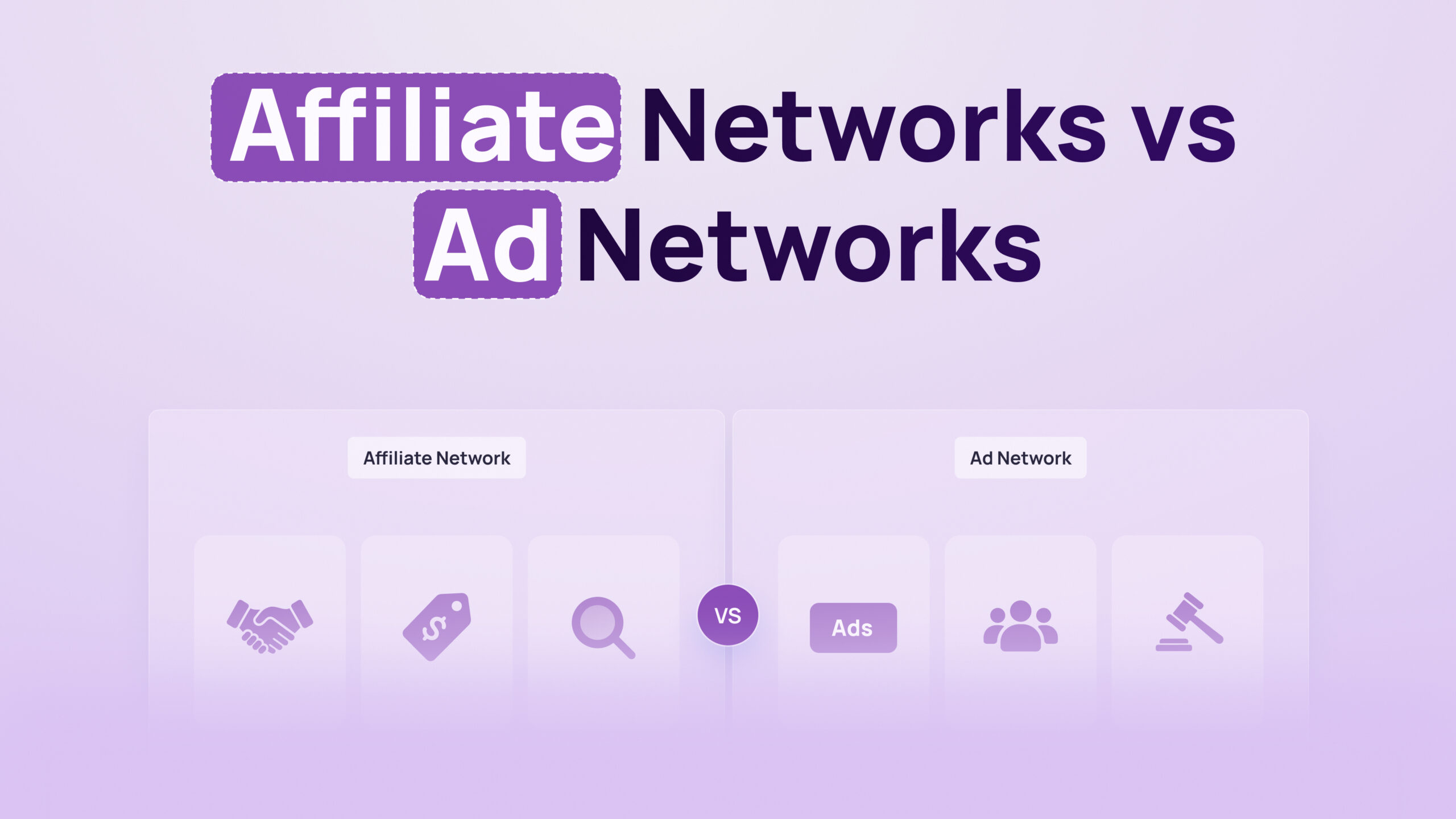
Affiliate marketing networks vs ad networks is not a definitions problem for advertisers. It is a risk-allocation decision: choose affiliate networks when you want outcome-based pricing on a proven offer, ad networks when you need placement control and budget-led scale, and run both only if attribution ownership is already locked.
Let’s break it down.
Affiliate Marketing Networks vs Ad Networks for Advertisers: Which Should You Choose?
Affiliate marketing networks vs ad networks for a CPA goal come down to three variables: risk allocation, control, and scale ceiling. Affiliate networks fit proven funnels where paying only on a lead or sale matters most. Ad networks fit cases where fast launch, tighter placement control, or large volume matters more than front-end efficiency. A hybrid model works when the advertiser tracker decides credit before either channel goes live.
If the offer already converts, affiliate is usually first. If the funnel is still unstable, buying traffic through Google Ads, Meta Ads, TikTok Ads, or a push/pop source is easier to diagnose because you control the media buy directly. If you need both scale and margin protection, split the job: use ad networks for testing and volume, affiliates for incremental CPA supply.
The harder part is not channel choice. It is choosing the variable that will break the model first: payout attractiveness, approval rate, or attribution leakage.
Summary Comparison Table: Affiliate Networks vs Ad Networks
Most advertisers assume the cheaper front-end metric decides this. It usually doesn’t. Net usable conversion cost does.
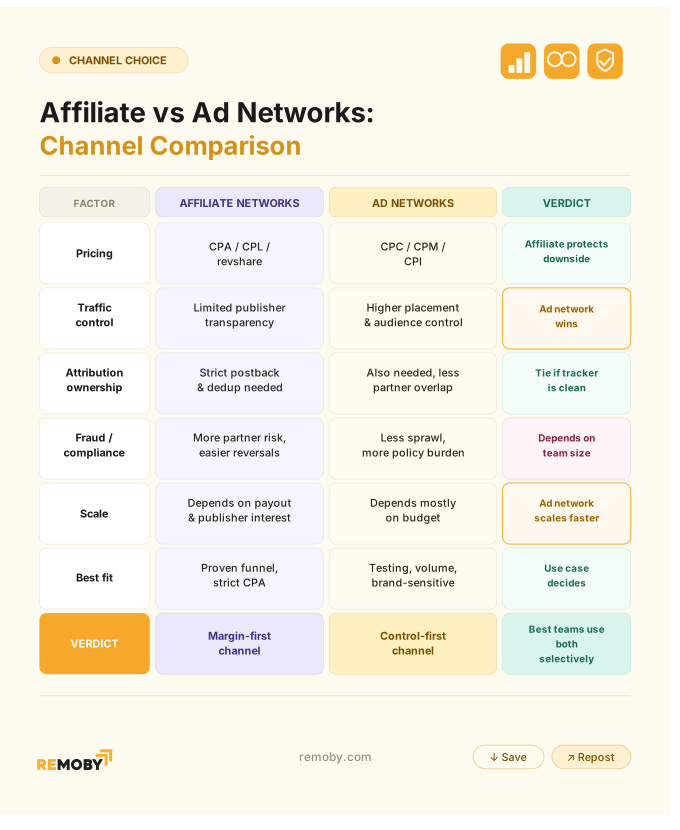
Once the table is clear, the next mistake is assuming both channels are selling the same thing. They are not.
What Affiliate Marketing Networks Are
A failed affiliate test often has nothing to do with traffic quality. The payout was too low, the approval rate was weak, or the offer terms scared off good publishers.
Affiliate marketing networks are a distribution layer for offers, not inventory pipes. Impact, Awin, MaxBounty, and ClickDealer recruit publishers who decide whether your payout, GEO, funnel, and compliance terms are worth promoting. That incentive matters more than the platform logo. An advertiser buying CPL is effectively asking the publisher to absorb media risk first.
I’ve seen affiliate launches stall with a decent funnel because nobody modeled publisher economics from the other side. If EPC is thin after scrub rate, good affiliates never even test it.
The publisher-side view of the same marketplace: CPA affiliate networks – how to choose one.
The offer card looks fine. Is the payout high enough? Is the approval rate real? Which variable actually moves the margin?
What Ad Networks Are
If you need traffic tomorrow, ad networks are usually the cleaner instrument.
Ad networks sell access to inventory and targeting tools, not guaranteed outcomes. Google Ads, Meta Ads, TikTok Ads, and DSP-style buys let the advertiser choose placements, audiences, bid logic, and creative rotation. Push and pop sources such as PropellerAds, Adsterra, and Remoby (we fit CPA-first Tier-2 strategy with direct publisher relationships in pop) sit in the same commercial logic: you buy exposure first, then make the funnel work.
That shifts the burden. The advertiser owns the funnel bundle, the whitelist/blacklist logic, and the optimization cycle.
Buying traffic solves the supply problem fast. It also exposes every weakness in your funnel on day one. Not to fail, follow our “How to choose the right ad network” framework.
Ready to launch with Remoby?
Key Differences in Business Model, Inventory Access, and Incentives
What most people assume is that affiliate networks and ad networks are interchangeable acquisition channels. In practice, they fail for opposite reasons.
Affiliate marketing networks scale when publishers believe the payout can support arbitrage. Ad networks scale when your budget can clear auction prices. Affiliates can send surprising incremental volume in a niche GEO, but source transparency is thinner. Ad networks give cleaner levers on placement and audience, but every bad click lands on your P&L.
Which Channel Gives More Control Over Traffic Sources and Placements?
Traffic-source control is stronger in ad networks because the advertiser usually chooses audiences, placements, bid strategy, and often the exact zone or publisher category. Affiliate networks offer less direct control because publishers decide where and how to promote within program rules. Example: a Google Ads campaign can exclude search terms and placements immediately, while an affiliate offer often relies on network enforcement and partner disclosure after traffic starts.
More control sounds safer. The trade-off is that you also own more of the failure when the CR collapses.
Decision Matrix for Choosing the Right Channel
For a team of one, affiliate is often easier to govern. For a team of five, ad network complexity becomes manageable and sometimes preferable.
Use this order:
- Set the economic target: approved CPL, paid order CPA, or payback window.
- Check funnel maturity: proven CR by GEO and device, or still exploratory.
- Decide control need: strict placement governance or broad publisher reach.
- Estimate scale ceiling: payout attractiveness versus available budget.
This sequence prevents the usual wrong start.
Best Choice for CPA Goals, Fast Launch, and Scale
Affiliate marketing networks become the cleaner choice for CPA goals, fast launch, and scale when the main constraint is risk tolerance, not just volume. Channel choice for CPA goals, fast launch, and scale depends on what constraint is hardest. Affiliate networks fit strict CPA goals because the advertiser buys outcomes. Ad networks fit fast launch and high volume because spend can increase immediately if inventory exists. Example: a saturated app install campaign may get cheaper CPI from affiliates but only 200 installs a day, while an ad network can hold 2,500 installs a day at a workable price (CPI rate benchmarks).
Payout Models and Unit Economics
Payout models differ mainly in where downside risk sits. Affiliate networks use CPA, CPL, and revshare, which push media risk toward the publisher and protect advertiser cash flow if post-click quality holds. Ad networks use CPC, CPM, and CPI, which give more buying control but charge before value is confirmed. Example: CPC works when the funnel converts predictably; CPL works when approval rate is stable after scrubs.
How CPA, CPL, and Revenue Share Shift Risk Compared With CPC and CPM
A flat CPA looks safer until approval rate drops from 80% to 60%. Then the usable lead cost jumps without any visible change in the offer card.
Revshare belongs in a separate bucket. It only works when D30 or D60 retention can compensate for weak front-end cash flow. That is why affiliates willing to take revshare are rarer and usually more selective.
The ad-network side of the pricing menu – CPC vs CPM vs CPA vs SmartCPM – is in ad network pricing models.
Worked Example: When Affiliate Pricing Protects Margin Better and When Ad Network Pricing Wins
Affiliate marketing networks can protect margin better than direct media buying when approval rates hold and payout math stays attractive. In a four-week insurance lead-gen test across three GEOs, affiliate traffic on a $15 CPL produced 1,200 leads on $18,000 spend. After dedup and scrubs, 78% were approved, so net usable lead cost was $19.25. An ad network buy at $1.40 CPC drove 14,000 clicks and 980 leads on $19,600 spend; with 68% approval, net usable lead cost rose to $29.40. Affiliate was 35% better on net cost per usable lead.
The opposite case showed up in app installs: affiliate CPI came in 2x cheaper but capped around 200 installs a day, while the ad network held 2,500 a day at a sustainable CPI. Cheap volume and scalable volume are different products.
If the numbers are close, attribution rules — not pricing model — decide which channel actually looks profitable.
Attribution and Tracking Setup Before Testing Affiliate Networks
Attribution setup before testing affiliate networks needs one canonical tracker, conversion postback or pixel validation, deduplication rules, aligned lookback windows, and coupon logic. Affiliate traffic becomes expensive fast when the same sale is credited twice or when loyalty partners take credit for paid media. Example: many advertisers use Voluum, RedTrack, Binom, or an MMP as the source of truth and reject duplicate conversions at that level.
Checklist: Postback or Pixel Setup, Deduplication, Lookback Windows, and Coupon Rules
Without this setup, both channels can claim the same conversion and you pay for the conflict.
- Make the advertiser tracker or MMP the single source of truth.
- Fire both network pixels/postbacks, but let the tracker assign credit by rule.
- Align lookback windows: 7-day click for ecommerce, 30-day for considered purchases, 24-hour view only if both sides accept it.
- Suppress affiliate-acquired users from ad retargeting for at least 90 days where lifecycle overlap is likely.
- Exclude coupon and loyalty affiliates when a paid ad click exists inside the valid window.
The mistakes, if happen, are expensive. For teams running affiliate marketing networks alongside paid media, affiliate tracking software and conversion deduplication guidance is a must-have.
Fraud, Compliance, Source Transparency, and Brand-Safety Tradeoffs
Risk profile is usually higher in affiliate networks for source manipulation and cheaper lead gaming, but easier to reverse when network terms are strict. Ad networks often carry lower partner-level fraud exposure, yet the compliance burden is heavier because creative approvals, brand safety, and IVT filtering sit more directly with the advertiser. Example: one analyst can often manage 5-10 affiliate programs deeply, but only 2-3 ad network accounts with the same governance depth (representative practitioner example). For affiliate marketing networks, affiliate fraud patterns and prevention deserve active monitoring, not a one-time review.
When Affiliate Networks Are the Better Choice
If you already know the funnel converts, affiliate usually wins first on economics.
Best Fits: E-commerce Acquisition, Lead Gen, and Margin-Protected Performance Campaigns
E-commerce with a stable checkout, lead gen with a hard CPL ceiling, and finance or iGaming offers with clear payout math are strong affiliate fits. The publisher absorbs testing risk, and the advertiser can scale payout before scaling budget. That works especially well when approval and scrub logic are tight.
The catch is that affiliate scale is never yours by default. Publishers have to want your offer more than the next one in their rotation.
When Ad Networks Are the Better Choice
Ad networks outperform affiliate channels for growth campaigns when budget, not payout attractiveness, is the main constraint. They are stronger for rapid traffic expansion, richer audience targeting, and campaigns where placement control or creative consistency matters. Example: brand-sensitive launches, large app install pushes, and new funnels with unstable CR usually benefit from direct media buying before affiliate recruitment starts.
Best Fits: App Installs, New-Offer Testing, Brand-Sensitive Campaigns, and Budget-Led Scaling
New-offer testing belongs here because one controlled media buy tells you whether the funnel is broken before ten affiliates each send noisy traffic. Brand-sensitive campaigns also fit ad networks better because creative use, placement categories, and policy enforcement are easier to police.
Using Affiliate Networks and Ad Networks Together Without Attribution Conflict
Hybrid deployment works when each channel has a job and the tracker enforces credit rules. Affiliate networks can own margin-protected acquisition, while ad networks handle testing, retargeting, or budget-led scale. Example: an advertiser can reserve prospecting in a new GEO for Meta Ads or push traffic, then open the proven funnel to affiliates after approval rate and EPC are validated.
Operational Hybrid Rules: Single Source of Truth, Deduplication Logic, Suppression Windows, and Reporting Ownership
Most teams skip this conversation and then wonder why reported ROAS looks better than actual margin.
Use one tracker, one dedup policy, and one reporting owner. Network dashboards are inputs, not truth. Put coupon exclusions in the IO, apply suppression windows, and define last-click exceptions before launch.
If two channels can claim the same user journey, they eventually will.
Ready to launch with Remoby?
FAQ: Affiliate Marketing Networks vs Ad Networks
Top-3 questions on affiliate marketing networks vs ad networks
Affiliate networks sell outcomes through publishers; ad networks sell traffic and placements. One is payout-led, the other inventory-led. For advertisers, that means affiliate buys protect cash flow better, while ad network buys offer stronger control over zone quality, audiences, and creative use.
Neither is better in every case. Affiliate wins when margin protection and CPA discipline matter most. Ad networks win when you need fast testing, larger volume, or tighter control. The better channel depends on funnel maturity, approval rate, and how much governance your team can absorb.
Use affiliate networks when the offer is proven, the payout supports publisher arbitrage, and you want to pay after the conversion instead of before. If the funnel is still unstable, or compliance and placement control are the main risk, direct media buying usually gives cleaner signals first.