Updated: July 13, 2026
|
10 min read
Updated: July 13, 2026
|
10 min read
CPA affiliate networks: how to choose the right one for your traffic

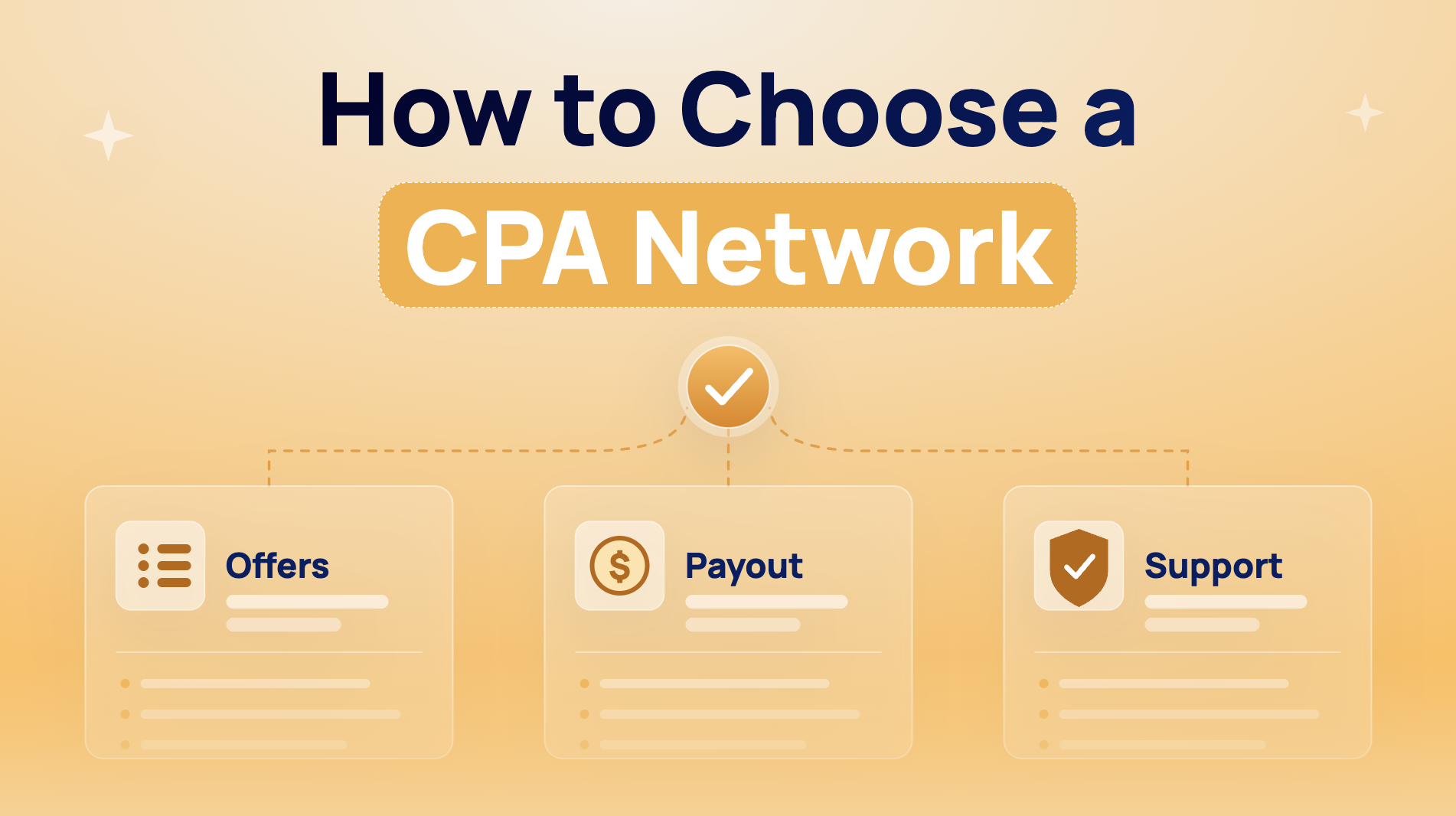
The network with the highest headline payout is often the one that hurts your cash flow fastest. With CPA affiliate networks, the real question is not who pays more on the card. It is which network still pays, tracks, and approves cleanly after your traffic source starts spending real money.
What a CPA affiliate network is – and what it is not
CPA affiliate network is a marketplace that connects advertisers with affiliates who get paid for completed actions such as leads, sales, deposits, or installs. The network tracks conversions, manages payouts, enforces offer terms, and sits between both sides as the commercial middle layer. Unlike a single in-house program, it pools many offers in one place and handles attribution and payment operations.
That distinction matters because affiliates routinely mix up four separate tools and make the wrong decision before they even launch. Check out 4 players in an affiliate stack:

You need both sides of the workflow. A network gives you the offer. A traffic source gives you the volume. If you pick an iGaming offer inside a CPA network, then buy push or pop traffic from a source such as Remoby, those are two different decisions.
One more distinction is worth keeping tight. CPA is the payment model umbrella. Within it, you will see CPL for a lead, CPS for a sale, and deposit-based actions in verticals like iGaming. The payout label changes the approval logic, which changes your risk.
The front-end offer list is clear now. The harder part is that two networks with the same offer can still be completely different businesses once traffic hits them.
There is no single best CPA affiliate network
The fastest way to pick badly is to search for a universal winner. There isn’t one.
A network that works for SEO traffic on Finance in Tier 1 can be weak for push traffic on Social in Tier 3. The variable that flips the answer is fit: vertical, GEO, traffic type, and how the offer approves. That is why generic “best CPA network” listicles are usually less useful than they look.
I’ve seen affiliates join a respected network, load a clean pop whitelist, and still lose money because the offer mix was built for PPC and content traffic, not interrupt traffic. The brand was fine. The fit was wrong.
Traffic source changes EPC and CR more than most offer cards suggest. In benchmarks, iGaming on pop often lands around 0.5% to 2% CR and $0.02 to $0.08 EPC, while SEO on commercial-intent queries can reach 5% to 15% CR and $0.25 to $1.50 EPC. The same pattern shows up in Social and Finance. SEO usually outperforms pop and push on intent-heavy queries. Tier-2 and Tier-3 can widen EPC if CPM stays low enough, but only if approval holds do not eat the gain.
That is the tension running through the whole decision. A “better” network on paper is often worse for your traffic.
The fit problem gets more specific once you stop judging networks in the abstract and start judging them by the clicks you actually buy.
How to choose the right CPA affiliate network for your traffic source
Traffic-source fit starts with matching your acquisition channel to the network’s offer style, approval logic, and reporting depth. SEO affiliates need content-friendly offers and longer attribution windows; PPC buyers need redirect-safe tracking and clear compliance rules; push and native buyers need volume-tolerant offers, smartlinks when suitable, and sub-ID reporting; email buyers need lead-gen flows with stable approval rates. Then check hold terms, scrub behavior, and affiliate manager (we call them AM for short) responsiveness before spending.
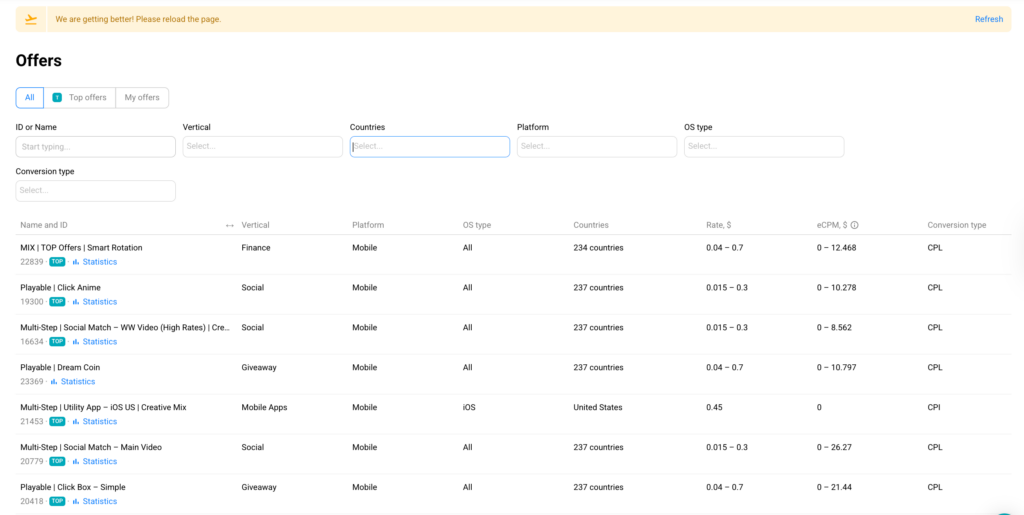
The cleanest way to choose is this:
- Start with your traffic constraints. Pop ad networks usually provide traffic that doesn’t match with all the CPA networks. Google Ads and Meta Ads traffic needs strict policy clarity, landing-page compliance, and confirmation that the network accepts those lead sources. For Facebook traffic especially, confirm they accept FB-sourced leads without requiring pixel-verified events if that is not part of your setup (most teams learn this after the rejection).
- Match traffic temperature to offer friction. Push, pop traffic, and broad native traffic do better with shorter funnels, softer conversions, or smartlink routing. FTD-heavy iGaming from pop alone is rarely efficient without CRM or retargeting to close (worth modeling before the first deposit target).
- Check reporting granularity. Pop traffic needs zone-level sub-ID reporting. Native and push need source, creative, and placement visibility. If the network cannot return enough data to build a blacklist or whitelist, you are buying blind.
- Confirm scale tolerance. Ask for cap figures, approval policy, and whether the advertiser is comfortable with your source. A network that loves your first 20 leads but freezes at 200 is not ready for your traffic pour.
For buyers running push and pop, that usually means preferring networks with broad Tier-2/Tier-3 availability, fast feedback loops, and sub-ID visibility. After the network decision, traffic can come from sources like Remoby for those GEOs, or from PropellerAds depending on format and volume.
The order matters. Offer first, click source second.
A network can match your traffic perfectly and still be unworkable if the economics behind the payout are wrong.
What metrics and payment terms to compare before joining
Pre-join metrics are payout, EPC, CR, approval rate, scrub rate, cap size, payment frequency, minimum threshold, and hold length (check our Affiliate marketing statistics blog for more). Payout alone is the least reliable number in the group. EPC and CR tell you if the funnel converts, approval rate tells you how much survives validation, scrub rate shows how much gets rejected, and payment terms tell you whether your cash flow survives long enough to scale.
Start the comparison from the cash-flow side, not the shiny side. Many networks pay net-30, and some move to weekly payouts only after you prove volume. If a network is net-30 with a high threshold and vague quality holds, you are funding its risk with your bankroll.
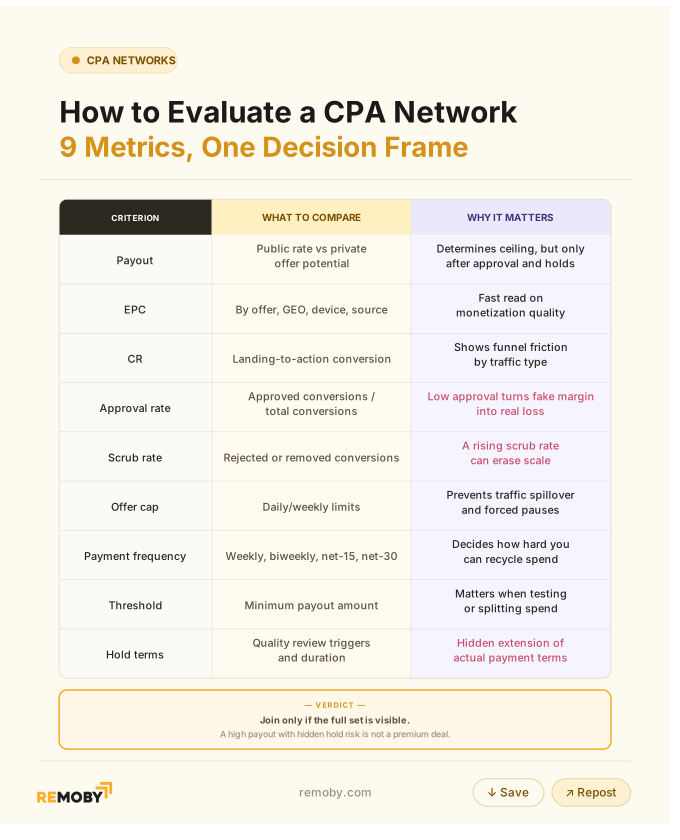
The phrase highest paying CPA networks payout terms hold sounds like one question, but it is really three. High payout with bad approval is fake. Fast payment with constant scrub is fake. Low payout with weekly clean settlements can be the better deal because payback is shorter.
I watched a Finance lead-gen campaign scale to $300 per day on paper profit, then stall because the network opened a quality review at the first payment date and held the full month beyond terms. The campaign was fine, unlike the cash flow. (the math changes here, and not in your favor)
Treat any network that cannot define what triggers a quality hold as net-45 by default, even if the contract says net-30.
And do not scale until one full payment cycle clears cleanly. That one rule prevents a lot of expensive confidence.
Once the economics pass, the next failure point is operational: whether your tracker, the network, and the affiliate manager can support the way you actually buy traffic.
Tracking, approvals, and affiliate manager quality: the operational fit check
Affiliate manager questions should test four things before approval: whether the network supports your tracker stack, how approvals and holds work, what caps apply, and whether the affiliate manager can actually move terms. Ask if they support S2S postbacks with Voluum, Binom, or Keitaro, whether click IDs are returned in postback, what macros are available, how often stats update, and what triggers quality holds or scrub reviews.
S2S postback compatibility is not a nice extra. It is the minimum. If the network cannot pass back your click ID, you cannot trust source-level data, zone pruning, or payout reconciliation. Tracking setup is a larger subject, and it belongs in the affiliate tracking software cluster elsewhere on the blog, but the yes-or-no decision here is simple: no reliable postback setup, no campaign.
Then ask the AM these questions before you apply or before you scale:
- What traffic sources are accepted for this offer, specifically?
- What is the approval process, and what gets scrubbed?
- What triggers a quality hold, and how long can it last?
- What are the current caps by GEO and device?
- Do you support S2S postback with returned click ID and flexible macros?
- Can I get zone or sub-ID level reporting?
- When do proven affiliates get weekly or net-15 terms?
- Are private offers or payout bumps available after clean volume?
Good AMs answer with specifics. Weak AMs give generic comfort. Risky AMs go vague on scrub and holds.
“Case by case” is often more informative than any polished sales line. So is “standard, don’t worry.”
I’ve seen rev-share style operator deals fail for less than this, and CPA networks are no different: the non-answer is usually the answer. (model it before the call, not after)
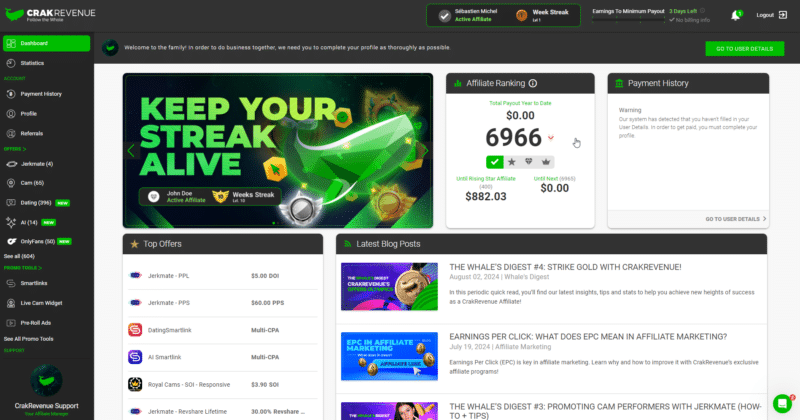
If you are evaluating networks specifically for email submit offers with tight approval rate requirements, this is where the answer actually lives. Not in the directory listing. In whether the network can explain approval logic before your first lead fires.
The AM can sound competent and the tracking can be clean. You still have to answer the harder question:
Should this network be trusted with your receivable at all?
How to verify legitimacy and score a CPA network before you join
Legitimacy checks start with independent payment history, clear terms, and tracking transparency. Check recent payment proofs and dispute threads in STM Forum, AffLift, AffiliateFix, BlackHatWorld, and Affpaying before signup. Reject networks that ask for activation fees, hide hold terms, refuse postback transparency, promise above-market payouts without evidence, or have no traceable AM presence in affiliate communities.
The first signal is not the sales deck.
It is payment history from the last six months across communities. That outweighs branding every time.
Use this pre-signup checklist:
- Search payment history in STM Forum, AffLift, AffiliateFix, BlackHatWorld, and Affpaying. Look for recent posts, not a five-year-old reputation.
- Read Terms of Service for hold language, prohibited traffic, chargeback logic, and dispute timelines.
- Test AM responsiveness with concrete questions on source acceptance, caps, scrub policy, and postback support.
- Verify technical transparency by confirming S2S postback, click ID return, raw conversion data access, and reporting latency.
- Ask for hold triggers in writing and confirm when weekly or net-15 is possible.
- Run a scored trial before scaling. One payment cycle first.
A weighted scoring matrix works better than gut feel:
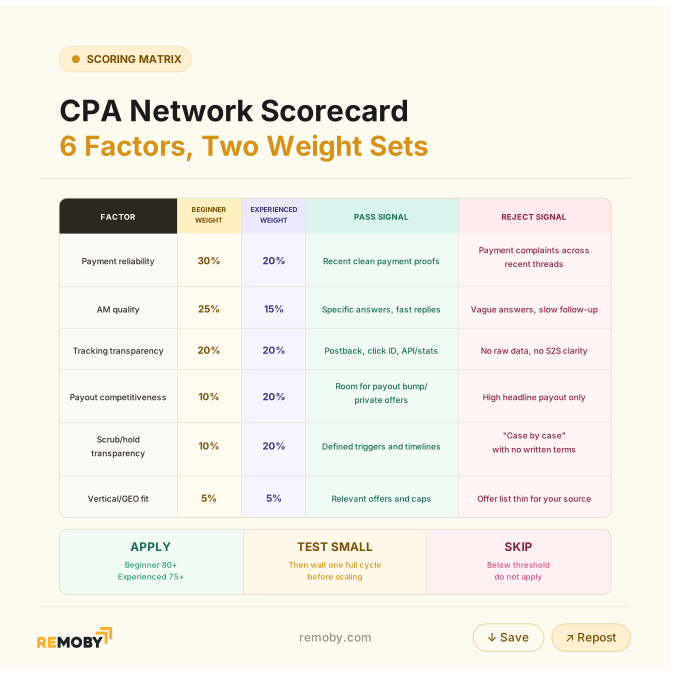
Two red flags deserve a hard stop. First, payouts that sit noticeably above market for the same offer. Second, networks that want an activation fee. Legitimate CPA networks do not charge affiliates to join.
If a network passes the scorecard, you still have one model choice left that beginners often skip: network first, or direct advertiser now.
CPA network vs in-house affiliate program: which model fits your stage
Most beginners should start with a CPA network. The reason is not brand safety but testing flexibility. Networks give you access to multiple offers, handle advertiser credit risk, and let you rotate verticals without renegotiating terms each time. If one offer scrubs badly, you switch. If a GEO goes cold, you pull back without putting a direct relationship at risk.
The case for going direct flips once two conditions are met: consistent volume the advertiser can verify, and margin that a network’s override is visibly eating. Around $5,000 to $10,000 per month in verified spend or consistent FTD volume, the conversation with an advertiser becomes a different one. You are not asking for an offer. You are bringing a number they can price against.
Direct programs give better payout floors, tighter feedback loops, and fewer intermediary hands on the scrub logic. The trade-off is full credit risk. If the advertiser holds, disputes, or disappears, there is no network layer absorbing it. And exclusive direct deals still require tracking infrastructure you control completely.
The honest frame: a network is a training environment with a commercial cost. The override the network takes is the fee for offer access, payment float, and dispute buffering. When your volume justifies removing that cost, go direct. Until then, the cost is probably worth it.
FAQ for choosing a CPA affiliate network
Best CPA networks do not exist as a universal list because fit depends on vertical, GEO, traffic source, and the way offers approve. A beginner running push on Tier-3 iGaming needs different network traits than an SEO affiliate ranking Finance content in Tier 1. Judge the network by payment history, AM quality, tracking fit, and hold logic, not by brand popularity alone.
$10,000 a month with affiliate marketing is possible (even though I've never seen an affiliate like this), but the path depends on margin, payback window, and scale discipline rather than headline EPC alone. The faster route is usually stable traffic plus repeatable offers, not one breakout campaign. If your network is net-30, caps hard, or scrubs heavily, revenue can look large while cash flow stays fragile.
CPA affiliate marketing is worth it when the network pays predictably, accepts your traffic source, and gives you enough data to control ROI. For beginners, networks usually make more sense than going direct because they provide testing flexibility and take advertiser credit risk. Around $5,000 to $10,000 per month in spend or consistent FTD volume, direct advertiser relationships start to make sense, but only when leverage is real.