March 31, 2026
|
12 min read
March 31, 2026
|
12 min read
Is Pop Traffic Profitable for Affiliate Marketing?

Pop traffic for affiliate marketing works when the offer can survive cheap but noisy volume, and fails fast when you send broad RON traffic into a weak funnel with no source discipline.
Is pop traffic profitable for affiliate marketing?
Pop traffic is profitable for affiliate marketing when the offer has low friction, the funnel is short, and the payout leaves room for volatile source quality. Pop works best for giveaway, utilities, app install, mVAS, and some iGaming or finance angles in Tier-2 and Tier-3 GEOs. Pop might not be a good fit for trust-heavy, research-heavy, or tightly restricted offers. For most buyers, the real question is fit, not format.
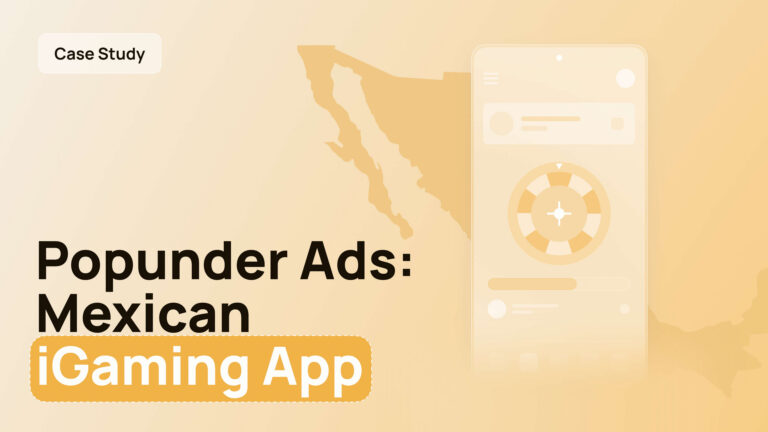
Test pops only when the math and the funnel both support impulse traffic. See how a Remoby’s client managed to build the right funnel for his app in Mexico.
What pop traffic means in affiliate buying
In buying terms, most affiliates mean popunder or on-click inventory when they say pops. Network naming varies, so check the actual source behavior inside PropellerAds (performance ad network with pop and push formats), PopAds (self-serve pop traffic network), or Clickadu (multi-format traffic source). A popunder gives you raw visit volume. An on-click source often behaves even colder. Treat them as discovery traffic, not intent traffic.
Signals that pop traffic is a viable test channel
If your offer already converts from broad traffic, you have a chance. Good signs include a single-step or short two-step flow, low approval friction, mobile-friendly lander speed, and a payout that can absorb variance. Tier-3 pop CPMs often land around $0.30–$0.80 and Tier-2 around $0.80–$1.80 (industry benchmark). That cost base can work if the funnel turns quickly.
A non-obvious positive signal is strong prelander LP CTR. On pop, a good angle often matters more than pixel-perfect targeting.
When pop traffic is a poor fit for an affiliate campaign
Pop traffic is a poor fit when the offer needs trust, long-form education, or strict compliance alignment. What goes wrong first is usually not traffic quality — it is offer mismatch. Pop burns budget on offers that need education, trust, or strict brand alignment. If the advertiser forbids click-under placements, if the redirect chain is messy, or if KYC-heavy finance leads choke after the front end, stop before launch. Examples include long finance forms, brand-sensitive subscriptions, and any offer with restricted traffic-source clauses.
Known failure mode: buyers blame bad zones when the real problem is a long funnel with weak message match. That happens a lot.
What affiliate offers work best with pop traffic?
Affiliate offers that work best with pop traffic are low-intent, low-friction offers with clear value in one screen. Giveaway SOI, VPN, antivirus, app installs, mVAS, and selected iGaming or finance lead flows are the usual fits. Pre-landers are close to mandatory for iGaming, finance, VPN, and nutra-style health offers, while direct link works only on very simple actions.
Short flows and strong hooks beat “better” offers with too much friction.
Offer traits that usually survive pop traffic economics
Most people assume high payout means better fit. Reality is harsher. Offers that survive pops usually fall into one of two profiles: very simple conversions at modest payout, or higher payouts with a prelander that qualifies traffic hard. Giveaway SOI in Tier-3 runs roughly 1–3% CVR and VPN/antivirus in Tier-2 roughly 0.3–0.8% CVR (industry benchmark).
Profile traits that help:
| Trait | Good fit on pops | Bad fit on pops |
|---|---|---|
| Conversion action | SOI, app install, short registration | Long lead form, sales call |
| User intent needed | Low to moderate | High |
| Funnel length | 1–2 steps | 3+ steps |
| Compliance sensitivity | Moderate | High |
| Payout tolerance | Enough to absorb traffic variance | Too thin for testing and optimization |
| Verdict | Testable and scalable with iteration | Usually not viable |
Funnel types: direct link vs pre-lander vs multi-step flow
If you direct link everything, you will misread the channel. On pops, direct link works for store redirects, brand-recognizable giveaway flows, and some carrier billing. For most other offers, use a prelander. Finance quiz or advertorial pre-landers can lift CVR by 1.5–3x, and broader prelander lift ranges run from 30% to 200%+ by vertical (industry benchmark).
Multi-step flows are hardest to keep profitable because every extra click leaks traffic. On cold zones, leak kills the campaign before the bid matters.
Offer-fit matrix by payout, conversion action, and user intent
Use this before you buy a single impression.
| Offer profile | Payout | Conversion action | Intent needed | Funnel recommendation | Pop verdict |
|---|---|---|---|---|---|
| Giveaway SOI Tier-3 | Low–mid | Email submit (SOI) | Low | Direct or short prelander | Strong test |
| VPN / antivirus Tier-2 | Mid | Install or trial | Moderate | Prelander recommended | Strong test |
| App install to store | Mid | App install | Low | Direct link | Strong test |
| iGaming reg/FTD | Mid–high | Registration + deposit | Moderate | Prelander required | Conditional (depends on GEO + compliance) |
| Finance lead with KYC | Mid–high | Long lead form | High | Prelander required | Borderline (tight optimization needed) |
| Brand-sensitive subscription | Mid | Subscription | High | Avoid | Poor fit |
| Verdict | Use pops where speed and volume outperform trust-building |
Economics of pop traffic: break-even CPA, payout thresholds, and conversion assumptions
Most buyers lose on pops before they lose on creative. They launch offers that need a heroic CVR to break even. Start with the back-end math, not the traffic source.
If the required conversion rate looks unrealistic, do not launch.
A simple break-even formula for affiliate pop traffic tests
Use this sequence:
- Take your payout.
- Adjust it for approval rate and shave risk.
- Estimate visits you can buy from CPM.
- Calculate required CVR to hit break-even.
Formula:
Break-even CPA = effective payout. And required CVR = cost per visit / effective payout.
Required CVR tells you if the channel is even worth a test.
Example: a Tier-2 campaign at a $1.20 CPM gives a cost per visit of about $0.0012 if each impression becomes one visit by format behavior. A $2 effective payout needs roughly 0.06% CVR to break even. A $0.40 effective payout needs roughly 0.30% CVR. The second offer sounds cheap, but it is often harder to make work after shave and source variance (worth modeling before you commit).
How low payouts, EPC, and CVR affect test viability
What most people assume: low payout offers are safer because the front-end event is easier. Reality: low payouts force near-perfect source quality. If your EPC from similar traffic is weak, pops expose that weakness fast. A top zone can convert 5x the average. Average EPC hides the real picture.
Zone-level variance matters more than blended CR in the first 48 hours.
How to decide if an offer can tolerate pop traffic costs before launch
Use a basic gate before launch:
- Confirm allowed traffic sources with the affiliate network and advertiser.
- Estimate effective payout after approval and reversal risk.
- Map the funnel length and decide on direct link or prelander.
- Set a zone cut threshold at 2x target CPA with zero conversions.
- Confirm the GEO fits pop CPM realities.
Kill bad economics before they become bad spend.
How do you start testing pop traffic for an affiliate offer?
Pop traffic testing starts with one allowed offer, one GEO, one tracker, and one clean funnel. Set up source IDs and postback in Voluum (affiliate tracking platform), Binom (self-hosted tracker), RedTrack (tracking and attribution platform), or Keitaro (self-hosted tracker). Launch broad on one network, use frequency cap 1/24h during the test phase, and cut zones after they spend past your rule without conversions.
One offer, one GEO, clean tracking, small controlled burn.
Minimum viable tracking setup: tracker, postback, tokens, and source IDs
If you cannot see zone, device, OS, and source ID, you are not testing. You are donating. Pass tokens from the source, fire postback on conversion, and keep the redirect chain short. Most teams overbuild this part (yes, again). You do not need fancy automation on day one. You need reliable attribution.
Minimum fields to capture:
- Campaign ID
- Zone or placement ID
- GEO
- Device and OS
- Landing variant
- Offer ID
No source ID, no meaningful blacklist or whitelist.
Landing approach: when to direct link and when to use a pre-lander
Treating prelanders as optional is the common mistake. For iGaming, finance, VPN, and health offers, the prelander is non-negotiable. For app installs, direct-to-store can still work. A Remoby (push and pop network with direct publisher relationships in Tier-2 and Tier-3 GEOs) style buy is usually CPA-first in Tier-2 when the flow is short and the offer team confirms the source is allowed.
Use direct link when the action is obvious. Use a prelander when the user needs warming or filtering.
Starting bids, GEO and device targeting, frequency caps, and placement depth
Start broad, not blind. Run 1 GEO = 1 campaign, mobile first where the offer supports it, and frequency cap at 1/24h during testing (industry benchmark). Launch run of network, then tune bids by zone. Tier-3 is where pops often win on CPM efficiency and volume. Tier-1 can still work, but the funnel has to be cleaner and the payout stronger.
Bad early move: stacking GEO, OS, carrier, browser, and placement filters before you know what converts. You choke discovery and get false negatives.
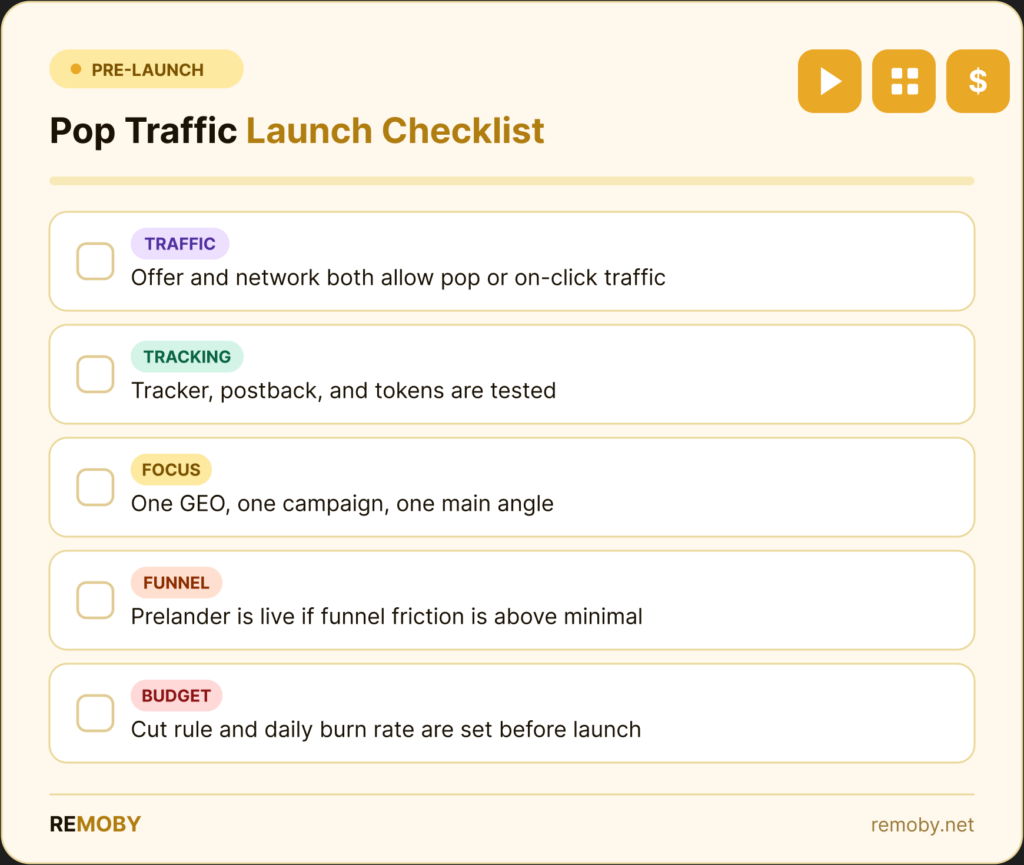
Test budget logic and launch checklist for a controlled first campaign
A controlled first test is not “set $50 and pray.” A 7–14 day cycle on roughly $300–$500 gives a usable whitelist build (industry benchmark). At the source level, spend 1–4 payouts per zone before deciding, with the higher multiple for low-payout offers (industry benchmark).
Launch checklist:
Traffic quality, fraud controls, and compliance risks in pop traffic campaigns
The biggest mistake is blaming “fraud” for every bad result. Pop quality varies hard by zone, but most losses come from poor source control, weak funnel match, or launching on offers that never allowed the traffic in the first place.
Traffic quality is manageable. Compliance mistakes are more expensive.
How to assess source quality before spending heavily
If you are buying from Adsterra (self-serve and managed traffic network), HilltopAds (performance traffic source), or Galaksion (pop-focused ad network), look for source transparency first. You want zone IDs, device splits, OS data, and enough reporting depth to see variance. Early warning signs include lots of spend from a small cluster of zones, near-zero downstream events, or source patterns that collapse after the first redirect.
A useful practitioner check: compare front-end CR with downstream quality. Cheap registrations that never reach the real KPI are not wins.
Whitelist and blacklist workflow for filtering low-quality placements
50–100 zones is a normal starting sample before a useful whitelist forms. Only 5–15% often survive into scale (industry benchmark). Blacklist any zone that spends 2x CPA target with zero conversions, then revisit only if the lander changed materially. One affLIFT case study moved to a single whitelist campaign by day 3 after broad testing (affLIFT case study).
Workflow:
- Launch on RON.
- Let zones spend to your preset threshold.
- Blacklist clear losers.
- Isolate surviving zones into a whitelist campaign.
- Raise bids only on proven zones.
Whitelist building saves more money than bid tuning alone.
Affiliate network and advertiser policy checks before launch
Ignoring source restrictions is what breaks campaigns fastest. MaxBounty (affiliate network) and ClickDealer (global performance marketing network) are examples of networks where finance, pharma-style health, and subscription offers often restrict pop or require opted-in traffic only. Read the allowed traffic source field in the dashboard, ask the AM directly, and document the answer.
Also check claims, disclosures, and cloaking risks. If your setup needs hiding to run, the deal is already wrong. The FTC’s notices on money-making opportunity claims are a useful reminder that compliance risk is real, especially around aggressive earnings-style angles.
Optimization workflow: what to measure, cut and scale
Pop optimization is mostly subtraction. You find winning zones, protect them, and stop feeding everything else.
Cut faster than you scale.
First metrics to watch: spend, LP CTR, CVR, CPA, ROI, and source-level variance
In pops, CTR is not the lead story — use LP CTR and downstream events as proxy signals. Watch spend, LP CTR, CVR, CPA, ROI, and variance by zone. If the lander gets clicks but the offer page dies, the problem is offer match or redirect friction. If nothing clicks through, the angle or prelander is weak.
Do not judge by campaign average. Judge by source spread.
Cut rules for placements, zones, devices, and landing variants
Most people wait too long because they want statistical comfort. Pops punish patience. Start with the rule of 2x target CPA with zero conversions for blacklist decisions. Cut landing variants with weak LP CTR early. Cut devices or OS buckets only after you see repeated underperformance across enough zones.
Known failure mode: blacklisting half the campaign when one broken prelander caused the loss (this is where most teams stop checking).
Scale rules: when to raise bids, expand sources, or build a whitelist
Scale only after you have stable survivors. Raise bids on zones that hold CPA after volume increases. Expand into nearby GEOs after one GEO is profitable. Duplicate the whitelist before testing a new angle so you do not contaminate clean readouts. Most platforms let whitelists propagate across campaigns instantly, which makes controlled scaling much cleaner (industry benchmark).
Pop traffic vs other paid traffic sources for affiliate campaigns
Most buyers think channel choice is about cost. It is really about user state. Pops give you fast volume and broad GEO reach. Push gives you stronger prior intent. Native buys you narrative space. Search gives explicit demand, and social gives creative leverage with more policy pressure.
Choose the channel that matches how much explanation your offer needs.
Comparison table: pop traffic vs push, native, search, and social
| Channel | User state | Speed to volume | Funnel dependency | Compliance sensitivity | Best fits |
|---|---|---|---|---|---|
| Pop | Cold, interruptive | Very fast | High | Medium–high | Giveaway, mVAS, app installs, selective iGaming |
| Push | Opted-in, moderate intent | Fast | Medium | Medium | Utilities, VPN, health, light finance |
| Native | Browsing, content-driven | Medium | Very high | Medium | Advertorial-led finance, health, nutra |
| Search | Explicit intent, query-driven | Slow–medium | Lower | High | High-intent leads, brand-safe offers |
| Social | Discovery with targeting | Fast–medium | High | Very high | Strong hooks, broad funnels, DTC |
When pop traffic is the better first test and when it is not
If you need fast data in Tier-2 or Tier-3, pops are often the better first test. If you need audience intent, search or push is usually the cleaner first read. Pop wins on volume, CPM efficiency, and GEO breadth; push usually converts better on moderate-intent utilities and health angles.
Use pops first when the offer is short, broad, and payout-tolerant. Skip pops first when policy risk or trust-building dominates.
For bigger context on channel economics and the broader ad market, the IAB Internet Advertising Revenue Report is useful background, and for broader industry context the affiliate marketing statistics roundup helps frame how affiliates think about channel testing and scale.
Contact us to start with Remoby
FAQ: Pop Traffic for Affiliate Marketers
Here're top questions related to Pop Traffic for Affiliate Marketers topic
Pop traffic is good for affiliate marketing under specific conditions: low-friction offer, short funnel, and a payout that can absorb source variance. It is not a general-purpose channel. Giveaway SOI, app installs, VPN, mVAS, and selective iGaming or finance flows in Tier-2 and Tier-3 GEOs are the reliable fits. For trust-heavy or compliance-sensitive offers, pop is usually the wrong choice regardless of CPM.
Pop is a poor fit when the offer needs trust, long-form education, or strict compliance. Examples include long finance forms, brand-sensitive subscriptions, and any offer with restricted traffic-source clauses.
Prelanders usually win unless the action is extremely simple. Direct link is best for store installs, some giveaway flows, and clear mobile billing offers. Multi-step flows leak too much volume.
Only if the conversion is very easy and the GEO is cheap. Low payout offers need stronger CVR and tighter zone control, so they are often less forgiving than they look. Run the break-even CVR calculation before committing budget: required CVR = cost per visit / effective payout. If that number looks unrealistic for the vertical, skip the test.
One offer, one GEO, mobile-first if relevant, tracker with zone tokens and postback, prelander if the offer has any friction, frequency cap 1/24h, $300–$500 test budget over 7–14 days, and blacklist any zone at 2x target CPA with zero conversions. Spend 1–4 payouts per zone before deciding. No source ID means no actionable data.
Look for weak downstream quality, not only weak front-end events. Bad sources often show broad spend concentration in a small cluster of zones, low LP CTR, and no progression past the first conversion step. Compare front-end CR with downstream KPI reach. If cheap events never convert further, the source quality — not the offer — is the problem.
Start with zone-level spend, LP CTR, CVR, CPA, and downstream quality events. Campaign averages hide the winners and losers. In the first 48 hours, zone-level variance matters more than blended conversion rate.
Pop is better for fast discovery and cheap reach in Tier-2 and Tier-3. Push is better when moderate intent matters — utilities, VPN, and some health angles typically perform more cleanly on push. If the offer needs warming but not a full narrative, push often gives a cleaner first test. If the offer is short, broad, and payout-tolerant, pop is usually faster and cheaper to learn from.