Updated: July 28, 2026
|
11 min read
Updated: July 28, 2026
|
11 min read
How to Increase Brand Awareness in a New Geo with Pop Traffic

Most new-GEO launches die at the same spot. Not in targeting, not in creative — in the half-second where a user decides whether the brand name means anything. In a fresh market, it usually means nothing for users.
If you’re figuring out how to increase brand awareness in a new GEO, pop traffic can work as a cheap preheat layer before you ask cold users to convert.
How pop traffic increases brand awareness in a new GEO
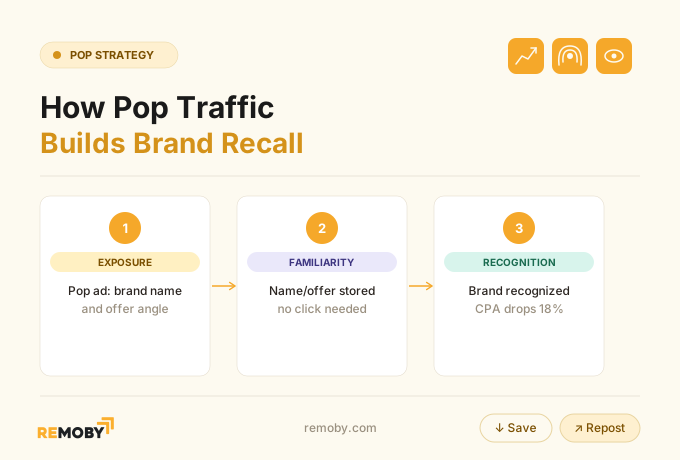
Pop traffic increases brand awareness in a new geo by buying cheap reach before the conversion push starts. The goal is repeated exposure to the brand name, offer angle, and landing experience so later push, native, or display campaigns feel less random to the user. In practice, a 5-10 day awareness flight can preheat a GEO, then improve CTR, CVR, and CPA on follow-up campaigns.
That only works if you treat pops like a preconditioning layer, not a direct-response shortcut. Blind traffic sent to a hard registration lander teaches you nothing except how fast a budget burns.
The mechanism is simple enough to test. Users see the brand once or twice, then later recognize the name in a push ad or native widget and hesitate less on the lander. Dynata’s brand lift framework and Built In’s overview of brand awareness metrics both support the general pattern that familiarity raises response and recall, even if they are not pop-specific.
I’ve seen this look fake in reporting and real in the tracker. The pop campaign itself looked useless, until the follow-up performance campaign came in 18% cheaper three days later. However, the cheap reach is the easy part. Proving it changed later traffic costs is where the real work starts.
Summary box: top answers on use case, CPA impact, and proof of lift
Most buyers assume awareness is fluffy. In a new GEO, it is often the only reason your later CPA is not inflated by pure cold traffic.
- Use case: Pop works when you need cheap reach, fast coverage, and enough volume to prime the funnel before a push or native test.
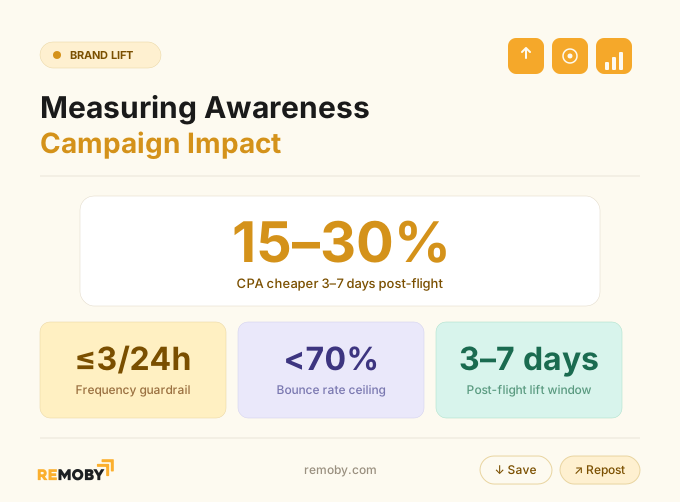
- CPA impact: 5-10 days of pop awareness often leads to 15-30% lower CPA and 10-20% CVR lift on later campaigns in Tier-2/3 betting and finance offers.
- Proof of lift: Look for branded search growth, direct traffic lift, better downstream CTR/CVR, and a cleaner CPA trend versus baseline or holdout.
When pop traffic is a valid awareness channel for entering a new geography
Pop traffic is a valid awareness channel for entering a new geography when cheap reach matters more than immediate conversion intent. The format fits unproven markets where the brand has near-zero recognition, the budget is too small for paid social reach, and the buyer needs frequency and coverage data fast. A valid test usually means controlled frequency, localized messaging, and clean placements rather than raw run-of-network volume.
Three conditions make it worth testing.
- You have a cold market. The lift is strongest when users have never seen the brand before.
- Your follow-up channel is ready. Awareness without a later push, native, or search capture step is half a test.
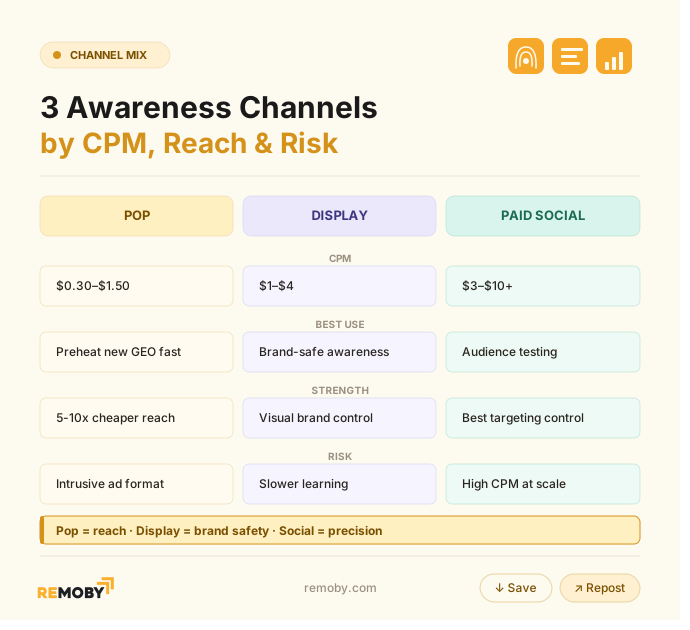
- You need reach on a small budget. Pop CPM in new GEOs often lands around $0.30-$1.50, versus $1-$4 for display and $3-$10 for paid social.
Check out average CPM for pop traffic in Remoby:
| GEO / Tier | Blended 2026 CPM | Notes |
|---|---|---|
| US pop CPM | $5.36 | Tier-1, filtered traffic average |
| UK pop CPM | $4.57 | Tier-1, strong mobile competition |
| Germany pop CPM | $3.85 | Tier-1, slightly lower blended clearing price |
| Canada pop CPM | $4.59 | Tier-1, broadly comparable to UK inventory |
| Australia pop CPM | $5.87 | Tier-1, premium traffic and auction pressure |
| Brazil pop CPM | $2.84 | Tier-2, established benchmark for quality traffic |
| Mexico pop CPM | $2.28 | Tier-2, common entry point for testing |
| Indonesia pop CPM | $2.02 | Tier-2, broad mobile inventory availability |
| Vietnam pop CPM | $1.55 | Tier 2, lower average auction clearing levels |
| Thailand pop CPM | $3.99 | Tier 2, quality inventory commands higher bids |
| Philippines pop CPM | $3.52 | Tier 2, competitive segments drive CPM upward |
| India pop CPM | $0.66 | Reference floor level; not representative of premium traffic |
Rates vary by date, see up-to-date rates in the Remoby Traffic Chart
Skip it when the brand is highly reputation-sensitive, the GEO is politically or culturally touchy, or the only inventory available is low-grade toolbar or incentivized traffic. That traffic inflates reach and poisons perception fast.
Whitelist placements matter more here than on a normal pop sweep. One bad source can make the whole GEO look hostile before your real campaign even starts.
Can brand awareness campaigns lower acquisition costs later?
Brand awareness campaigns can lower acquisition costs later because familiarity changes user behavior on the next touchpoint. Exposure makes the ad feel less random, lifts recognition, improves click-through on later campaigns, and reduces hesitation on the lander. In a new GEO, that often shows up as stronger CTR first and cheaper CPA a few days later rather than instantly. A live example is an iGaming brand that cut awareness costs by 68% with SmartCPM.
Google’s work on geo experiments is useful here: measure downstream effect by comparing exposed markets against a clean baseline or holdout. Haus.io makes the same practical point from testing methodology — if you want to claim lift, you need a control logic, not vibes.
In practice, watch this chain:
- pop awareness delivers cheap reach
- branded and direct traffic start moving
- later push/native CTR improves
- warm traffic spends longer on the prelander
- CPA drops after day 3-7
I used to expect the awareness campaign itself to show intent. Wrong metric, wrong expectation. The better question was whether the next campaign stopped acting like it was talking to strangers.
The effect can be real and still get crushed by bad setup. That starts with the test structure, not the creative headline.
How to set up a pop traffic awareness test in a new geo
Pop traffic testing works best when the setup is small, controlled, and tied to a later campaign window. The minimum viable test is one GEO, one brand-safe message, one simple lander, capped frequency, full UTM tracking, and a fixed 7-14 day timeline. The point is to measure post-view lift on later traffic, not force pop to close the deal.
Sending pop traffic straight into a hard-convert funnel bundle is a reliable way to learn nothing. The lander should introduce the brand, set the offer angle, and hand off to the later conversion campaign. (and yes, I learned this one expensively)
- Pick one GEO and baseline it. Save 7 days of branded search, direct traffic, and any existing paid CTR/CVR.
- Use a simple prelander. One headline, one proof point, one CTA. No messy multi-step flow.
- Cap at 1/24h. That is the sweet spot from practitioner data; below it you leave reach on the table, above it frequency burn starts creeping in.
- Run 5-10 days of awareness first. Then launch push or native into the same GEO.
- Track every stage. Use Voluum, Binom, RedTrack, or Keitaro with clear UTMs and downstream tagging.
- Start broad, then trim. Run-of-network is fine for discovery, but move fast to whitelist placements with acceptable engagement.
Minimum budget: $300-$500 over 7-14 days in most Tier-2/3 GEOs. For pricier markets like Nordics or Australia, push it to $700-$1000 or the readout is mostly noise.
This is the minimum test that gives you a signal.
Ready to launch with Remoby?
What to measure to prove awareness is working in a new market
Brand awareness measurement in a new market should track both exposure and downstream behavior. The cleanest proof combines branded search lift, direct or organic traffic growth, follow-up campaign CTR and CVR changes, and CPA movement against a baseline or holdout. Read the awareness flight and the later conversion flight as one sequence, not two separate dashboards.
Brandwatch-style awareness measurement frameworks, Dynata brand lift methods, and Google geo testing logic all point in the same direction: one metric is not enough.
Key metrics:
- Branded search volume: check Google Search Console before and after the flight.
- Direct and organic traffic: look for movement in the test GEO, not sitewide noise.
- Follow-up CTR: warmer users should click more often on later push/native ads.
- CVR and CPA delta: the real readout.
- Engagement quality: bounce rate, time on lander, session depth.
- Holdout logic: compare to a GEO or audience slice that did not get the awareness layer.
If branded traffic rises but downstream CTR stays flat, the pop flight created visibility without useful trust. If CTR rises but bounce rate blows past 70%, the creative probably overpromised or attracted junk traffic.
Scorecard table: metrics, guardrails, and before-during-after readouts
| Metric | Before | During | After | Guardrail |
|---|---|---|---|---|
| Branded search | Baseline in GSC | Watch for early movement | Compare 3-7 days post-flight | Negative modifiers growing faster than brand terms = stop |
| Direct traffic | Baseline sessions by GEO | Check volume quality | Lift in target GEO only | No quality lift = weak awareness |
| Push/native CTR | Existing CTR benchmark | n/a | Target improvement on warm campaign | Flat CTR = no recognition lift |
| CVR | Baseline by source | n/a | Compare exposed vs holdout | No CVR gain after enough reach = kill |
| CPA | Baseline CPA | n/a | Compare 3-7 days after launch | 15-30% cheaper is strong |
| Bounce rate | Baseline lander quality | Monitor awareness lander | Recheck branded and paid sessions | Above 70% post-awareness = perception problem |
| Frequency | n/a | Distribution by unique | Audit fatigue | Above 3/24h = risk zone |
| Verdict | Clean baseline ready | Reach building | Downstream lift visible | Scale only when both reach and CPA move |
What frequency cap is reasonable for a pop traffic awareness test
Frequency cap for a pop traffic awareness test should start at 1 impression per 24 hours per unique user. That level usually maximizes reach while keeping fatigue flat, and some buyers stretch to 2 impressions per 48 hours when inventory is thin. Once delivery goes above 3 impressions per 24 hours, negative signals tend to show up fast: bounce rates climb, retargeting CTR softens, and complaint volume rises in regulated GEO.
A lot of buyers see cheap CPM and forget that awareness traffic can still sour the funnel. So, remember that frequency is where that gets ugly first. Read about cap mechanics and the testing protocol in pop ads frequency capping blog.
When pop traffic can hurt brand perception
If you buy the wrong sources, pop does not warm the market. It teaches the market to ignore you.
I’ve seen a clean brand angle get wrecked by low-quality inventory from toolbar and incentivized sources. Reach looked amazing, then branded search CTR dropped 30% and warm users spent under 3 seconds on the lander afterward. That is not awareness. That is contamination.
Watch for these failure modes:
- creative and GEO mismatch, especially in conservative markets
- aggressive promise on the pop, weak handoff on the prelander
- sources that inflate uniques but send junk sessions
- frequency burn hiding behind low CPM
- branded queries picking up words like “scam” or “legit”
One network worth testing for Tier-2 pop is Remoby (push and pop network with direct publisher relationships in Tier-2 and Tier-3 GEOs), but the same rule applies there as anywhere else: placement quality decides whether awareness helps or hurts. (this is the part buyers usually rush past)
Bad sources do not always fail inside the awareness campaign. They fail later, when your supposedly warm traffic acts colder than your prospecting traffic.
How to compare pop traffic with display ads for low-cost market entry awareness
Pop traffic should be compared with display ads and paid social on cost per reached user, speed of testing, brand-control needs, and how much blind traffic the funnel can tolerate. Pop usually wins on impressions per dollar, display is safer for brand presentation, and paid social gives the best audience controls but often loses on entry cost in small or unproven GEOs. The right choice depends on whether the job is cheap reach, cleaner perception, or tighter targeting. A middle option between the two is Engagement ads – pre-engaged pop traffic billed by click.
Comparison table: pop traffic vs display vs paid social
Signals that a paid campaign gets cheaper
Later paid campaigns should get cheaper after a pop awareness phase when exposure creates measurable recognition before the conversion launch. The clearest signals are higher follow-up CTR, longer lander engagement, better CVR, and a CPA drop within 3-7 days after the awareness flight ends. In a clean test, those changes happen in the exposed GEO while the holdout stays flat.
The strongest early signal is usually CTR, not CPA. CPA takes longer because the funnel needs enough volume.
What to look for before scaling:
- at least 50k unique impressions delivered
- 3+ days of downstream conversion data
- no fatigue spike in frequency distribution
- branded search and direct traffic moving in the same GEO
- follow-up push/native campaign beating baseline on both CTR and CVR
If only one of those moves, wait. If three move together, the market is warming.
A simple 7–14 day pilot plan and scale or kill criteria
Most buyers kill this too early or scale it too early. Both mistakes cost money.
Use this pilot plan:
- Days 1-3: launch pop awareness at 1/24h, broad placements, one localized prelander.
- Days 4-7: trim weak zones, begin whitelisting, keep cheap reach but remove junk sessions.
- Days 6-10: launch follow-up push or native campaign into the same GEO.
- Days 8-14: compare CTR, CVR, CPA, branded search, and bounce rate against baseline or holdout.
Scale when unique reach clears 50k+, follow-up CPA drops at least into the 15-30% improvement range, and bounce rate does not deteriorate.
Kill when reach is there but branded search quality worsens, bounce rate on branded or warm landers exceeds 70%, or downstream CTR falls after frequency pushes past safe levels.
The buyer who waits for perfect proof usually misses the window. The buyer who scales off 20 conversions usually buys a prettier version of noise.
Ready to launch with Remoby?
Still got questions?
We broke down the most frequent ones for you.
Brand awareness matters in a new GEO because cold users convert worse when the brand feels unfamiliar. A cheap preheat layer reduces that first-touch friction, which can lift later CTR and CVR instead of forcing the conversion campaign to do all the trust-building alone.
Audience and positioning basics should be locked before launch: one clear offer angle, a localized headline, a believable prelander, and a follow-up campaign that uses the same message. If the pop creative says one thing and the funnel says another, the test reads like traffic quality failure when the real problem is messaging drift.
The gap between a pop awareness flight and the conversion launch should usually be short — overlap the last 2-4 days rather than waiting for a clean break. Recognition decays fast in a cold market, so a long pause lets the preheat cool before the real campaign arrives. In practice, launching push or native around day 6-10 while pop is still trickling tends to beat a hard handoff with a week-long gap.
Pop awareness can support app-install funnels, but the readout is messier than on web. The preheat still lifts recognition, yet install attribution and store friction sit between the exposure and the conversion, so the CPA signal arrives later and noisier. If you run it for installs, lean harder on branded search and direct store traffic as proof, not just install CPA — the lander-to-store step hides a lot.
The smallest GEO worth preheating with pop is one where you can clear roughly 50k unique impressions inside the test budget without buying junk inventory to get there. Below that, you can't separate a real recognition lift from normal variance, and the holdout comparison falls apart. Tiny or thin-inventory markets often force you above safe frequency just to hit volume — and that's exactly where awareness starts hurting perception instead of helping.