Updated: October 8, 2026
|
10 min read
Updated: October 8, 2026
|
10 min read
How to Buy Website Traffic Safely: Costs, Tests & Quality

You can buy 10,000 website visits for $9. Or spend $500 on Google Ads and get fewer than 1,000 clicks. Which traffic is better? There’s no way to answer without knowing what happens after those visitors arrive.
A campaign delivering $0.02 visits can outperform one paying $1.50 per click. It can also lose money just as quickly. The difference comes down to the offer, traffic source, landing page, and cost per approved conversion.
If you’re planning to buy website traffic, this guide covers where to buy it, what it costs, how to test a new source, and when the data tells you to scale or stop.
Can you buy real website traffic?
Yes. Google Ads, Meta Ads, native networks, popunder, and push advertising all give advertisers access to real audiences. The important distinction is how the traffic is delivered and what you can measure.
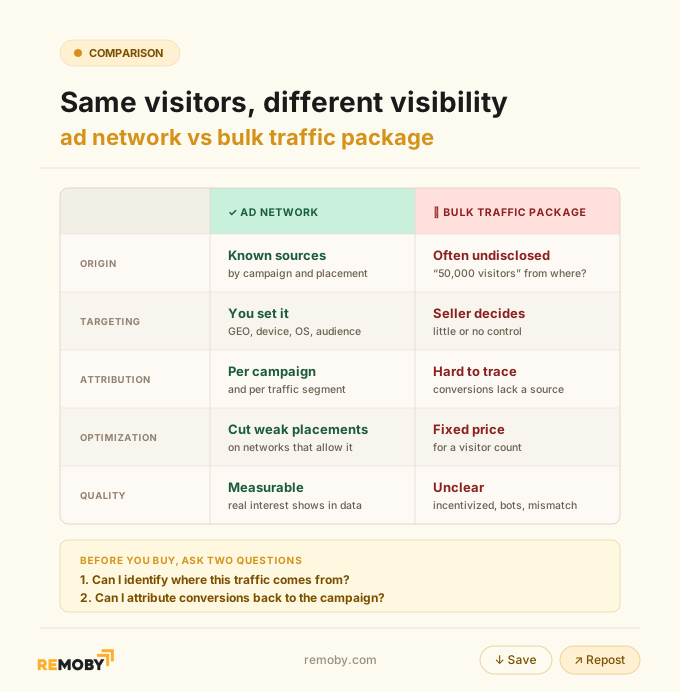
With an advertising network, you can control targeting, track conversions, and evaluate performance by campaign or traffic segment. Some networks also let you optimize individual publisher placements.
Bulk traffic packages are less transparent. A seller promising 50,000 visitors for a fixed price may provide little information about where those visitors came from or how they were acquired. That makes it difficult to distinguish genuine interest from incentivized visits, automated activity, or poorly matched audiences.
Before buying traffic, check whether you can identify its origin and attribute conversions back to the campaign.
Where to buy website traffic
Different sources serve different purposes. The choice starts with what your potential customer is doing before encountering the ad.
Google Ads: when users already know what they want
Search advertising is a natural fit for offers with existing demand. Someone searching for “best VPN for Android” or “business insurance quote” already has a specific problem in mind. A relevant offer can convert without much introduction.
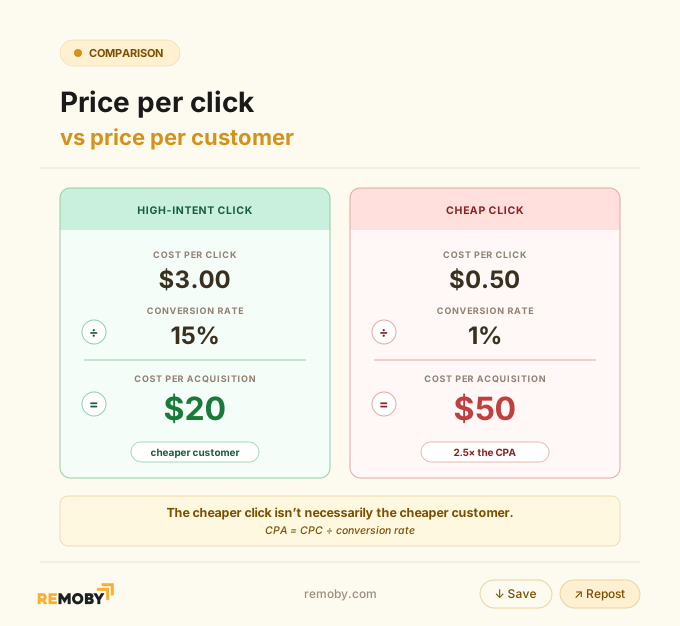
The challenge is competition. High-intent queries often attract advertisers willing to pay substantial CPCs. That doesn’t make Google expensive in terms of customer acquisition. A $3 click converting at 15% produces a $20 CPA. A $0.50 click converting at 1% produces a $50 CPA.
The cheaper click isn’t necessarily the cheaper customer.
Meta Ads: when creative needs to generate interest
Meta is useful when a product benefits from visual explanation, demonstration, or a compelling problem-and-solution message. Consumer products, apps, subscriptions, and certain lead-generation offers are natural candidates.
Creative quality matters, but the landing page still needs to deliver on the ad’s promise. A high CTR doesn’t help much if visitors lose interest after arriving.
Pop ads: when the funnel can convert broad reach
Pop and popunder ads deliver full-page landing experiences, commonly purchased on CPM. They’re worth testing for utilities, app installs, registrations, subscriptions, and affiliate offers with a clear conversion path.
The main difference from Search is intent. A pop visitor may not have been actively looking for the advertised product, so the landing experience needs to establish relevance quickly. For a simple app install, a direct landing page may work. For an unfamiliar offer, a short pre-lander explaining the benefit or qualifying interest might perform better.
Neither approach is automatically superior. The conversion data should decide.
Pop also allows buyers to work with substantial traffic volumes and optimize by placement. That becomes valuable when the network provides enough reporting detail to identify which segments produce approved conversions.
Push ads: when the message can be communicated quickly
Push works well for offers with an immediate, understandable benefit: app promotions, limited-time deals, subscriptions, and similar direct-response campaigns. Classic web push reaches notification subscribers, while in-page push displays a notification-style ad within a publisher’s webpage.
These formats have different delivery mechanics, but both depend on getting the message right before the visitor reaches the landing page.
Can’t choose between pop and push? See our pop vs push comparison blog.
Native ads: when an offer needs explanation
Native advertising can work well for product comparisons, finance-related offers, and other campaigns where readers benefit from more context. An article-style pre-lander can introduce the problem and build interest before sending visitors to the advertiser.
The extra step only makes sense if the resulting conversion quality compensates for the additional drop-off.
How much does website traffic cost in 2026?
The pricing model matters as much as the price.
CPC is the cost per charged click. CPM is the cost per 1,000 impressions.
Neither guarantees a particular number of engaged website visitors. With popunder, the ad opens the advertiser’s page, but a reported impression isn’t necessarily an engaged GA4 session. Loading, measurement, and user attention are different things.
Pop CPM rates by country
According to the Remoby live traffic chart, these were the reported CPM rates on the date of publication:
- United States — $3.46
- Mexico — $3.62
- Brazil — $4.25
- Indonesia — $1.76
- India — $0.48
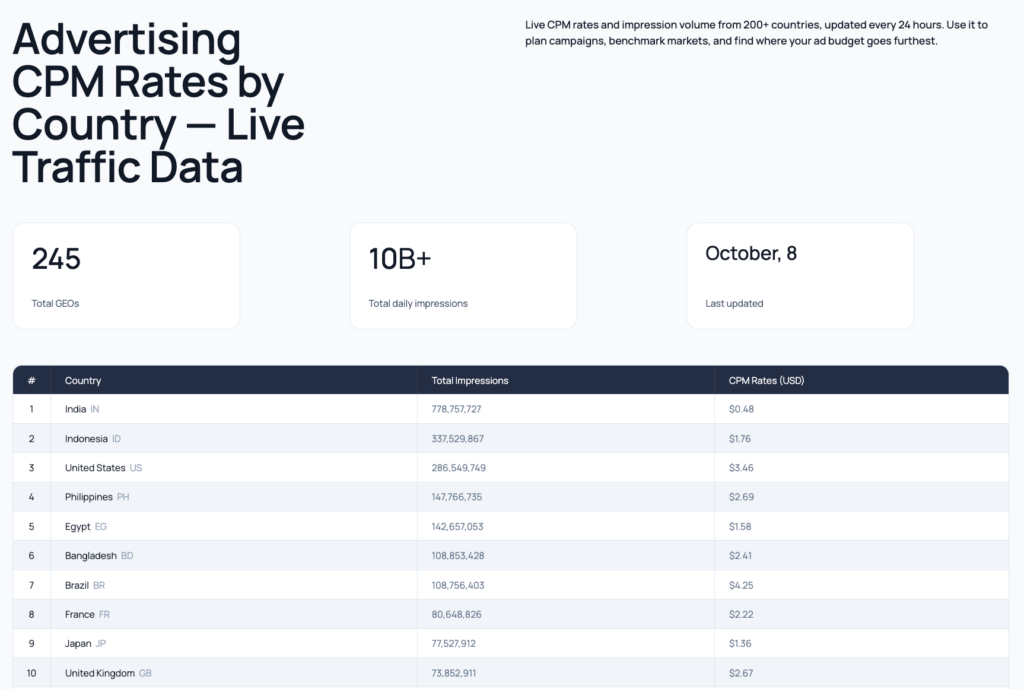
These figures reflect the network’s reported traffic prices, not guaranteed rates for every targeting configuration. They refresh daily.
India offers much lower CPM than the US in this snapshot. But if the offer pays more for US conversions, or the US audience converts better, the higher CPM may produce a better return.
Ready to launch with Remoby?
Why a higher CPM can be more profitable
Consider two hypothetical pop placements with a target CPA of $25.
Placement A costs $1 CPM. You spend $60 on 60,000 impressions and receive no approved conversions.
Placement B costs $5 CPM. You spend $100 on 20,000 impressions and receive six approved conversions.
Placement B’s CPM is five times higher, but its approved CPA is $16.67. Placement A has produced no measurable return.
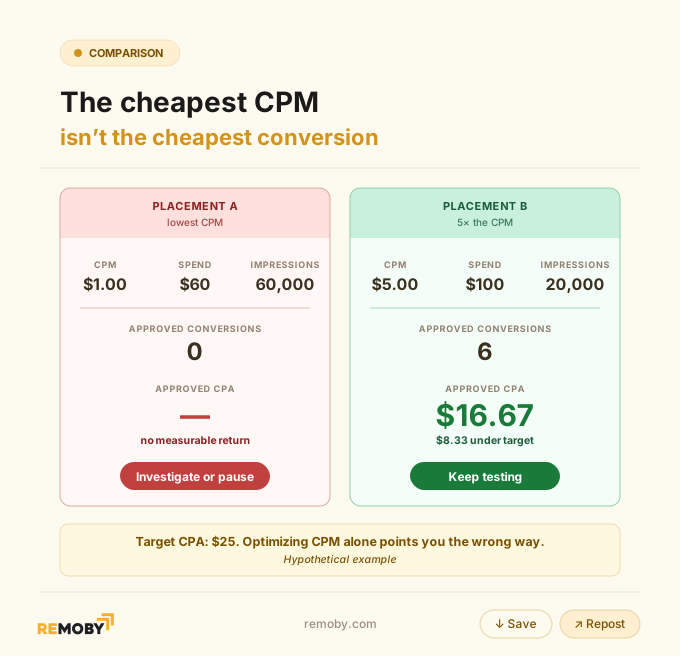
The next decision is straightforward: keep testing B within the available margin and investigate or pause A.
This is why optimizing CPM alone can lead buyers in the wrong direction.
Real paid traffic tests: Google Shopping and popunder
Two published campaigns illustrate how different acquisition strategies can produce profitable results.
They involve different products and conversion events, so the purpose isn’t to rank the channels against each other.
Google Shopping: 6.34× ROAS
In a published Google Shopping case study, an Australian hygiene-products retailer recorded the following Standard Shopping results in February 2026:
- Average CPC: approximately A$0.65
- Conversion rate: 6.69%
- CPA: approximately A$9.79
- ROAS: 6.34×
The agency had addressed missing purchase tracking, improved the product feed, and restructured campaigns. The account’s leading campaigns eventually became budget-limited, indicating an opportunity to investigate higher spend.
The buying decision: a 6.34× ROAS is a promising signal, but scaling still depends on product margins and whether additional budget can acquire customers at similar efficiency.
A high ROAS at a relatively small spend doesn’t guarantee the same return after the audience expands.
Popunder: changing the funnel instead of abandoning the source
A published AdOperator campaign targeted mobile users in Germany, Austria, and Switzerland.
The initial acquisition stage generated 172 registrations from 98,767 reported pop deliveries. At a $2 CPM, spend was approximately $197.53, while reported revenue reached only $65. On its own, that stage was unprofitable.
Instead of continuing to push cold visitors directly toward the final offer, the advertiser used the registration audience for a separate retargeting campaign. The second stage delivered 44 conversions, $610 in revenue, and $37.95 in spend. Its CPM was $30 — fifteen times higher than the original campaign — but its CPA was approximately $0.86.
Across both stages:
- Total spend: $235.48
- Total revenue: $675
- Full-funnel ROAS: 2.87×
- Reported ROI: approximately 187%
The registration and retargeting conversions represent different actions, so they shouldn’t be combined into a single acquisition conversion rate.
The buying decision: the advertiser changed how the audience was approached rather than continuing to optimize a cold-traffic funnel that wasn’t working.
So, the relevant measure was whether the complete acquisition strategy generated more value than it cost.
How to test a new traffic source
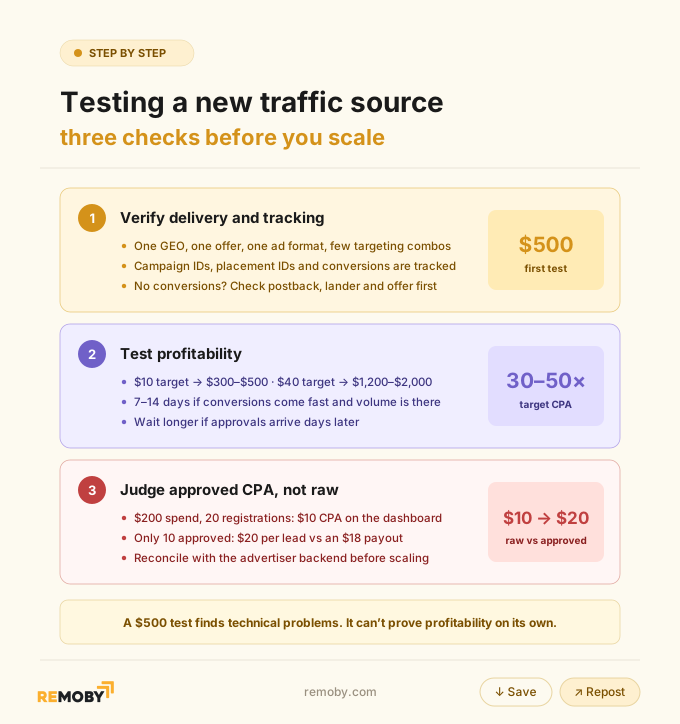
A $500 test can identify technical problems and reveal early performance patterns, but can’t establish profitability on its own. And of course, test budget should reflect the question you’re trying to answer.
First $500: verify delivery and tracking
Your first step is a $500 test. Keep the setup narrow though: one GEO, one offer, one ad format, and a limited number of targeting combinations. Before spending, confirm that the conversion event fires correctly. If you’re using Binom, Voluum, RedTrack, or Keitaro, verify that campaign IDs, placement IDs, and conversions pass through the tracking chain.
Then check whether the source delivers the audience you requested. For pop traffic, review placement distribution, landing-page loading, the first meaningful user action, and any recorded conversion events.
If the campaign produces no conversions, examine the funnel before blaming the inventory. Broken postbacks, an inaccessible landing page, or a poorly matched offer can make legitimate traffic look worthless.
Profitability test: budget around your target CPA
A practical starting allowance is approximately 50 target CPAs for one focused test. For a $10 CPA target, that’s $500. For a $40 target, it’s $2,000. These are planning ranges, of course.
For short conversion cycles, 7–14 days can provide a useful observation window if volume is sufficient. Longer conversion or approval delays require more time. There’s little point judging today’s leads against yesterday’s costs if approvals typically arrive three days later.
Don’t confuse raw CPA with approved CPA
Suppose a campaign spends $200 and records 20 registrations. The dashboard shows a $10 CPA. But only ten registrations are approved. Your actual cost per approved lead is $20.
If the offer pays $18 per approved lead, the campaign is losing money despite an attractive reported registration CPA.
Before scaling, reconcile conversions with the advertiser’s backend or affiliate network.
When to pause a placement — and when not to
One practical loss-control rule is to pause a placement after it spends approximately three times the target CPA without an approved conversion.
For a $20 target CPA, that’s around $60.
But this is a budget-management rule, not proof that the placement is bad or fraudulent. There are situations where an immediate blacklist would be premature.
Conversions are delayed. If approvals take 48 hours and the placement only started delivering this morning, the results haven’t matured.
The sample is small. One conversion can change CPA dramatically when spending is limited. A few early failures shouldn’t automatically eliminate a promising segment.
The landing page is the weak point. If users engage with the offer but consistently abandon the same form step, excluding placements may not address the actual problem.
On the other hand, if a placement repeatedly generates fake registrations, invalid attribution, or abnormal rejection rates after technical checks, it deserves stronger action.
Start by pausing or excluding individual placements. There’s no reason to discard an entire network because a few zones perform poorly.
Five signs of bot or low-quality traffic
Not every unprofitable campaign has a traffic fraud problem. A genuine visitor can be outside your target audience. A legitimate registration can be rejected. A technically valid conversion can be worth less than it costs.
Look for patterns supported by more than one signal.
1. Repetitive session behavior. Large groups of visitors completing identical actions at implausibly similar intervals warrant investigation, particularly when other technical signals agree.
2. Unusual technical characteristics. Unexpected concentrations of hosting-provider IPs, inconsistent location signals, or implausible browser combinations can indicate automated traffic. Shared IP addresses alone are insufficient evidence.
3. Unverifiable conversions. Reported purchases or leads without corresponding backend records are a serious warning. Check tracking duplication and attribution errors first.
4. Strong registration numbers but no downstream activity. Compare approved leads, activations, purchases, or retention across placements and mature cohorts. Low-quality traffic can be entirely human.
5. Recurring anomalies from the same placement. Suspicious timing, invalid submissions, and inconsistent technical signals repeatedly concentrated in one zone provide a stronger reason to exclude it than a high bounce rate alone.
For more detail, see our buyer-side guide to detecting affiliate fraud in pop traffic.
The important distinction is between traffic that fails commercially and traffic that appears fraudulent. They don’t require the same response.
Ready to launch with Remoby?
FAQ on how to buy traffic safely
Yes. Google, Meta, native, push, and pop networks provide paid access to real audiences. Prioritize sources that offer suitable targeting, conversion attribution, and sufficient reporting to evaluate performance.
Estimate the required budget from your expected CPC or CPM, then measure how many website sessions and conversions the campaign actually produces. With CPM inventory, 1,000 impressions shouldn't automatically be treated as 1,000 engaged visits. Once the acquisition economics work, increase volume gradually and watch whether the additional traffic maintains its quality.
Purchased visits don't directly improve organic search rankings. Legitimate paid campaigns can help you discover audience interests and landing-page weaknesses, but buying traffic isn't a shortcut to better SEO positions.
Publishers can earn money from advertising clicks, impressions, affiliate conversions, and other monetization models. Advertisers operate on the other side of that transaction. For them, the important numbers are acquisition cost, approved conversions, and the revenue generated after the click.
Yes. Pop can be effective for affiliate offers with clear benefits and relatively short conversion paths, including installs, registrations, utilities, and subscriptions. Performance depends heavily on targeting, landing-page structure, offer economics, and placement optimization. Testing with accurate postbacks is essential because raw registrations and approved affiliate conversions can tell very different stories.