Updated: September 30, 2026
|
9 min read
Updated: September 30, 2026
|
9 min read
Meta Ads vs. Pop Traffic: A 21-Day US Acquisition Case

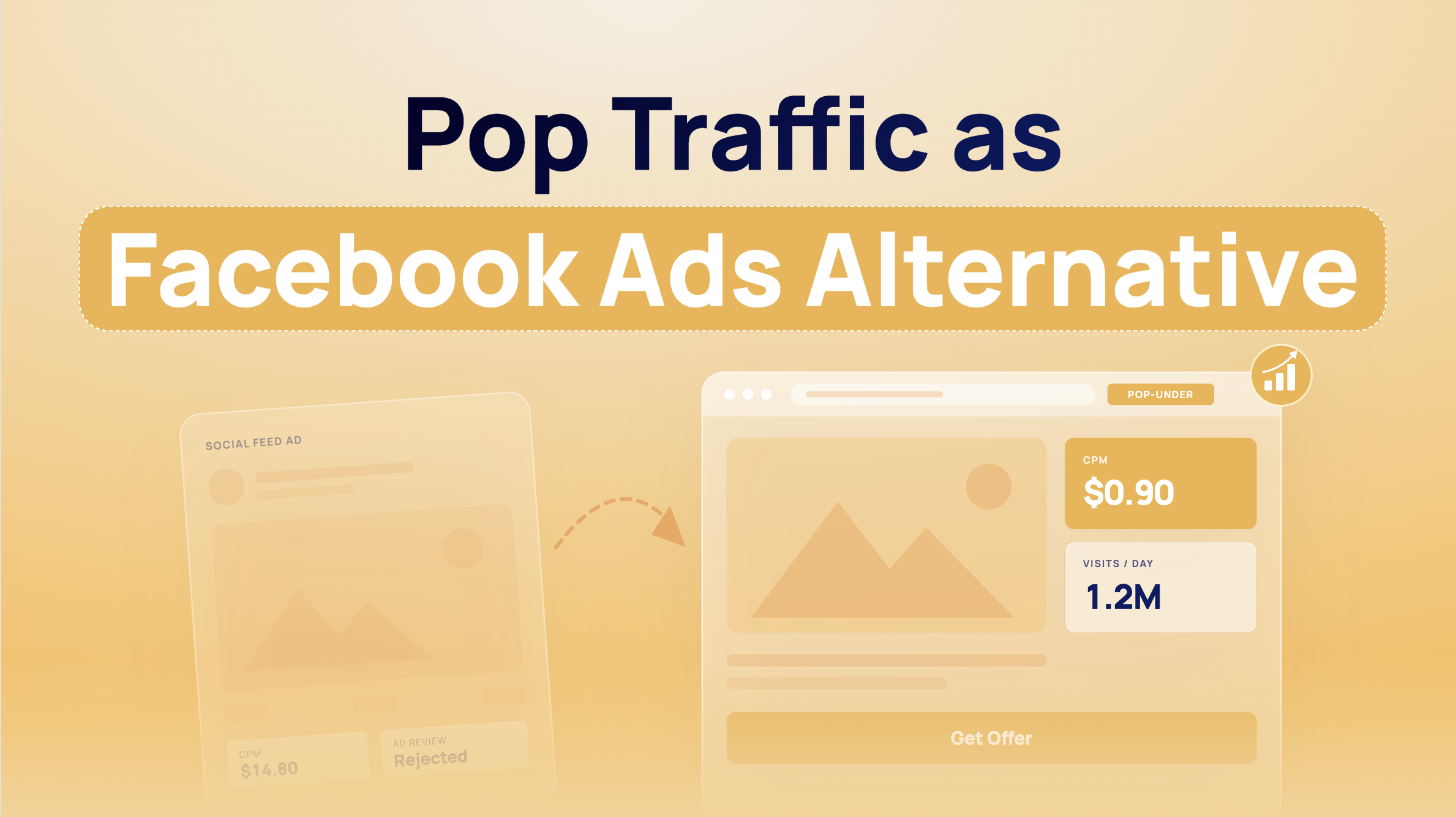
Most buyers look for a Facebook ads alternative only when something breaks. One of our advertisers ran a Utilities offer (a privacy and device-protection subscription) on Facebook for more than two years, at a steady $40 cost per approved trial. Then, as auction pressure increased in the run-up to a US political event, CPM climbed to $50, and the same campaign started losing money without a single change to the offer or the landing page.
They moved 65% of the budget to Remoby popunder traffic for 21 days for a test. Pop required more impressions per conversion than Facebook, but its much lower CPM brought the acquisition cost back under control. Below is why the numbers worked, what the funnel needed, and where the first five days nearly made them quit.
Methodology: all figures come from the advertiser’s own tracker and were shared with us with permission to publish. The advertiser is not named. The campaign ran for 21 days, and final results were calculated after the seven-day validation window closed for the last day’s trials. Conversions are approved trials unless stated otherwise, so raw trial counts and approved counts differ throughout.
What actually changed on Facebook
The offer paid $52 per approved paid trial. On a normal 21-day stretch, Facebook took $36,823 of spend, delivered 1.15 million impressions at a $32 CPM and produced 923 approved trials. That is a $39.90 CPA and a 130% ROAS, which the advertiser calls a working baseline. It wasn’t a good month, just a normal one.
In the next 21 days, CPM climbed to $50 and the same budget bought only 715,260 impressions. Click-through rate barely moved (1.42% before, 1.39% after), and post-click conversion held up as well. The campaign produced 644 approved trials at $55.53 each, so a campaign that used to earn 30% on spend was now losing about 6%.
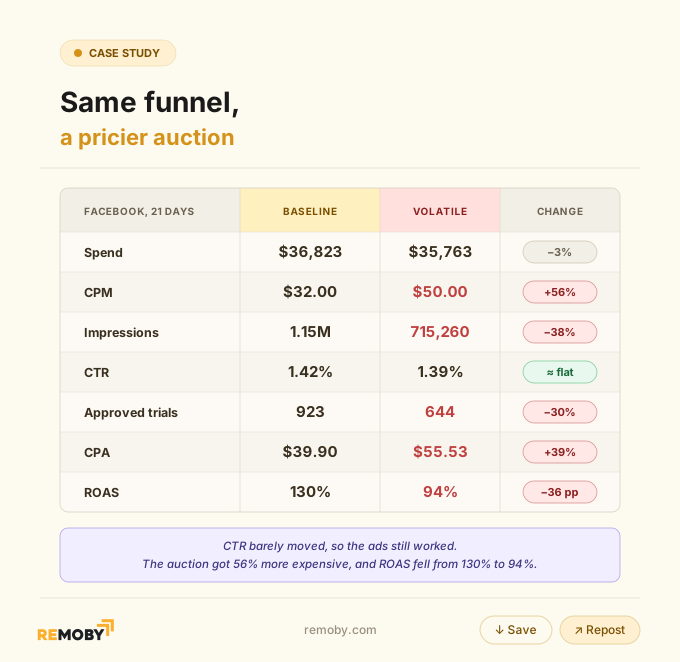
The detail that matters is what did not change. Facebook needed about 1,250 impressions per approved trial in the baseline and about 1,110 in the volatile period, so the audience actually converted slightly better. The funnel kept converting at roughly the same rate, and the main change was a 56% higher cost of reaching the audience. Creative and landing page work might have offset part of that, but the underlying problem was auction cost rather than a visible break in the funnel.
Why lower CPM changed the unit economics
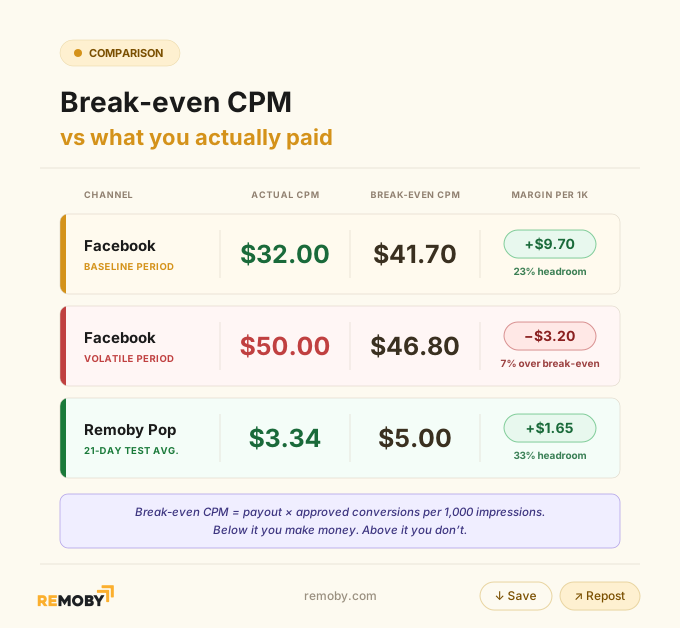
The useful way to compare two channels with very different CPMs is the break-even CPM: the payout multiplied by approved conversions per thousand impressions. It’s the most you can pay per thousand impressions before a campaign stops making money. On Facebook’s baseline it came to about $41.70 against a $32 price, which is where the 30% return on spend came from. In the volatile period it was $46.80 against a $50 price, and that gap is the whole loss.
Pop traffic sits at the other end of the scale. Across the 21-day test, Remoby required roughly 10,400 impressions per approved trial, compared with around 1,100–1,250 on Facebook. But those impressions cost $3.34 per mile rather than $50. The lower CPM more than compensated for the difference in conversion density, bringing approved CPA down to $34.82.
Instead of asking whether pop would convert like Facebook, they asked whether they could buy approved trials under their $40 target without depending on the Facebook auction. At planning time our Traffic Chart showed around 209 million daily US impressions, so the question was only whether the funnel could turn broad, cold traffic into approved trials at the target CPA.
Same budget, split two ways
The test kept total spend at $36,823, the same as the Facebook baseline. Facebook kept $13,043 and stayed live as a benchmark, and Remoby took the other $23,780. Nothing was added on top of normal spend, which keeps the final comparison clean: same money, same offer, same 21 days, different channel mix.
A small side test can look good on 50 conversions and fall apart at scale. Here pop carried $1,132 a day on average, so the 683 approved trials it produced were bought at real volume.
Rebuilding the funnel for pop traffic
The Facebook funnel sent users straight from the ad to the product page. That works in a feed, where the creative explains the problem before anyone clicks. Popunder visitors arrive without that context, and sending them straight to a subscription page produced exactly the bounce rate you would expect.
The fix was a light prelander between the pop and the offer.
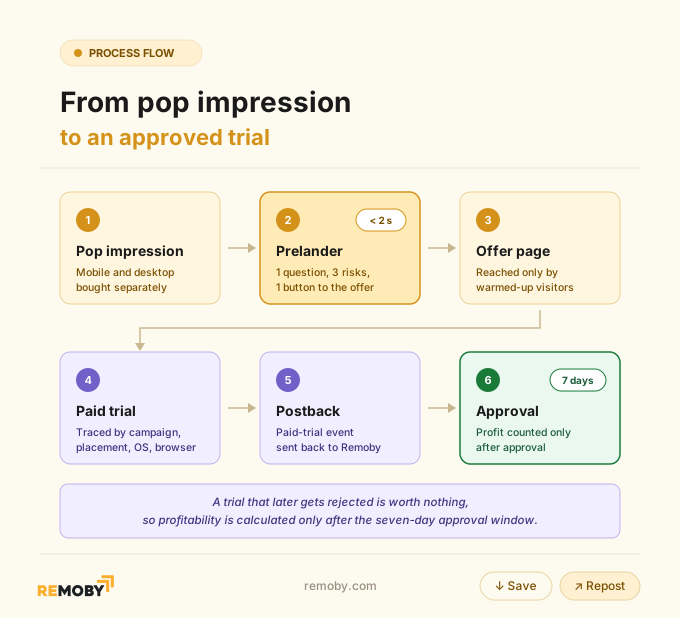
It asked one question about the user’s current level of online protection, listed three common privacy and device-security risks, explained briefly how the product dealt with them, and ended with a single button to the offer. It was built for mobile and loaded in under two seconds. It filtered out people who were never going to care and warmed up the ones who might.
Mobile and desktop ran separately, and campaign, placement, OS and browser were passed into the tracker so every conversion could be traced back to where it came from. The paid-trial event went back to Remoby by postback, while final profitability was calculated only after the seven-day approval window, since a trial that later gets rejected is worth nothing.
Ready to try Remoby instead of Meta?
Three phases, three very different CPAs
The Remoby campaign launched on SmartCPM with a $3.30 starting bid, a $1,200 daily budget, a frequency cap of two impressions per user per 24 hours and broad run-of-network traffic. Running SmartCPM from day one meant automated optimization could be switched on later without rebuilding the campaign. There was no big blacklist and no narrow whitelist at the start, because the first goal was placement-level data. Profit could wait a few days.
| Phase | Days | Spend | Impressions | Approved trials | CPA |
|---|---|---|---|---|---|
| 1. Collect data | 5 | $5,920 | 1.76M | 119 | $49.75 |
| 2. Cut placements | 7 | $7,830 | 2.36M | 226 | $34.65 |
| 3. Automated optimization | 9 | $10,030 | 3.00M | 338 | $29.67 |
The first five days were the dangerous part. CPA came in at $49.75, better than Facebook’s $55.53 but well above the $40 target, and plenty of buyers would have called the channel a failure right there. The advertiser looked one level down. Some placements were already producing approved trials under $35, while others had spent heavily with nothing to show, so the average was a blend of good and bad inventory rather than a verdict on pop.
Phase two worked through that blend with simple rules. A placement that spent one target CPA without converting had its bid lowered, and after two target CPAs with nothing it was paused. Nothing was scaled on a single conversion, and bids went up 10 to 15% only after at least three conversions at an acceptable cost. The strongest mobile traffic moved into its own campaign, and three prelander variants were tested, with the winner sending 27% more users to the offer page. CPA fell to $34.65, already about 38% cheaper than Facebook during the same period.
Phase three switched on Remoby’s automated campaign optimization with Target conversion cost set to about $31.60. The postback carried the paid trial, not the approved one, so the platform counted cost per paid trial while the advertiser counted cost per approved trial. At a 79% approval rate, $31.60 per paid trial is what a $40 approved-CPA goal works out to. From there, the system placed fair CPM bids for each particular placement and excluded underperforming ones to reach the target conversion cost, and the team kept checking approval rates by hand. In this phase a paid trial cost $23.43, an approved one $29.67, and daily approved volume rose to about 38, against 24 in phase one. The setup behind this is covered in automated campaign optimization for pop ads.
The column missing from that table is the most telling one. The price per thousand impressions stayed between $3.32 and $3.36 through all three phases. Every dollar of improvement came from conversion density: phase one needed about 14,800 impressions per approved trial, phase three about 8,900. On Facebook the problem was price. On pop the work was in picking the right placements and the right prelander, and the price barely moved while that happened.
Did the cheaper trials hold up?
A low CPA means little if users cancel before the first rebill, so the offer owner shared retention too. First rebill rate was 71% for Facebook users and 68% for Remoby users. Approval rate was about 82% on Facebook and 79% on Remoby. Facebook kept a small quality edge on both counts, which you’d expect when users see a feed ad and choose to click.
The gap is small next to the cost difference. Three points of rebill do not come close to offsetting a CPA that was 37% lower, and a 79% approval rate sits well inside what the offer owner considered normal. It also rules out junk conversions flattering the CPA.
The combined result
Over the 21 days, Remoby delivered 683 approved trials at a $34.82 CPA and a 149% ROAS, with $11,736 of profit. The smaller Facebook campaign stayed exactly as weak as before: 235 approved trials at $55.50 and a 94% ROAS.
| Same $36,823, 21 days | Facebook only (baseline) | Facebook + Remoby |
|---|---|---|
| Approved trials | 923 | 918 |
| CPA | $39.90 | $40.11 |
| ROAS | 130% | 130% |
| Share of approved trials from pop | 0% | 74% |
The mix recovered more than 99% of the baseline volume on the same budget, even though Facebook itself was still losing money on every trial. Pop did not match Facebook’s conversion density. It did something more important: it delivered approved trials at a lower cost while preserving almost the same approval and rebill quality. Pop became the main acquisition source, and Facebook turned into a benchmark that couldn’t sink the whole campaign when its CPM moved.
Testing a Facebook ads alternative
For a CPA offer, these parts are worth copying:
- Work out your break-even CPM first. Multiply the payout by the approved conversions you expect per thousand impressions. If a channel’s CPM sits well under that number, a much lower conversion rate is survivable.
- Put the target in the same units as the postback. If the postback fires before the offer owner validates, multiply your approved-CPA goal by the expected approval rate. A $40 goal at 79% approval means a target of about $31.60.
- Launch on SmartCPM and collect data before you judge. Phase one is expensive by design. Cutting the channel on its first five days would have thrown away a source that later ran at $29.67.
- Give pop traffic a prelander. A feed ad builds intent before the click, a popunder does not, so the page after the pop has to do that job in two seconds.
- Judge on approved conversions. Optimise on the fast event if you need to, but compare channels only after the approval window closes, and check rebill if the offer owner will share it.
Where this doesn’t apply
This was one offer, in one GEO, over 21 days. Utilities subscriptions suit pop well because the problem they solve is easy to explain on a short prelander, and the same approach will be harder for an offer that needs trust built over several touches. Facebook was also unusually expensive at the time, so the gap was wider than it’ll be in a quiet quarter.
What should carry over is the way the decision was made. When one auction gets expensive, ask which channel leaves margin at today’s price. This advertiser answered it with a spreadsheet, a two-second prelander and five uncomfortable days of data.
Ready to try Remoby instead of Meta?
FAQ
For offers that can be explained on a short prelander, yes. In the case above pop delivered 74% of approved trials at a $34.82 CPA against $55.53 on Facebook in the same period, and first rebill was 68% against 71%.
An average of $3.34 across the 21 days, starting from a $3.30 bid on SmartCPM. Current US volume and recommended bids are published on the Traffic Chart linked above.
Start from the real cost per approved conversion of the last stable period on any channel. If the postback fires before validation, multiply it by the expected approval rate, then lower it in steps.
![Pop Ads CPM in Mexico [2026]](https://remoby.com/wp-content/uploads/2026/07/Screenshot-2026-07-30-at-16.06.45-768x432.png)