Updated: July 28, 2026
|
6 min read
Updated: July 28, 2026
|
6 min read
iGaming Platform Owner Cuts Brand Awareness Costs by 68% with SmartCPM

Overview
| Vertical | iGaming (online sports betting) |
| Campaign Objective | Brand awareness and reach |
| Traffic Type | Pop |
| Pricing Models Tested | SmartCPM vs. Fixed CPM (parallel campaigns) |
| GEOs | SG, PH, CI, AZ, TR, ZA, VN, KZ, IN, MY, NG |
| Campaign Period | 1 month |
An online bookmaker running brand awareness campaigns across 11 GEOs tested Remoby’s SmartCPM bidding model against fixed CPM – running both in parallel on pop traffic for a full month. The goal was simple: maximize impression volume within a fixed budget.
The challenge
For online bookmakers, brand awareness isn’t a vanity metric — it’s a competitive necessity. In markets like the Philippines, Malaysia, and Singapore, multiple betting brands are fighting for the same users at the same time. Being visible before a competitor captures attention is directly tied to account registrations and long-term player value.
For this advertiser, that meant running awareness campaigns simultaneously across 11 GEOs — markets with very different auction dynamics, traffic volumes, and competitive pressure. And that’s where the pricing model started to matter.
Fixed CPM gives you precision and predictability: you know exactly what you’ll pay per impression, which makes it the right choice for tightly controlled creative tests, pre-qualified whitelisted inventory, or exact pacing for reporting. The trade-off is inflexibility — a static bid pays the same rate on every impression regardless of what the auction actually clears at. Setting one fixed bid that works well in Singapore, the Philippines, and Nigeria simultaneously is structurally difficult: bid too high globally and you overpay on low-competition inventory; bid conservatively and you underdeliver in the markets that matter most.
With a fixed budget and multiple GEOs to cover, the real question was whether we were paying the market rate – or just our declared rate on every single impression.
Maksim, Head of Advertiser’s Mediabuy Team
Campaign setup
Both campaigns – CPM and SmartCPM – ran simultaneously throughout the test period. The only variable was the pricing model – everything else was held constant.
Traffic format: Pop (popunder)
Devices: Mobile and desktop
Targeting: GEO-level targeting across 11 markets. No additional demographic or behavioral filters applied – the objective was maximum reach within each GEO, not audience narrowing.
Budget: Comparable daily budgets allocated to both campaigns across all GEOs. Total monthly spend was roughly equal between the two – approximately $1,536 on SmartCPM and $1,460 on fixed CPM.
SmartCPM campaigns: Advertiser set a max CPM ceiling per GEO. The system bid dynamically per auction using second-price logic – winning at the second-highest bid plus a minimal increment, never at the declared ceiling unless competition forced it there. Full mechanics of the model in the how SmartCPM works breakdown.
Fixed CPM campaigns: Advertiser set a static bid per 1,000 impressions. Every won impression was charged at that fixed rate regardless of actual auction pressure.
No pre-landers. Direct pop delivery. Tracking handled via the advertiser’s internal analytics stack.
Ready to launch SmartCPM campaign with Remoby?
Results that matter
Over the one-month test period across all 11 GEOs:
| Metric | SmartCPM | Fixed CPM |
| Total Impressions | 1,850,000 | 570,000 |
| Total Spend | ~$1,536 | ~$1,460 |
| Average RPM | $0.83 | $2.56 |
| Impression Volume Advantage | +224% | – |
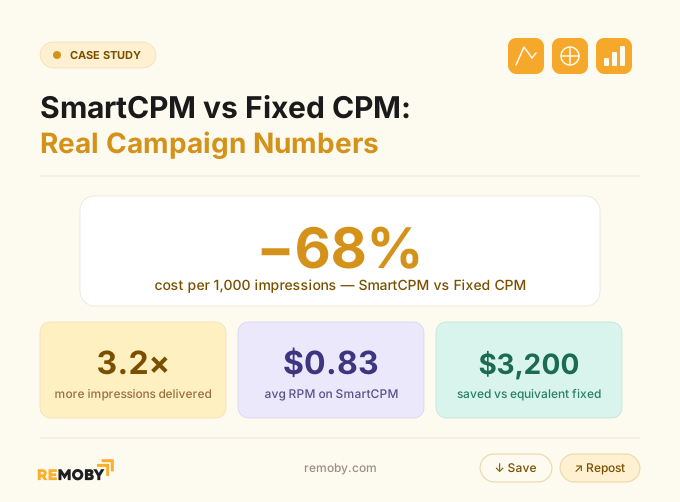
For a near-identical budget, SmartCPM delivered 3.2x more impressions.
The RPM gap – $0.83 vs $2.56 – illustrates why: fixed CPM bids paid the declared rate on every impression. SmartCPM consistently cleared auctions below the ceiling, because in a second-price auction the actual clearing price is set by the second-highest bidder, not by you.
To put it in budget terms: delivering 1.85 million impressions at the fixed CPM rate would have cost $4,736. SmartCPM delivered the same volume for $1,536 – a saving of $3,200 in a single month across 11 GEOs.
GEO-level breakdown
The efficiency gains were consistent across markets, but the scale of the difference varied by auction competitiveness.
Philippines (PH) showed the largest gap. SmartCPM delivered 612,000 impressions at an RPM of $0.58. Fixed CPM delivered 85,000 impressions at $1.19 RPM – roughly seven times fewer impressions for comparable spend.
Malaysia (MY) was equally stark. SmartCPM: 186,000 impressions at $0.54 RPM. Fixed CPM: 79,000 impressions at $1.28 RPM. More than double the volume at less than half the effective cost.
Singapore (SG), a Tier 1 market with higher auction floors, still showed a 2x gap: 77,000 SmartCPM impressions at $1.30 RPM versus 41,000 fixed impressions at $2.48 RPM.
In every single GEO tested, SmartCPM delivered more impressions at a lower effective RPM than the fixed CPM equivalent – without a single exception.
Maksim, Head of Advertiser’s Mediabuy Team
When to use each bidding model
Fixed CPM and SmartCPM are tools with different strengths. Choosing between them comes down to what your campaign actually needs.
Fixed CPM is the right choice when:
- You’re running creative or landing page tests and need to isolate the bid as a variable
- You’re working with pre-qualified whitelisted inventory where dynamic bidding adds no advantage
- You need exact daily spend predictability for client reporting or budget forecasting
SmartCPM is the right choice when:
- Your campaign spans multiple GEOs with varying auction dynamics – and you don’t want to manually calibrate a separate fixed bid for each market
- Your objective is reach and impressions per dollar, not bid-level precision
- You’re launching a new offer on pop traffic for the first time and have no historical data on what bids actually clear in your target GEOs
For iGaming specifically, SmartCPM’s advantage compounds further. Betting brands compete for the same inventory windows – around sporting events, in the evenings, on weekends. A fixed bid calibrated for a Tuesday morning will either overpay or underdeliver on a Saturday night in the same GEO. SmartCPM adjusts to that variation automatically, without any manual intervention. We tell about where these two sit among CPC and CPA billing in the ad network pricing models blog.
Key takeaways
- SmartCPM delivered 3.2x more impressions than fixed CPM for a comparable monthly budget across 11 GEOs.
- Average effective RPM was $0.83 on SmartCPM versus $2.56 on fixed – a 68% reduction in cost per 1,000 impressions.
- The advantage held across every GEO tested – from Tier 1 competitive markets (SG) to high-volume Tier 2 and Tier 3 markets (PH, MY).
- Fixed CPM remains the right model for controlled tests, narrow whitelisted campaigns, and exact pacing requirements. SmartCPM is the right model when the priority is reach efficiency across varied auction environments.
- SmartCPM produces the strongest results at $100+/day per campaign, with optimization signal stabilizing after 2–3 days. No conversion tracking setup is required – the system optimizes on bid and win dynamics alone.
- The advertiser has since moved all awareness-focused campaigns to SmartCPM.
Why this case matters
The choice between fixed CPM and SmartCPM isn’t about which model is better in the abstract – it’s about matching the tool to the task. Fixed CPM gives you control. SmartCPM gives you market efficiency. When your goal is reach at scale across multiple GEOs, and you don’t want to manually manage a separate bid for every market, SmartCPM does that work for you.
The ceiling you set protects your unit economics. The second-price mechanism finds the actual clearing price. The result, in this case, was $3,200 saved and 3x more impressions – not from a bigger budget or better targeting, but from a pricing model that pays what inventory is actually worth.
For iGaming advertisers running multi-GEO awareness campaigns on pop traffic, this is the benchmark. The setup guide for this play – metrics, caps, and kill criteria – is in brand awareness with pop traffic in a new GEO. If you’re still on fixed CPM and not running controlled tests or whitelisted campaigns, the question worth asking is: how much of your budget is going to the declared rate rather than the market rate?