Updated: September 16, 2026
|
5 min read
Updated: September 16, 2026
|
5 min read
Why I Still Start New GEO Tests for iGaming campaigns with Pop Traffic

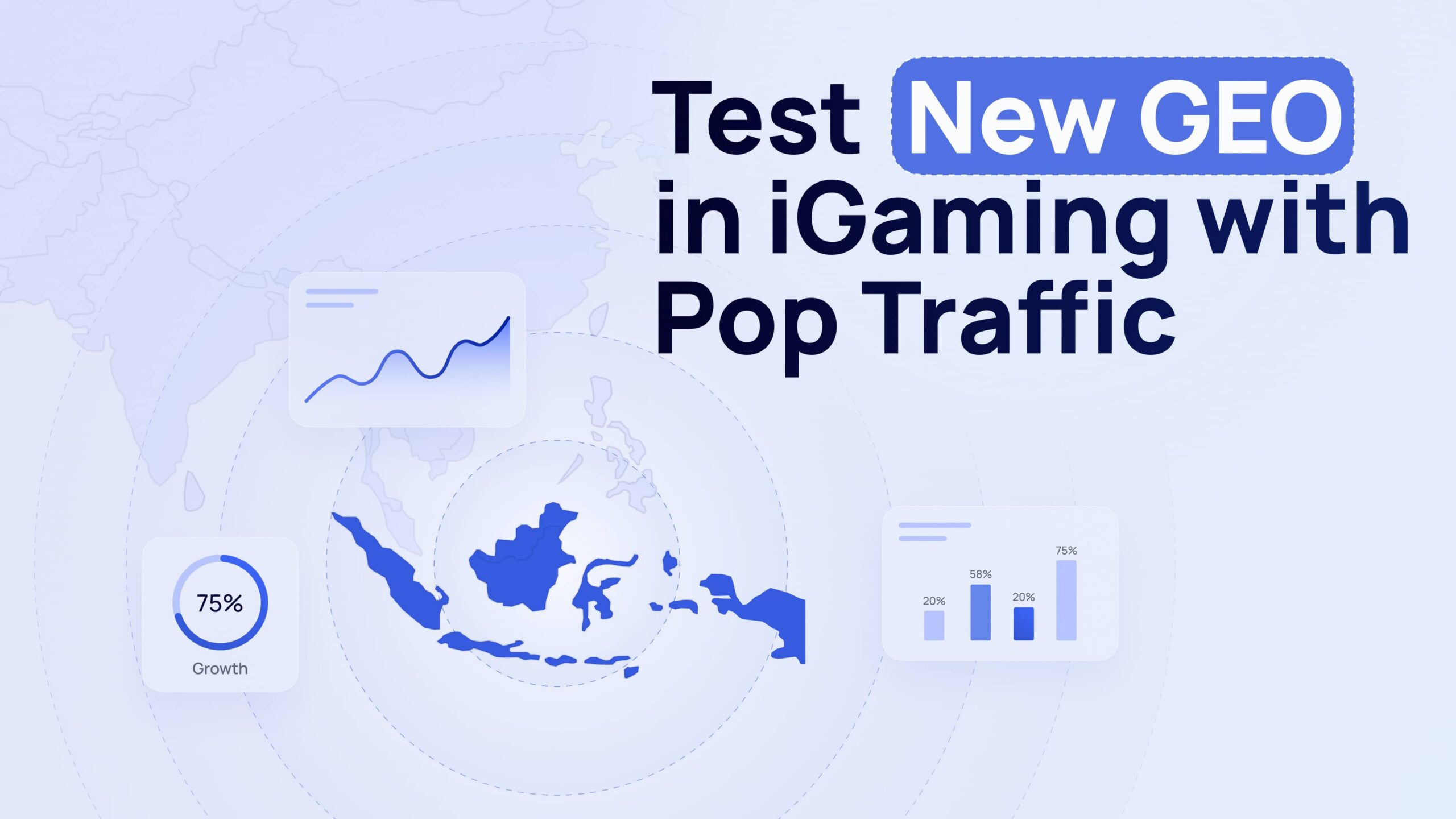
Most GEO testing advice is written by people who’ve never actually lost money on a bad one. This wasn’t. We sat down with Ilyas Abishev, a media buyer who’s been running iGaming traffic for five years – and asked him one question: how do you actually test a new GEO without blowing your budget on the wrong assumptions.

When I enter a new GEO, I’m not looking for scale. I’m looking for contradictions.
Everyone says the same thing at the beginning: “The GEO is hot”, “Competitors are printing”, “Traffic is cheap”.
None of that matters until I see how the funnel behaves under pressure.
That’s why I usually start with Pop traffic. Not because they’re premium or they are easy to manage. But because they expose weaknesses faster than almost anything else.
Pop traffic doesn’t forgive friction. And that’s exactly what makes them useful in early-stage iGaming traffic testing.
What Pop Actually Tests (That Other Channels Hide)
When you run Facebook or Google from day one, you’re often buying intent or at least algorithmically filtered audiences. The traffic is smoother. Sometimes too smooth. Pop is different. Users are reactive. Impatient. If something in your funnel feels off, they don’t think about it – they leave.
Ready to launch with Remoby?
That behavior stress-tests three things immediately:
- Whether your registration flow is unnecessarily heavy
- Whether your payment methods match local expectations
- Whether your bonus messaging aligns with reality
If your minimum deposit is unrealistic, or if your creative overpromises for the GEO, Pop will show it.
You don’t need massive spend to see this. Usually a controlled $1000 – $1,500 test is enough to understand whether the unit economics are even worth modeling.
A LATAM Test That Nearly Got Killed
A couple of years ago we tested a LATAM GEO on a hybrid deal. Nothing exotic. Decent payout structure, strong operator brand, good affiliate chatter.
We started with Pop. Registrations came in quickly – around 24–26% CR. On paper, that looked healthy. But FTD wouldn’t stabilize. One day 6%, next day 4%, then back to 5%. Not catastrophic, just inconsistent.
Inconsistent numbers are worse than low ones. You can optimize low. You can’t optimize chaos.
At first we blamed the traffic mix. Then we rotated creatives. We assumed maybe we were attracting bonus-only users.
The real issue was more boring. The local bank transfer method had a confirmation delay that wasn’t clearly explained in the deposit flow. Users clicked “deposit,” waited, saw no instant confirmation, and assumed something failed.
Once the operator adjusted the UX – and we modified creatives to emphasize instant deposit options – FTD moved into the 9–10% range and, more importantly, stayed there.
Same source. Same GEO. No magic. Just clarity.
If we had started on Facebook, we would have spent five times more before diagnosing that.
The Trap of Chasing CTR
One thing I learned the hard way years ago: high CTR in Pop doesn’t mean healthy economics.
Early in my career I’d celebrate strong click-through rates. It felt like momentum. In reality, it often meant misalignment.
If your creative screams “100% bonus, no risk,” but your landing introduces heavy wagering and a deposit minimum that feels high for the GEO, you’ll get curiosity clicks – not deposits.
I’ve had campaigns where lowering creative aggressiveness reduced CTR noticeably but improved FTD and CPA in a meaningful way. The traffic became smaller, but more aligned with the actual offer.
Pop makes that misalignment visible quickly.
When Pop Says “No” – And You Should Listen
Not every test reveals a fixable problem. We tested the best Tier-3 Asian GEO where CPC looked incredibly cheap. Registration CR was around 30%, which sounds great. But FTD stayed in the 3–4% range across multiple creatives and placements.
We let it run long enough to remove randomness – close to 200 FTD. Retention was weak. Deposit sizes were small. Affiliate managers insisted others were scaling. Maybe they were on different terms. Maybe different funnels. Anyway, for our economics, it didn’t work.
Pop traffic didn’t show us what to fix. It showed us that forcing scale would likely amplify weak LTV.
That saved money.
Why I Don’t Start with Expensive Channels
There’s a psychological trap in starting with social or search (if it’s possible anyway). The traffic feels “higher quality.” The dashboards look clean. Early CR might even look better.
But if there’s structural friction – payment service provider mismatch, unrealistic deposit minimum, confusing onboarding – those problems don’t disappear. They just become more expensive to detect.
I’d rather discover a broken deposit flow at $1,000 spend than at $15,000.
Pop is not about long-term channel strategy in this phase (even though iGaming brands use it extensively for that too), it’s about risk containment. There’s the flip side thought: pop is also a cheap way of building brand awareness in a new GEO before performance spend kicks in.
What I Actually Look For in the First 3–5 Days
When testing iGaming traffic sources, I’m not trying to win immediately. I’m looking for stability.
- Does registration CR fall into a realistic range for the GEO?
- Does FTD stabilize instead of swinging wildly?
- Does early retention completely collapse, or does it show baseline health?
If the numbers are coherent – not perfect, just coherent – then I’ll consider bringing in higher-cost channels and scaling gradually. Baseline costs per GEO are visible upfront in the live CPM chart.
If they’re chaotic or structurally weak, I go back to the offer, the payment stack, or the onboarding flow before spending more.
The Old-School Lesson That Still Applies
Years ago, before real-time postbacks and conversion APIs, we used to reconcile FTD manually. CSV exports from traffic source. Backend reports from the operator. Half the time numbers didn’t match and you had to figure out why.
That process taught something important: distrust clean narratives.
If a GEO looks “easy” in the first 48 hours, I get cautious. Sustainable iGaming traffic optimization rarely looks smooth at the beginning. It stabilizes gradually once the obvious friction points are removed.
Pop traffic doesn’t solve your funnel. They don’t 100% guarantee long-term LTV. But they make weaknesses visible early – especially in new GEO testing.
And in global iGaming traffic, finding weaknesses early is usually the difference between controlled experimentation and expensive optimism.