Updated: July 28, 2026
|
8 min read
Updated: July 28, 2026
|
8 min read
Popunder Zone Optimization: Thresholds, Decision Matrix, and Scaling

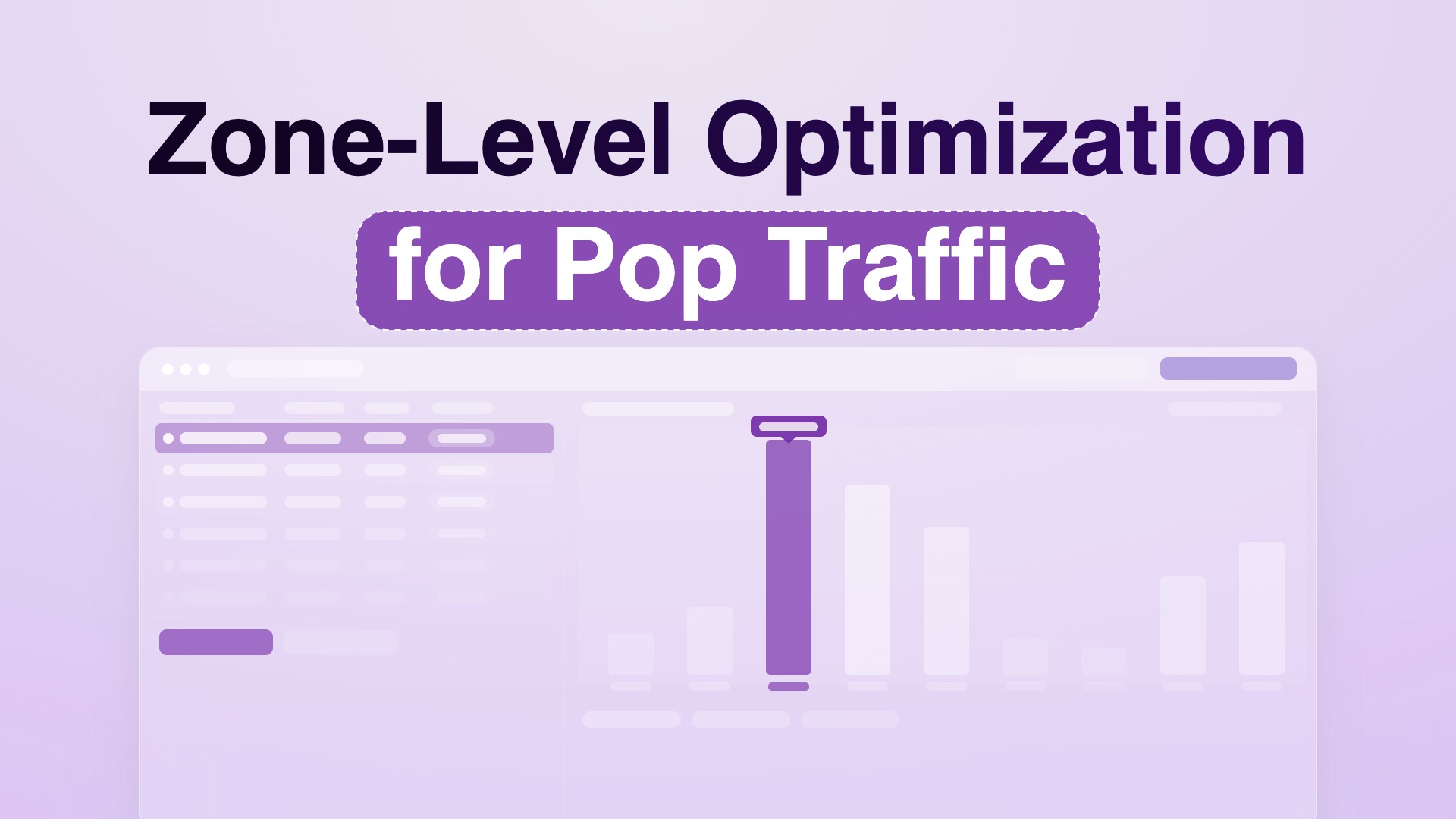
The zone report says one thing, the money says another. That’s where popunder zone optimization starts: not with a blacklist management, but with proving the data deserves to be trusted.
What is popunder zone optimization?
Most buyers treat zone work like cleanup. Reality is narrower and more useful: popunder zone optimization means deciding, zone by zone, whether to hold, bid down, isolate, whitelist, or blacklist based on outcome data instead of campaign averages.
That distinction matters because a campaign can look dead while two zones carry the margin, or look healthy while one bleeder zone eats the next scale step. On pop traffic from sources like PropellerAds or Remoby, the zone is often the smallest unit where auction behavior and user quality actually show up.
The report is grouped correctly. The hard part is deciding when the signal is real enough to act on.
Tracking checklist before you optimize any zone
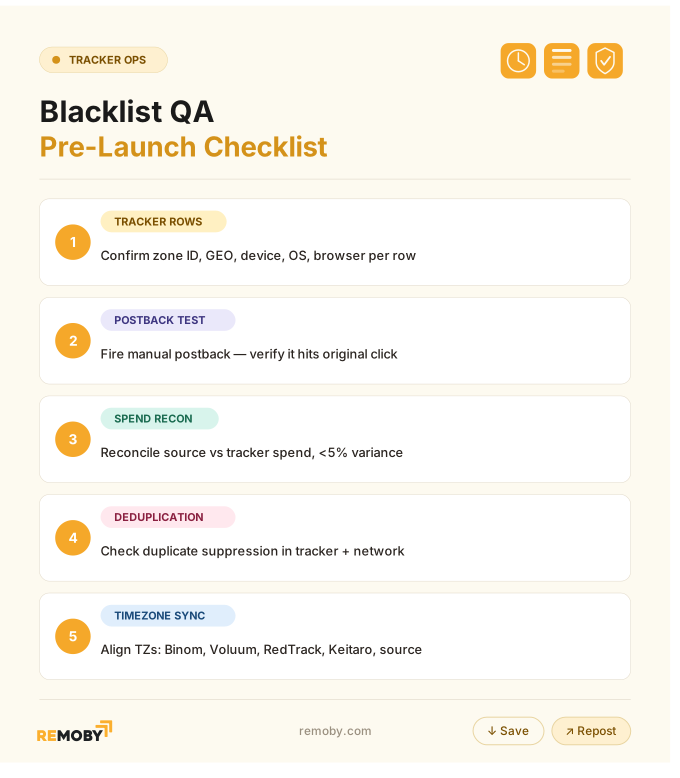
Tracking setup is the gatekeeper for valid zone decisions. A trustworthy setup passes click ID and zone ID on every visit, matches ad-network spend to tracker spend within about 5%, suppresses duplicate postbacks, and keeps the same time zone across tracker, ad network, and affiliate platform. A 50-100 click test plus one manual postback catches most breakpoints before real spend hides them. We covered the full postback setup and validation steps in how to set up a postback URL for pop campaigns blog.
Use this checklist before touching a blacklist:
PropellerAds documentation and Voluum documentation both stress click ID passthrough and S2S postback integrity. They say less about the ugly failures after setup. I spent two days debugging a dead zone report once. The token fired. The macro was wrong by one character. Every good zone looked empty.
Postback can be perfect and the report can still lie if segment fields arrive half-empty.
Which metrics matter most at zone level
Three numbers do most of the work: CPA vs target, profit/ROI, and EPV/EPC versus CPM. Pop campaign optimization guidance explicitly leans on EPV against CPM, and that check still holds because pop traffic pays for visits, not curiosity.
CTR sits far lower on the stack. For popunder traffic, CTR often tells you almost nothing about the payable event. If a zone sends cheap visits but those visits do not turn into registrations, SOI, DOI, or FTD, it is still a bleeder zone.
The practical order looks like this:
- Spend vs target CPA or payout multiple
- Conversion count
- CPA and profit
- EPV/EPC against CPM
- Secondary quality signal like FTD rate after lead volume exists
Ready to launch with Remoby?
Minimum data before you touch a zone
Minimum data thresholds should be measured in payout or target-CPA multiples, not fixed dollars. A workable rule for zero-conversion zones is 1.5-2x target CPA before any cut on high-volume events like registration, and 2.5-3x target CPA before cutting low-CR events like FTD or sale. For promotion decisions, require real conversion count: around 50 registrations or 75+ stable conversions before trusting zone-level CR.
For a $5 payout, 1.5-2x equals $7.50-$10 with no conversions. That is enough to review a registration flow. It is not enough to judge an FTD funnel.
Loose absolute rules break because payout changes. A $40 iGaming FTD and a $3 giveaway lead do not deserve the same cut threshold (the docs won’t tell you this).
The threshold looks simple until you account for what kind of event the zone is trying to produce.
How conversion flow changes zone thresholds
What most people assume is that one spend rule fits every offer. It does not. Low-friction events give you faster reads and more false confidence; low-CR events give you slower reads and more hidden winners.
For registration or SOI, cutting around 1.5x target CPA with zero conversions is reasonable because the funnel should produce volume quickly. For DOI, push that wider. For FTD or sale, wait for 2.5-3x target CPA before you blacklist the zone, and do not optimize on redeposit at zone level because variance is too high.
Chasing lead CVR while ignoring FTD quality is how buyers build a beautiful whitelist that loses money later. Once event depth changes, the same zone can move from obvious loser to premature cut.
Zone decision matrix: whitelist, bid down, isolate, or blacklist
Zone decision framework works best as a four-state system. Hold a zone until it reaches the minimum spend threshold, blacklist after threshold spend with zero payable conversions and no segment explanation, bid down when the zone converts but CPA sits 20-40% above target, whitelist when CR and CPA stay stronger than campaign average across enough conversions, and isolate when a high-volume zone is profitable but volatile enough to need its own bid and budget control.
That last state matters. Buyers skip it and jump from whitelist to scale, then wonder why the campaign average gets worse. Isolation protects a winner from the rest of the funnel.
A zone can be profitable and still belong outside the main campaign.
Comparison table: when to whitelist, bid down, isolate, blacklist, or hold
Bid down is better than blacklisting when a zone already proves it can convert, but the cost of the impressions you win keeps CPA 20-40% above target. Lowering the zone bid changes auction share and often strips out the marginal impressions first. Blacklisting makes sense only after the zone spends through the threshold with no meaningful payable event or stays bad after segmentation review.
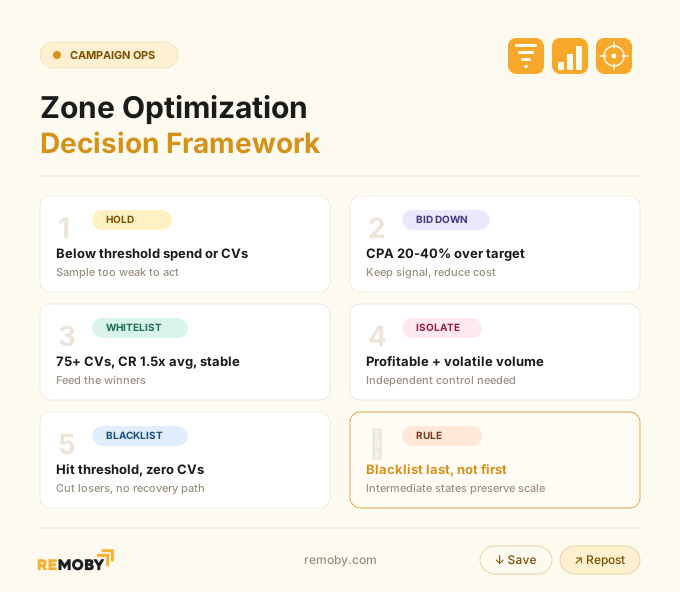
The matrix is clean on paper. Mixed traffic is where it usually gets messy.
Bad zone or bad segment? How to diagnose mixed traffic
Weak zone diagnosis starts with segment concentration, not instinct. If a zone has meaningful volume and the loss clusters in one device, OS, browser, or GEO slice, treat the segment as the problem first. A practical trigger is 1,000+ impressions or enough visits to show one subset absorbing most spend with clearly worse CPA; then split or filter before blacklisting the full zone.
Use this workflow:
- Pull a zone dump from the tracker.
- Sort by spend, then payable conversions.
- Break the suspect zone by GEO, device, OS, browser, and lander.
- Check whether one subset drives most of the loss.
- Segment or isolate first; blacklist only if weakness stays broad.
A classic false cut is a zone that is 80% good mobile and 20% junk desktop. If one slice carries the damage, cutting the whole placement cleanup list is the expensive shortcut.
Segmentation by GEO, device, OS, and browser
If you run RON too long, campaign averages hide where the traffic actually breaks. GEO first, then device, then OS/browser gives the fastest path because those layers usually change both intent and auction price.
Luke Kling has recommended splitting mobile and desktop early; the logic remains sound. A zone can behave like two different publishers once browser and device split out. One Android Chrome slice prints FTDs, one iOS Safari slice burns spend, and the zone average tells you neither.
Do segmentation first on high-volume zones. Do not waste time slicing tiny zones into statistical confetti (this is where most implementations break). After segmentation, the next mistake is letting automation make decisions it cannot understand.
Common zone optimization mistakes and false-cut scenarios
Blacklisting after spend with no conversions is correct only after the zone reaches the right spend multiple for that event type and passes a segment review. Zero-conversion spend on 10-15 impressions is bad luck, not evidence; zero-conversion spend after 2x CPA on a registration flow is evidence.
The costly mistakes repeat:
- Cutting on CTR instead of payable events
- Blacklisting high-volume mixed zones before device/OS review
- Promoting zones on thin conversion counts
- Optimizing on redeposit instead of FTD quality at campaign level
The ruinous cuts usually look disciplined in the spreadsheet before they show up in lost volume.
What to automate vs review manually
Automation boundaries are narrower than most buyers want. Safe auto-rules include hard blacklist rules after threshold spend with zero conversions, spend caps, duplicate blacklist imports, and alerts for missing zone IDs or spend mismatch. Manual review should keep whitelisting, isolation, segment-based bid-downs, and sudden reversals after one event spike.
RichAds exposes automated rules and micro-bidding features — useful tools, but rule governance matters more than feature depth. Review the auto-blacklist log daily and reinstate premature cuts when a low-CR offer was still learning.
Once cleanup stops the bleeding, scaling becomes a bidding problem before it becomes a sourcing problem.
How to scale after zone cleanup
Scaling after cleanup starts with zone bids, not broader traffic. Raise bids first on proven zones, watch CPM closely, and isolate only when the zone is large enough to deserve separate control. If CPM jumps 20%+ without matching EPC movement, you are buying marginal impressions instead of useful volume (industry benchmark).
The order matters:
- Feed the winners inside the current campaign.
- Isolate high-volume profitable zones into dedicated campaigns.
- Expand only into adjacent winning segments, not the whole RON pool.
Cheap scale usually comes from the zones you already understand. Where to put the freed-up spend — campaign splits, GEO caps, rebalancing – is covered in budget allocation in pop traffic.
Ready to launch with Remoby?
FAQ for popunder zone optimization
If you scrolled the page without reading anything, here's 5 questions that summarize this article
A popunder zone earns a trustworthy read when it clears the spend multiple for its event type, not after a fixed number of days. For a registration flow that usually means 1.5-2x target CPA; for FTD or sale, 2.5-3x before any cut. Time matters less than spend depth — a zone can burn through a clean read in hours on high volume, or take a week on a thin source.
Reusing a zone blacklist across GEOs or offers is risky because the traffic mix underneath the zone ID changes. The same publisher zone can carry different device, OS, and intent splits in another market, so a list built for one funnel can cut profitable inventory in the next. Keep GEO-specific blacklists, and treat an imported list as a starting filter to validate, not a finished decision.
Optimizing popunder zones on the network dashboard alone is possible but unreliable, because most dashboards can't cleanly split zone by device, OS, browser, and post-click behavior at once. Without that, a mixed zone reads as one bad placement instead of one good segment and one junk segment. An external tracker — Voluum, Binom, RedTrack, or Keitaro — is what makes the bad-zone-versus-bad-segment call possible in the first place.
Zone action depends on threshold first, then efficiency. Hold below threshold, blacklist after threshold spend with no payable event, bid down when the zone converts above target CPA, whitelist after stable high-volume outperformance, and isolate when a profitable zone needs its own bid, budget, or segmentation rules.
Zone metrics that matter are spend VS target CPA, conversion count, CPA, profit or ROI, and EPV/EPC versus CPM. CTR is usually secondary on pop traffic because it does not tell you whether the zone can produce the event you actually get paid for.
![Pop Ads CPM in India [2026]](https://remoby.com/wp-content/uploads/2026/07/Screenshot-2026-07-30-at-17.09.10-768x432.png)