Updated: June 8, 2026
|
6 min read
Updated: June 8, 2026
|
6 min read
How Ad Networks Match Ads to Websites Step by Step (RTB Explained)


How ad networks match ads to websites step by step works as a millisecond-level chain: a page loads, an ad request is created, an SSP sends it to demand sources, DSPs evaluate the impression using targeting signals, bids are calculated based on predicted value, and the winning ad is returned and rendered – all in under 100 milliseconds.
How ad networks match ads to websites step by step in real time
Ad networks match ads to websites step by step by triggering an ad request on page load, sending it through an SSP to exchanges and DSPs, evaluating the impression using targeting and models, running an auction, and returning the winning creative for rendering in milliseconds.
1) 0–20 ms: Page load or app open initializes ad slot
The browser or app SDK fires an ad tag. It defines slot size, placement ID, format, and constraints. This is where viewability and format eligibility are set.
2) 20–40 ms: SSP creates and routes bid request
The SSP packages the impression and routes it to demand sources, often via one or more exchanges or direct DSP connections. Floors, deal IDs, and filtering are applied before distribution.
3) 40–80 ms: DSPs evaluate and decide whether to bid
DSPs receive the bid request and evaluate user, device, and context signals. Most impressions are skipped if they don’t meet value thresholds.
4) 80–100 ms: DSPs submit bids and creatives
Eligible DSPs return bid responses containing price, creative, and metadata within strict timeouts.
5) ~100 ms: Auction runs and winner is selected
The exchange or SSP selects a winner based on bid and internal ranking logic (often first-price with constraints).
6) 100–120 ms: Ad is returned and rendered
The winning creative is passed back through the SSP to the page or app and displayed. Impression tracking begins upon render and viewability conditions.
Bid request and response mechanics
Bid request mechanics define how impression data is transmitted to DSPs, including user, device, and placement fields, and how DSPs respond with bids, creatives, and decision signals under tight time constraints.
A typical bid request includes:
- Geo (country, region, sometimes city)
- Device (OS, model, browser, connection type)
- Placement (size, position, app or web)
- User data (IDs, segments, behavioral signals)
These fields directly determine whether a DSP can bid and how much. Missing or malformed data reduces bid density.
Bid response mechanics:
- DSP evaluates the request using predictive models
- Calculates bid = expected value adjusted for pacing and risk
- Returns price, creative, and tracking info
- Must respond within latency limits or be excluded
Example: If payout = $20 and predicted conversion rate = 2%, expected value is $0.40. The DSP may bid below this (e.g., $0.25–$0.35) after margin and pacing adjustments.
How signals influence ad matching decisions
Targeting signals influence ad matching by feeding into DSP models that estimate conversion probability and expected value, directly determining whether a bid is placed and how high it is.
Key signal categories:
- Behavioral: past activity, intent segments, retargeting IDs
- Contextual: page topic, content type, historical performance of placement
- Geo: country and region filters, purchasing power signals
- Device: OS, app vs web, connection type, hardware capabilities
The logic is that a high-intent user in a premium geo on a compatible device increases predicted conversion probability. That raises expected value, leading to higher bids and more aggressive participation in auctions.
Low-quality or uncertain signals reduce confidence, lowering bids or causing DSPs to skip the impression entirely.
What happens during a real-time bidding ad auction
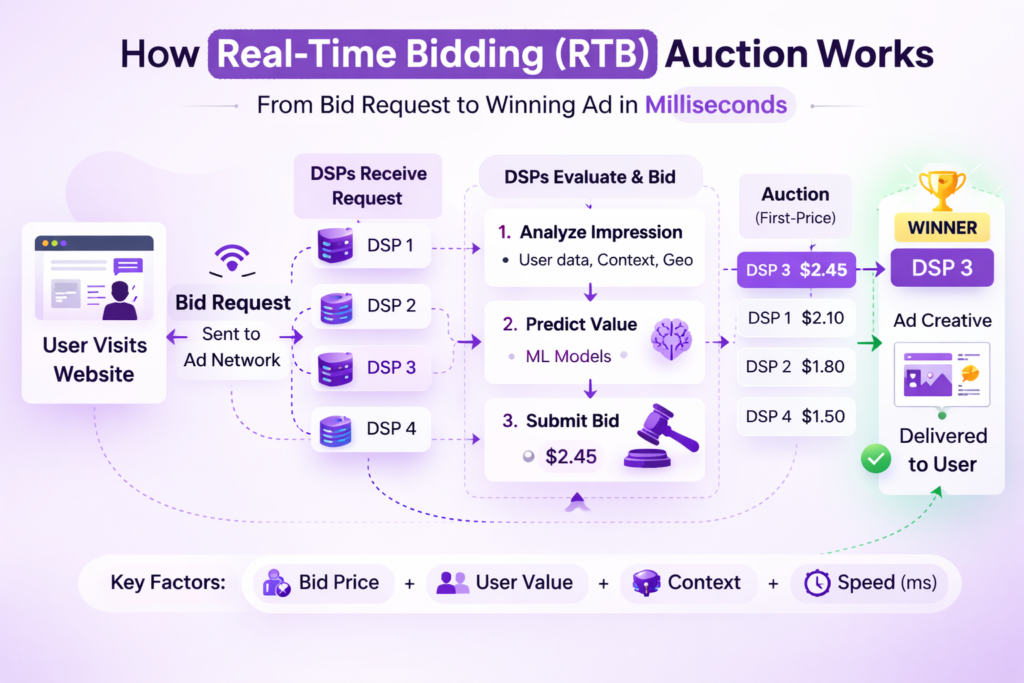
Real-time bidding auction is the process where multiple DSPs receive a bid request, evaluate it, submit bids, and compete in a time-constrained auction where a winner is selected based on bid value and platform rules.
Core steps:
- Bid request distributed to multiple DSPs
- DSPs filter and evaluate impression quality
- Bids generated using predictive models
- Auction executed (commonly first-price)
- Winner selected and creative returned
Comparison of auction types:
- First-price: winner pays their bid; requires bid shading to avoid overpaying
- Second-price: winner pays slightly above second-highest bid; now rare or hybridized
Modern auctions are mostly first-price, but ranking logic may include floors and eligibility filters.
How DSPs calculate bids using expected value models
DSP bidding logic calculates bids as expected value (probability × payoff), then adjusts for pacing, budget constraints, and risk filters before submitting a final bid.
Ready to launch with Remoby?
Inputs used in bidding:
- Predicted CTR and CVR
- Historical performance of similar impressions
- Campaign goals and budget pacing
- Fraud and quality filters
Example: If predicted CVR = 1.5% and payout = $30, expected value = $0.45. The DSP may bid lower (e.g., $0.30) to maintain margin and stable delivery.
Most impressions never receive a bid because they fail to meet minimum value thresholds.
Auction mechanics and why the highest bid doesn’t always win
Auction mechanics determine winners using bid price, floor constraints, and platform-specific ranking logic, which means the highest raw bid does not always guarantee delivery.
Key factors:
- Floor prices: minimum thresholds set by publishers or SSPs
- Eligibility filters: creative approval, format compatibility
- Bid adjustments: DSP-side value modeling already incorporates quality
Clarification:
In many exchanges, the highest eligible bid above the floor wins. However, DSPs embed quality into bids themselves, so lower-quality impressions receive lower bids or no bids at all.
As a result, better-performing impressions attract higher value bids, not just higher arbitrary prices.
How DSPs, SSPs, ad exchanges, and ad networks interact during matching
DSPs and SSPs interact by exchanging bid requests and responses through exchanges or direct connections, where SSPs represent publisher inventory and DSPs represent advertiser demand in a coordinated auction process.
Roles in the flow:
- SSP: packages inventory, applies floors, routes requests
- DSP: evaluates impressions and submits bids
- Ad exchange: facilitates auction and connectivity
- Ad network: aggregates demand or supply, sometimes acting as an intermediary layer
These components operate simultaneously within the same auction cycle, enabling large-scale automated matching.
Ad relevance and quality logic inside bidding systems
Ad relevance and quality are embedded into DSP bid calculations rather than applied as a separate external score, influencing both bid price and participation decisions.
Mechanisms:
- Higher predicted CTR → higher expected value → higher bid
- Poor engagement history → reduced bids or filtering
- Slow or low-quality landing pages → degraded performance signals
This integration ensures that ads likely to perform well are naturally more competitive in auctions.
How matching differs across inventory types
Ad matching differs across inventory types because formats, signals, and user behavior vary between environments like display, video, native, and mobile apps. These differences influence both bid strategies and auction dynamics.
Examples:
- Display: fast auctions, lower signal depth, high volume
- Video: higher CPMs, stricter latency and format constraints
- Native: strong contextual alignment and creative variation
- Mobile in-app: SDK-driven, richer device signals, event-based triggers
Final ad rendering and impression tracking
Ad rendering completes the matching process by delivering the winning creative back to the user’s device and logging the impression when display and viewability conditions are met.
Key points:
- Creative is returned through exchange → SSP → publisher
- Rendering must meet format and latency constraints
- Impression is counted upon display, often tied to viewability standards
Faster, lighter creatives tend to perform better because they render reliably and feed stronger performance data back into DSP models.
Ready to launch with Remoby?
FAQ for matching ads to websites
Ad networks match advertisers with publishers by routing ad requests from publisher pages through SSPs to DSPs, where advertisers evaluate impressions using targeting signals and submit bids. The system runs an automated auction in milliseconds, and the winning ad is returned and displayed based on bid value and eligibility rules.
Ad selection is determined by targeting signals such as user behavior, location, device type, and page context, along with DSP bidding models, campaign goals, floor prices, and auction rules. These factors combine to estimate impression value and decide which advertiser bids and ultimately wins the auction.
Real-time bidding auction is a process where DSPs receive a bid request, evaluate it using predictive models, submit bids with creatives, and compete in a time-limited auction. The system selects a winner based on bid and constraints, and the ad is returned and rendered within roughly 100 milliseconds.
Ad selection sequence starts when a page loads and triggers an ad request, which an SSP sends to DSPs via exchanges. DSPs evaluate the impression, submit bids, and an auction determines the winner. The selected ad is returned and rendered on the page, all within a fraction of a second.
Targeting signals influence ad selection by feeding into DSP models that predict outcomes like clicks or conversions. Higher predicted performance increases expected value, which raises bid amounts and win probability, while weak or uncertain signals reduce bids or cause DSPs to skip the impression.
DSPs and SSPs interact by exchanging bid requests and responses in real time, where the SSP sends impression data and DSPs respond with bids. The SSP or exchange then runs the auction and selects a winner based on bids, floors, and eligibility criteria, completing the matching process.
Highest bid does not always win because auctions include floor prices, eligibility filters, and DSP-side value modeling. While many auctions prioritize the top eligible bid, DSPs already adjust bids based on expected performance, so higher-quality impressions receive stronger bids and dominate outcomes over time.