Updated: September 15, 2026
|
29 min read
Updated: September 15, 2026
|
29 min read
Popunder Ads and Pop Traffic: How the Format Works

An affiliate started popunder ads with pop traffic. The campaign looked alive: cheap CPM, plenty of volume, lander loading fine. Then the CR came back ugly, and the problem wasn’t the tracker or the offer — it was that the affiliate treated pop ads like warm traffic again. Here’s a full overview of what pop traffic is and how to make it profitable.
What are Pop ads?
Pop ads are full-page ads that open a new browser page or tab after a user action on a publisher site. Pop traffic is the inventory advertisers buy through that behavior, usually on a CPM basis. When a user clicks anywhere on a content page, a new page opens with your pre-lander, and the visit is counted as one pop impression delivered by the network.
That umbrella term matters because buyers and networks use it loosely. Some mean any pop format. Some mean popunder inventory only. Some use “pop traffic” to describe the source, not the creative format.
In practice, you buy pops when you want raw reach, fast data, and a full-page interruption that forces a first impression. That works for low-friction funnels. It fails fast on offers that need trust, education, or brand control.
The naming is messy. The mechanics are worse if you don’t map them before launching.
Explain pop ads in simple terms for a beginner marketer
Pop ads are website-triggered visits bought from an ad network, not banner placements inside a page. The user does something on a publisher site, a new page opens, and the advertiser pays for that delivered visit through pop traffic buying.
If you’re new to the format, think of it like this: push traffic waits for a click on a notification, display waits for a click on a banner, but pop buys the page visit itself. That’s why beginners look at it when they need cheap testing volume and don’t care about polished user intent.
The part many new buyers miss is intent temperature. Pop is cold-interrupt traffic. The user did not ask for your offer. Your funnel has to make the case fast, or the visit turns into a bounce and your blacklist fills up in a hurry.
What Is a Popunder Ad?
Popunder ads are pop ads that open behind the active browser window instead of in front of it. Popunder traffic is the most common version sold by ad networks because it is less disruptive at the exact moment of the trigger.
Most media buyers – beginners and experienced user – say “pop” when they really mean popunder. That’s where the terminology confusion starts. On networks like PropellerAds, Adsterra, PopAds, Clickadu, and Remoby, the inventory you test under a pop campaign is often dominated by popunder behavior.
For campaign decisions, the distinction changes user timing more than buying logic. You still care about GEO, zone quality, bid floor, pre-lander angle, and whether the offer can survive cold traffic.
The trigger is the easy part. The timing of attention is where the format gets sneaky.
Popunder vs Popup Ads
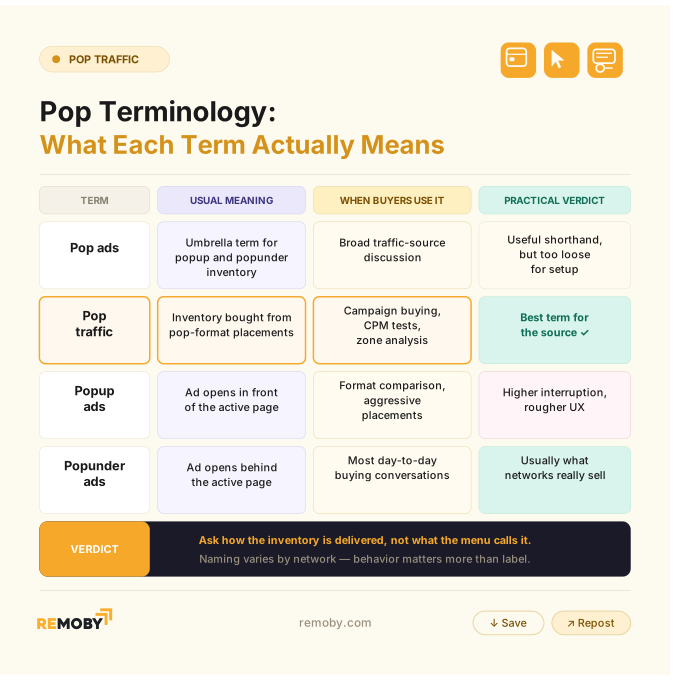
Pop ads are not always the same thing as popup ads, even though people use the terms interchangeably. Pop ads is the broad label buyers use for traffic from windows or tabs opened by a page trigger, while popup usually means the ad appears in front immediately and popunder means it opens behind.
The practical issue is not vocabulary purity. It’s buying the wrong expectation. If you think you’re getting an in-your-face popup and the network serves mostly popunders, your lander, timing assumptions, and even session depth expectations change.
Are pop ads the same thing as popup ads?
Pop ads are a broad category, while popup ads are one specific version of that category. Popup ads appear in front of the current page immediately, and popunder ads open behind the active window. One media buyer may say “I launched pop,” but the source is actually serving mostly popunder placements.
What is the difference between popup and popunder ads?
Most people assume the difference is cosmetic. It isn’t.
A popup interrupts attention immediately; a popunder delays the moment of attention until the user switches tabs or closes the page.
That changes behavior more than most guides admit. Popup traffic is harsher and usually easier for users to reject on sight. Popunder traffic often gets a slightly longer chance because the page is discovered a few seconds later, outside the original browsing action. On weak funnels, that extra moment still won’t save you. On a decent pre-lander, it can be the difference between a dead zone and a whitelist candidate.
I learned this one by sending the same lander to both behaviors and wondering why one source looked “mysteriously cleaner.” It wasn’t mysterious. The user saw it in a different state of mind.
Terminology comparison table
What Is Pop Traffic?
Pop traffic is ad traffic delivered through pop-under or pop-up ad units that open in a new browser window or tab when a user clicks anywhere on a webpage. Unlike banner or native ads, pop ads don’t require the user to click the ad itself — the window opens automatically, showing the advertiser’s page behind or in front of the current one.
Pop traffic is attractive because it gives you volume fast and forces a full-page visit without relying on a banner click or notification opt-in. If you’re pushing a giveaway, social, utility install, or Tier-2 iGaming pre-lander, that matters. You can gather zone-level data quickly, cut bad placements, and move from run-of-network to whitelist buying before the test budget disappears.
It also punishes lazy funnels. Sending pop traffic straight to a raw registration page is a reliable way to buy bounce sessions at scale. I did that with a utility app funnel years ago because the offer owner swore the store page was “already optimized.” The CPI looked impossible until I added a pre-lander that matched the user problem. Then it started behaving like pop traffic instead of throwaway traffic.
Affiliates use the format where the math is forgiving. Expert input here is blunt:
pop performs best with short-funnel, low-commitment offers where cold-traffic CVR can still clear the threshold at low CPMs.
That means giveaway flows, single-field lead gen, utility apps like VPNs and antivirus, and Tier-2/Tier-3 iGaming with localized pre-landers. It does not mean B2B SaaS, mortgages, enterprise software, or high-ticket DTC. Those offers need intent and trust, and pop brings neither on day one.
There is another piece newer buyers miss: minimum bid traffic is usually the leftovers. As one expert note put it, “Minimum-bid traffic is dominated by zones experienced advertisers already blacklisted.” If your unit economics fail at 1.5x the published floor, the test is already telling you something ugly.
Cheap traffic is easy to buy. Buying traffic that stays cheap after the blacklist starts growing is a different game.
How Popunder Ads Work (Technical Flow)
Popunder ads work through a page-level trigger, a network call, an auction or priority decision, and a redirected page load to the advertiser’s URL. A user action on a publisher page starts the sequence, the network picks an eligible campaign for that GEO and zone, and the winning ad opens as a new page behind the current window. For example, a click on a download page triggers a network script, the system checks bids and rules, and the user’s browser loads your pre-lander.
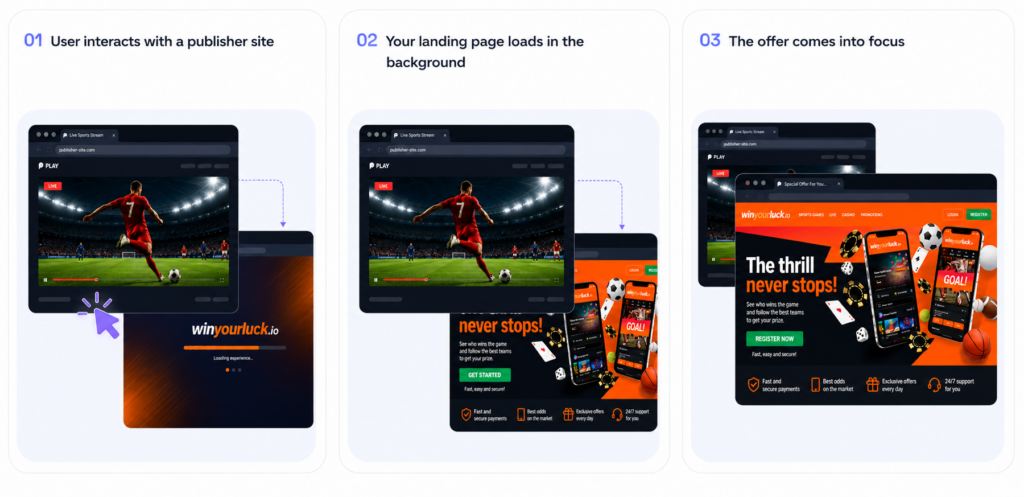
The technical flow sounds simple, but small setup misses wreck tests. Bad tokens, wrong macros, busted frequency rules, or an offer URL that drops parameters can make a source look bad when the plumbing is the real problem.
Common triggers that open a pop ad
What goes wrong first is assuming every pop is tied to the same user action. It isn’t. The trigger depends on the publisher integration and browser constraints.
Common triggers include:
- Clicks on page elements or blank areas.
- First interaction on page after load.
- Buttons tied to download, play, or continue actions.
- Scripted triggers limited by browser behavior and publisher rules.
On the publisher side, those triggers sit inside site scripts or ad tags. On the advertiser side, you only see the result: a visit from a given zone, browser, device, and GEO. This is why zone reports matter more than broad source labels.
What happens between the trigger, network auction, and landing-page load
If you buy pops without understanding the handoff, troubleshooting gets sloppy fast. The visit doesn’t teleport from publisher to lander. The network has to validate targeting, bid, caps, and availability before your page loads.
The path usually looks like this:
- User action fires the publisher-side pop script.
- The ad network receives the request with device, browser, zone, and GEO data.
- Eligible campaigns are filtered by targeting rules, bid floor, frequency caps, and budget availability.
- The winning campaign is chosen through the network’s auction or priority logic.
- The browser opens the destination URL, often through a tracking redirect.
- Your tracker, such as Voluum, Binom, RedTrack, or Keitaro, records the visit and passes tokens downstream.
- The lander or pre-lander loads, and the user either bounces or enters the funnel.
That is the delivery chain in plain English. The important part for buyers is where delay or loss happens: between trigger and page load, between redirect and tracker, or after the lander opens when the user never engages.
The page can load perfectly and still fail the test. Delivery is only half the argument; attention is the other half.
Why Popunders Open Behind the Window
Browser rules, user experience pressure, and publisher monetization all push the format toward opening behind the active page. Google Chrome and other major browsers have spent years restricting intrusive front-loaded pop behavior, so networks and publishers leaned harder into popunders as the version more likely to pass through in real browsing conditions (Google Chrome Help, MDN Web Docs).
For advertisers, the reason matters less than the consequence. A popunder doesn’t fight for attention immediately. It waits. That delay can soften the interruption, but it also means the session starts cold and late. Your timestamp says the visit happened now; the user’s attention says maybe not yet.
That’s why short-funnel offers survive here better. The user finds the page later, scans it, and either takes a low-friction action or closes it. There isn’t much room for long copy, complicated forms, or trust-building assets.
If you treat that delayed attention like a real-time click, the numbers will lie to you for a day or two before the CPA report catches up.
When Users Actually See Popunder Ads
If you picture the ad being seen at the exact trigger moment, you’ll misread both behavior and performance. Users often notice popunders only after closing the original page, switching tabs, or returning to the browser later.
That gap creates strange patterns in the data. Session duration can look weird. Bounce can spike without telling the whole story. Conversion lag can stretch because the impression, visit, and actual attention aren’t perfectly aligned. On utility and iGaming funnels, that is normal. On high-consideration funnels, it is fatal.
A good buyer reads this format with timing in mind. If a zone sends volume but the post-lander engagement is dead across browsers and devices, the problem is often not that the traffic never arrived. The problem is that the ad was seen in a low-intent moment and your page asked for too much too fast.
The user finally notices the page. Now the format has done its job. The harder question is whether pop deserved the test against other traffic sources in the first place.
Pop ads vs push ads, display ads, and interstitials
Pop ads differ from push ads and display ads because they buy a forced page visit, not a voluntary click on a message or banner. Push depends on notification engagement, display depends on creative click-through, and interstitials appear inside the content flow rather than opening a separate page.
For channel choice, the real difference is user state. Pop is cold-interrupt. Push is also interruptive, but the user still chooses to click. Display is weaker per impression but often less abrasive. Interstitials are high-visibility too, yet they stay tied to the app or page experience instead of spawning a separate browsing context.
Comparison table: pop ads vs push ads vs display ads vs interstitials
| Format | How attention starts | User intent | Common buying use | Typical strength | Main weakness |
| Pop | Page opens after site trigger | Cold | Fast testing, utility installs, giveaway, Tier-2/3 iGaming | Huge volume, full-page presence | Intrusive, weak trust |
| Push | User clicks a notification | Warmer than pop | Mid-funnel affiliate offers, retarget-style angles, broad testing | Better engagement signal | Lower raw volume than pop |
| Display | User clicks a banner/native unit | Usually cold to mixed | Broader brand/performance mix | More placement control | Lower direct-response force |
| Interstitial | Full-screen ad inside app/page flow | Mixed | App monetization, mobile flows | High visibility | UX friction, context dependent |
| Verdict | Choose by user state, not by CPM alone | Pop wins on forced reach | Push/display win on cleaner intent |
Pros and cons of pop traffic for advertisers
Pop traffic gives advertisers cheap reach, fast testing volume, and a full-page chance to sell a low-friction offer — but it also brings intrusive delivery, cold intent, weak brand control, and bigger quality spread between zones. A good example is when a Tier-2 giveaway funnel can work on a $0.80 CPM and a $3 payout, while the same traffic source can destroy a high-ticket finance offer because the user never wanted that conversation in the first place.
I’ve had pop campaigns go profitable before noon and still die by day three because the first winning zones fatigued fast. That is the trap with this source: early momentum looks cleaner than long-run survivability. (this is the part buyers usually skip)
Advantages: reach, volume, and direct response potential
Tier-2 starting budgets around $150-$300 per day and Tier-3 starting budgets around $50-$150 are often enough to get readable zone data on pop, while Tier-1 usually needs $300-$500 a day before the noise settles. That entry point is exactly why affiliates keep testing it.
The upside is straightforward:
- Full-page delivery gives the offer a real chance to be seen.
- Volume comes faster than many push or display tests in the same GEO.
- Low CPMs leave room for low-payout funnels to work.
- Utility installs, giveaway, social, and Tier-2/3 iGaming can match the traffic psychology well.
One network worth testing for Tier-2 pop is Remoby, especially if you’re comparing direct publisher-heavy sources against broader market inventory. Not because the format becomes magical there. Because Tier-2/3 supply quality and zone consistency matter more than fancy auction language when you’re building a whitelist.
Trade-offs: intrusiveness, cold intent, traffic quality, and brand risk
What most buyers underestimate is how unforgiving pop gets when the offer and placement don’t match. The format itself is the filter. If the user needs trust, context, compliance comfort, or high intent, you lose before the lander loads.
That makes the trade-offs pretty hard-edged:
- Intrusiveness creates immediate bounce risk.
- Traffic quality varies hard by zone, browser, and publisher behavior.
- Brand-sensitive categories take reputational risk they cannot control.
- Tier-1 regulated finance and iGaming add compliance exposure on top of weak economics.
- Minimum-bid buying usually pulls the zones better buyers already blacklisted.
Expert input was clear here: brand-sensitive advertisers and high-consideration purchases should avoid pop traffic entirely. I agree. If you’re selling B2B software, mortgages, insurance, or anything that needs credibility on first contact, pop is not a “cheaper test.” It’s an expensive way to confirm a bad fit.
The format can buy you reach. Whether it buys you enough intent to survive pricing, launch, and scaling is the next fight.
To make that decision practical, the next step is knowing exactly when pop belongs in the media plan and when it should be cut before launch.
Ready to launch with Remoby?
When advertisers should test pop traffic and when to avoid it
Pop ads belong in the test plan when the funnel is short, the payout is modest, and the offer can survive cold-interrupt traffic. Pop ads should stay off the plan when the sale needs trust, compliance control, or a user who actually meant to start the journey. For instance, a localized Tier-2 iGaming pre-lander or a utility app install can work on low CPMs, while B2B SaaS or regulated finance usually burns through budget without giving you a fair read.
The useful split is not “good format” versus “bad format.” It’s whether the traffic source matches the ask you’re making from the user. If the first page can get a click with one promise and one action, pop deserves a test. If the funnel needs education, comparison, or reassurance, skip the pop campaign and save yourself the postmortem.
Main advertiser use cases that fit pop traffic
$1-$10 per conversion is the payout band where pop often starts making practical sense for giveaway and lead-gen flows, especially in Tier-2 and Tier-3 GEOs from the expert input. That range leaves room for a weak first impression, a few bad zones, and still enough margin to optimize the blacklist before the campaign dies.
The best fits are boring in a good way:
- Giveaway and lead-gen funnels with one-field or short-form actions.
- Utility installs like VPNs, antivirus, cleaners, and browser extensions.
- Tier-2 and Tier-3 iGaming with localized pre-lander angles.
- Social offers where curiosity beats trust requirements.
That list is not random. Each case asks the user for a low-commitment action after a forced visit. That is the whole game with pop. You are not building desire from scratch; you are trying to catch curiosity before the tab gets closed.
I learned this the expensive way on a utility funnel that looked too plain to work. The lander was ugly, the copy was short, and I nearly replaced it with something “cleaner.” The ugly page won because it matched the interrupt better. The polished version looked like an ad and died.
Tier-2 and Tier-3 iGaming are still where most buyers make pop work because paid-platform alternatives are thinner and competition is cheaper there, based on the expert notes. A Bet365 or 1xBet style angle with a localized pre-lander, local currency, and one clear next step has a real shot. A cold user thrown straight onto a registration form does not. (yes, I’ve done this too)
The same logic explains why utility apps keep showing up in winning whitelists. When a user lands from a download page, file-hosting page, or general “fix your device” environment, the install psychology lines up with the format. The expert line on this was accurate: pop’s full-page interrupt matches the “something needs fixing” mindset.
Good fit is only step one. The faster way to save budget is knowing what should never be tested at all.
Poor-fit scenarios and red flags before launch
What kills campaigns here is not bad traffic. It is bad matchmaking between the source and the funnel.
If you send pop to B2B SaaS, enterprise software, insurance, mortgages, or high-ticket DTC, the CR usually collapses before zone optimization even starts. The user did not ask for a product demo, did not plan to compare plans, and definitely did not arrive ready to trust a brand on first contact. That is not a testing problem. That is a channel mismatch.
The same goes for brand-sensitive advertisers. Uncontrolled placements, inconsistent publisher environments, and weak context control make pop a rough place to defend reputation. In regulated finance and Tier-1 iGaming, you also add compliance exposure on top of poor economics. KYC, responsible gambling controls, disclosure requirements, and stricter review standards do not pair well with forced-entry traffic.
Red flags before launch are usually visible early if you stop lying to yourself:
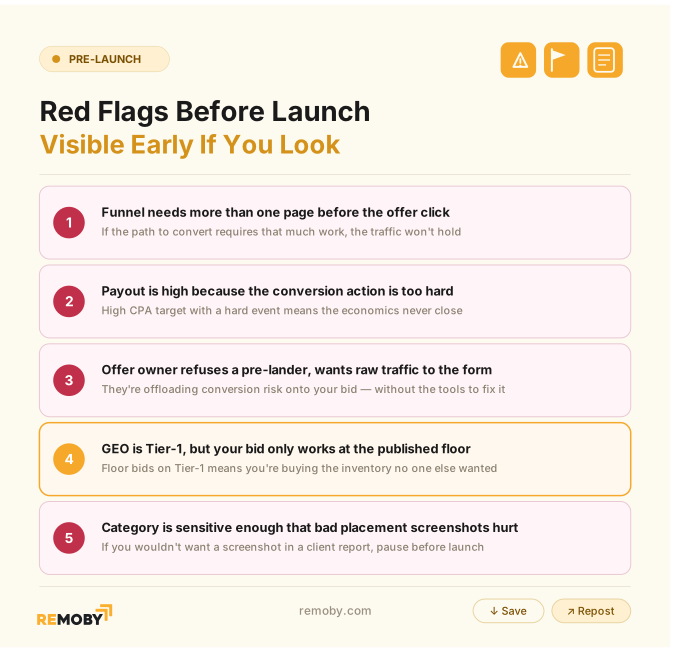
That fourth point matters more than beginners think. Expert input was blunt: if the unit economics do not work at 1.5x the network’s published minimum CPM, the campaign will not survive the test phase. Minimum-bid pop is usually whatever stronger buyers already blacklisted (this is the part everyone skips).
I have also seen buyers blame the network when the real issue was the offer owner’s restrictions. No pre-lander, no angle testing, no localized copy, and then surprise when run-of-network pop traffic bounces at scale. That is not a traffic mystery.
Once the obvious bad fits are gone, the decision gets easier when you force it into a table instead of a debate in your own head.
Decision table: use pop traffic vs avoid pop traffic
Most people assume the question is whether the CPM is cheap enough. In reality, the decision is whether the funnel can convert before trust becomes the bottleneck.
| Scenario | Use pop traffic | Avoid pop traffic | Why |
| Giveaway lead-gen | Yes | Low-friction action can clear on cold traffic | |
| Utility installs | Yes | Full-page interrupt matches install behavior | |
| Tier-2/3 iGaming with pre-lander | Yes | Localized angle can warm cold visits fast | |
| Social offers | Yes, selectively | Curiosity-driven flows can work with strict zone control | |
| B2B SaaS | Yes | Needs trust, comparison, and intent | |
| Insurance or mortgages | Yes | High consideration kills CVR on pop | |
| Tier-1 regulated finance | Yes | Compliance and placement risk are too high | |
| High-ticket ecommerce | Yes | Forced visit rarely supports premium purchase behavior | |
| Brand-lift or reputation campaigns | Yes | Placement control is too loose | |
| Verdict | Use pop for short funnels and low-friction actions | Avoid pop when trust is the sale | The source is an intent filter before it is a pricing decision |
A table like this looks obvious after you’ve lost money in the wrong vertical. Before launch, it saves arguments.
The go/no-go call is clear. The next mistake buyers make is assuming pricing on pop works like the cleaner traffic sources they’re used to.
How pop ads are usually priced by traffic networks
Pop ads are usually priced on CPM, with the advertiser paying for delivered impressions or visits generated by the pop placement rather than for a click on a creative unit. Networks then layer bid floors, zone competition, GEO pricing, and frequency rules on top of that basic model, e.g. a buyer bids above the floor in a Tier-2 GEO to win cleaner popunder zones, while a floor bid often pulls leftover run-of-network traffic.
To see real-time CPM by GEO, go to our live Traffic Chart
The part newer buyers miss is that the published minimum bid is not the real market price for workable traffic. It is the entry ticket to whatever inventory nobody else fought for. If you want zones that stay alive after blacklisting the worst placements, you usually end up buying in the middle of the bid distribution, not at the floor.
Typical buying models, CPM logic, and budget expectations
If you launch pop like a CPC campaign in your head, the read gets messy fast.
Most networks in this category sell on CPM logic, even when the interface makes the setup feel simplified. You are paying for exposure delivered through the pop or popunder event, then judging the source through downstream metrics: lander engagement, offer click, CR, ROI, and how quickly the blacklist grows. That means a low CPM is only useful when the visit quality stays stable after the first round of cuts.
The numbers from the brief are practical enough to plan around:
- Tier-3 blended pop CPM: $0.10-$0.60
- Tier-2 blended pop CPM: $0.50-$2.00
- Tier-1 blended pop CPM: $1.50-$4.00, with strong zones in competitive verticals reaching $5-$10
Those ranges tell you where to test, not what you will pay forever. Tier-2 is where many campaigns still get a fair shot because the CPM is cheap enough to collect zone data without instantly blowing past payout limits. Tier-1 is a different fight. The expert notes described Tier-1 iGaming as brutal, and that matches what I’ve seen. The floor looks tempting until the real zones start requiring bids you didn’t budget for.
To see real-time CPM by GEO, go to our live Traffic Chart
Budget expectations should follow the same logic:
- Tier-3: start around $50-$150 per day, often across multiple GEOs if volume is thin.
- Tier-2: start around $150-$300 per day for readable zone-level data.
- Tier-1: expect at least $300-$500 per day before the signal stops looking random.
That is testing budget, not scaling budget. If the offer pays $3 and your GEO needs a $2.40 effective CPA to leave room for volatility, a $60 test is not a test. It is a coin flip pretending to be data.
I used to love winning traffic at the floor because it made the dashboard look efficient. Then the blacklist grew, the whitelist stayed empty, and the campaign taught me what cheap really means.
A first pass on networks such as PropellerAds, Adsterra, PopAds, Clickadu, or Remoby (one network worth testing for Tier-2 pop) should focus less on the cheapest bid and more on whether you can hold economics after bidding above the floor. If you cannot, the traffic source is answering you already.
Pricing tells you how to enter. Benchmarks tell you whether the source is misbehaving or your funnel is.
Compact pricing table: pricing model, what you pay for, and beginner budgeting cues
The fastest way to misread pop is to compare a cheap CPM against a push CPC without adjusting for user intent.
| Pricing model | What you pay for | Where it shows up in pop buying | Beginner budgeting cue |
| CPM | 1,000 delivered impressions/visits | Standard model across pop networks | Best starting point; judge via downstream CR |
| Smart bidding / auto rules | Bid adjustments set by the platform or rules engine | Common in larger networks | Use only after you understand winning zones manually |
| Zone-based bidding | Different effective prices by placement quality | Happens even under a CPM shell | Expect better zones to sit well above floor |
| Frequency cap controls | Limits repeated exposure per user | Affects spend speed and quality | Tight caps protect budget during testing |
| Verdict | You are buying delivered exposure, then filtering for quality | Floor price is not quality price | Budget for optimization, not for a lucky day-one result |
That last point matters because budgeting errors on pop are usually emotional. Buyers underfund the learning phase, then overreact to ugly early CR before enough zone data exists.
Performance Benchmarks (CPM, CTR, Conversions)
Tier-2 CPM around $0.50-$2.00 and Tier-3 around $0.10-$0.60 are the starting references that actually help on pop, because CTR is not the main steering wheel here. You still watch clickout rate from the pre-lander and conversion rate on the offer, but CPM and post-visit behavior tell you more than a headline CTR ever will.
That said, beginners keep asking for universal pop benchmarks as if the format behaves like display. It does not. Pop traffic performance swings harder by zone, browser, device, and pre-lander than most sources. One whitelist can carry the whole campaign while the rest of run-of-network burns cash.
Here is the practical way I read benchmark buckets on a fresh pop test:
- CPM: fine if it sits inside GEO norms and does not spike after raising bids.
- Pre-lander clickout rate: useful early signal for message match.
- Offer CR: the truth metric once enough volume lands.
- Conversion lag: important on popunder because attention is delayed.
On a utility or giveaway funnel, a decent pre-lander clickout can tell you the angle is alive even before full conversion volume shows up. On Tier-2 iGaming, a weak clickout usually means the page lost the user before the offer owner even had a chance. That is why I do not obsess over CTR headlines here. If the user hits the lander and nothing moves, the campaign is already telling you what matters.
A rough operating rule: if zone-level spend is stacking and the pre-lander cannot create any separation between good and bad placements, the funnel is too weak for the source. If you only have a CPM story and no clickout story, the pop campaign is decoration.
The benchmark question sounds simple. The harder one is how often to show the page before a zone turns from profitable to irritating.
Frequency Capping in Pop Traffic
What goes wrong fast is leaving frequency too loose because the first conversions make the source look cleaner than it is.
Frequency capping in pop is less about user comfort and more about not paying three times for the same annoyed person. Repeated forced visits from the same browser can inflate traffic volume, muddy zone reads, and make a mediocre placement look busier than it deserves.
For testing, I prefer conservative caps first:
- Start with 1 impression per 24 hours on broad run-of-network tests.
- Open to 2 per 24 hours only after the whitelist starts showing repeat value.
- Split browser and device reports before relaxing the cap further (more on cap selection and testing cadence >>).
This is one of those settings buyers skip because it feels secondary. Then the campaign gets plenty of traffic, weak unique reach, and weird CR decay by day two. The source did not suddenly fail. You kept paying to remind the same user that they never wanted the page.
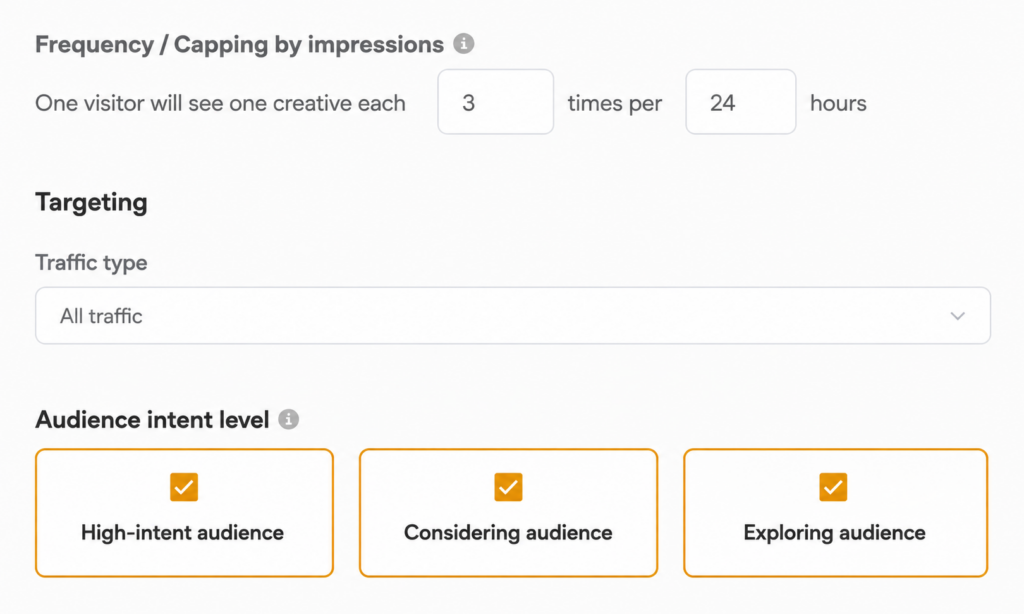
There are exceptions. Some utility and social flows can tolerate slightly higher frequency if the publisher environment keeps rotating and the action remains low friction. But if your zone-level ROI only exists at aggressive repeat exposure, it is not really a stable win. It is borrowed performance.
Cap too tight and you starve the test. Cap too loose and you buy fake comfort from repeated exposure. Launch settings decide which mistake you make first.
How to Launch a Pop Traffic Campaign
Most guides tell you to start broad and optimize later. That is half right, and half how budgets disappear.
A workable launch for pop needs structure from day one:
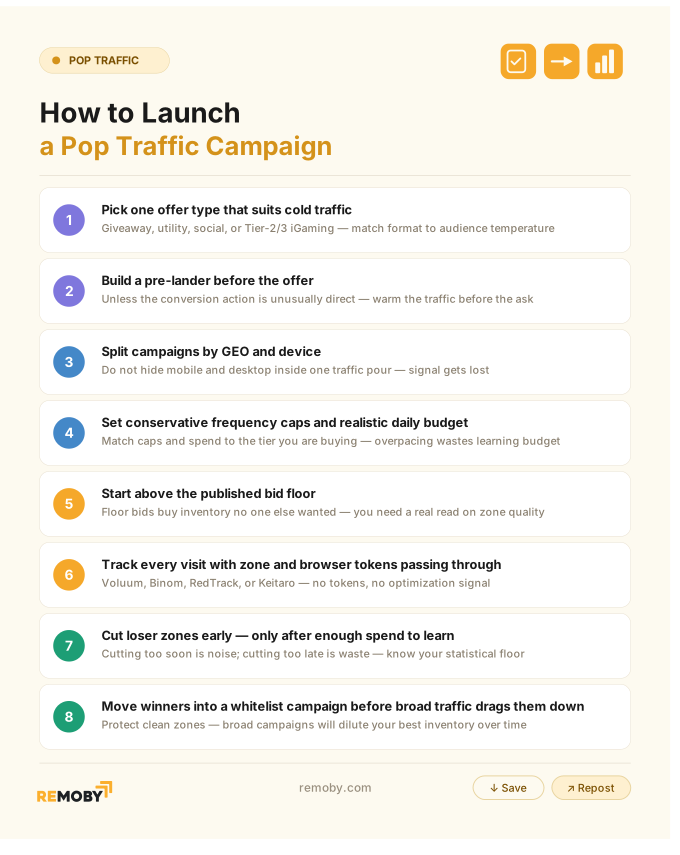
That is the launch sequence I wish I had followed earlier on a lot of my tests. Sending raw pop straight to the offer with mixed devices and floor bids is not a launch method. It is a fast way to create confusing data and then blame the source. For more tips go to our pop ads campaign setup playbook.
One non-obvious optimization: keep pre-lander variants simpler than you think.
With popunder traffic, the user often discovers the page a beat later and with less patience. Long copy that might survive on push often collapses here. Short headline, one promise, one button. Anything else has to earn its space.
A campaign can be perfectly launched and still fail if the network itself makes it too hard to find stable zones.
Choosing a Pop Ad Network
The mistake is choosing a network by minimum bid instead of by how easy it is to control quality.
When I compare pop sources, I care about five things first:
- Depth of zone reporting.
- Ability to whitelist and blacklist quickly.
- GEO strength in the markets I actually buy.
- Traffic consistency after bid changes.
- Support for trackers, tokens, and postback-friendly setup.
That is why two networks with similar CPMs can perform very differently in practice. If one source hides placement detail or mixes quality too aggressively inside run-of-network traffic, optimization gets slower and more expensive. A side-by-side pop ad network comparison for advertisers covers reporting depth, deposits, and quality controls.
For named options, PropellerAds, Adsterra, PopAds, Clickadu, and Remoby all belong on the shortlist depending on GEO and vertical. Remoby matters mostly when Tier-2 and Tier-3 direct publisher relationships are the angle you want to test, not because any one source magically fixes a bad funnel.
I also look at how a network behaves after the first blacklist wave. Some sources look great until you cut 30% of zones. Then volume disappears or the remaining traffic gets noisy. That is useful information. A network that keeps delivering workable placements after aggressive cleanup is easier to scale from test to whitelist.
The network can be solid and the campaign can still get blocked, throttled, or made ugly by browser rules and page-quality problems you ignored at setup.
Browser Restrictions and Popup Blocking
Most buyers blame the traffic source when browsers are filtering part of the behavior before the user even notices it.
Modern browser restrictions are one reason popunder became the common delivery shape instead of aggressive front-loaded popup behavior. Chrome, Firefox, and Safari have long pushed against intrusive window-opening patterns, and ad experience standards added more pressure around disruptive formats (Google Chrome Help; Better Ads Standards; MDN Web Docs). That does not kill pop traffic. It changes how inventory is delivered and which placements remain viable.
Browser blocking, platform limits, and Better Ads Standards context
What most people assume is that pop either works or gets blocked. Reality is messier.
Browser behavior depends on user action, script handling, site integration, and whether the ad experience looks too aggressive. A click-triggered popunder tied to a publisher action has a better chance of delivery than front-loaded behavior with no clear user interaction. Chrome’s support documentation and MDN both make the broad direction obvious: unsolicited windows and intrusive behavior face restrictions, while user-initiated actions get more room.
That matters for campaign reading. If a source suddenly loses volume on a browser-device segment, it is not automatically fraud or a broken zone. Sometimes the environment changed upstream. Better Ads Standards also shaped publisher behavior by making the more disruptive experiences riskier for sites that depend on mainstream browser compatibility and ad access.
You do not need to become a browser engineer to buy this format. You do need to segment reports by browser and device so one blocked environment does not distort the whole campaign.
Delivery restrictions are annoying. Compliance mistakes are worse, because they let the traffic through and then create a problem after the spend is already gone.
Ad-quality, landing-page suitability, and compliance checks
If you run weak pages on pop, the format punishes you harder than push or display.
Ad-quality checks here start with the lander and pre-lander, not the network. Page speed, redirect cleanliness, broken buttons, false urgency, and mismatch between angle and offer all hit harder on cold traffic. A bad page on push can limp. A bad page on pop gets closed before the user even understands the ask.
Suitability matters too. Regulated offers, sensitive audiences, and anything that would create real brand damage from a bad placement screenshot need stricter judgment than “the payout is high.” This is where media buyers talk themselves into dumb tests. Maybe the EPC bails it out. It usually doesn’t.
My basic compliance check before launch is plain:
- Make sure the pre-lander claim matches the offer page.
- Check GEO-language match and local payment or currency references where relevant.
- Confirm the advertiser allows pop traffic and pre-landers.
- Review whether the category brings legal or platform risk that outweighs any ROI upside.
That list is not glamorous, but neither is burning spend on traffic the offer owner later rejects.
Ready to launch with Remoby?
Most asked questions about Pop ads
Still got questions? Read on to find answers.
Pop ads are worth testing for beginners when the offer is short-funnel, the payout is modest, and the buyer can track zones properly. Beginners usually get hurt by picking the wrong funnel, not by the format itself. A giveaway flow, utility install, or Tier-2 iGaming pre-lander is a fair first test; B2B or high-ticket finance is not.
Pop ads still work on modern browsers, but delivery is shaped by browser restrictions, user-action rules, and publisher implementation. That is why popunder inventory is more common than aggressive front-facing popup behavior. The format is viable when the source respects current browser limits and the buyer watches browser-level reports instead of treating all traffic the same.
Pop ads are usually bought on CPM, not CPC. The buyer pays for delivered exposure through the pop placement, then optimizes using downstream signals like pre-lander clickout, offer CR, and zone-level ROI. Some platforms add smart bidding layers, but the core buying logic is still CPM-based exposure rather than click-based intent.
![Pop Ads CPM in the United States [2026]](https://remoby.com/wp-content/uploads/2026/07/Screenshot-2026-07-28-at-11.23.44-768x399.png)
![Pop Ads CPM in Indonesia [2026]](https://remoby.com/wp-content/uploads/2026/08/Screenshot-2026-08-03-at-16.38.38-768x431.png)