Updated: July 28, 2026
|
6 min read
Updated: July 28, 2026
|
6 min read
Why Pop Ads Won’t Die: A Realist’s Guide to Profitable Onclick Campaigns

Popunder traffic – often lumped under “onclick” – is the format that refuses to disappear from performance media plans. It’s not because buyers are nostalgic. It’s because popunder solves a massive problem in modern advertising: finding scalable, affordable inventory that produces data fast.
If managed poorly, popunder is a great way to incinerate a budget. But when managed with discipline, it remains one of the most efficient ways to validate offers and scale aggressively.
This guide breaks down the reality of running popunder in the current market: why it works, who it’s for, and how to actually make the economics make sense (featuring traffic quality insights from Remoby).
The Mechanics: It’s Not About “Views,” It’s About the Funnel
At its core, a popunder ad is a new tab or window that opens behind a user’s active browser session after they click on a publisher’s site.
Unlike display banners, which fight for attention within the content layout, popunder is purely a traffic delivery mechanism. It doesn’t rely on a user deciding to click a banner; the user is delivered directly to your landing page. Read our full technical guide to find out how pop ads work.
This distinction changes how media buyers treat the format. You aren’t paying for “brand awareness.” You are paying for a shot at the user’s attention the moment they close their current tab. Because of this, popunder is best used for:
- Rapid Offer Testing
- High-Volume Acquisition
Why Do Advertisers Buy Pop?
The format has staying power because it aligns perfectly with direct-response math.
1. Speed to Signal: In competitive verticals, time is expensive. If you are running a new Betting offer, waiting three days for Facebook to “optimize” is a luxury you might not have. Popunder delivers thousands of visits immediately, allowing you to kill bad landers or angles in real-time.
2. Immunity to “Banner Blindness”: Users have trained themselves to ignore banners. Popunder bypasses that psychological filter by loading your page fully. The challenge shifts from “getting the click” to “keeping them on the page.”
3. The Perfect Fit for Specific Verticals: Popunder isn’t for selling luxury cars. It thrives in high-intent, impulse-driven verticals where the user is already in a consumption mindset. It is the bread and butter for:
- iGaming & Betting: Where localization and pre-landers drive the conversion.
- Utilities & Software: Where speed and trust signals (like antivirus scans or VPNs) need a full page to explain.
- Dating: Where segmentation by device type allows for highly specific messaging.
- Finance: Where broad prospecting is needed to find qualified leads.
Is Popunder “Beginner Friendly”?
Yes and no. The barrier to entry is low (setup is easy), but the barrier to profit is higher than it looks.
New advertisers often fail because they treat pop traffic like Facebook traffic. They throw a direct link to an offer page, target “All Countries,” and wonder why they lost money.
Popunder rewards methodical buyers. It requires you to be obsessive about tracking, strict about cutting bad placements, and smart about using pre-landers to warm up cold traffic. If you aren’t ready to look at a tracker every few hours, this format isn’t for you.
The Quality Problem: How Remoby Solves It
The elephant in the room with pop traffic is bot activity. Because the volume is so high, invalid traffic can slip through the cracks, diluting your data and wasting your ad spend.
With popunder, “quality” means two things:
- Bot Filtration: Ensuring the click comes from a human.
- Actionable Data: Ensuring the traffic source is transparent so you can optimize it.
This is where Remoby focuses its infrastructure. Rather than just opening the floodgates, Remoby employs anti-fraud controls designed to scrub invalid patterns before they hit your budget. For an advertiser, this changes the game. Instead of spending your first week trying to filter out bots, you can focus on optimizing your creatives and landing pages.
Furthermore, Remoby provides manager support to help structure campaigns correctly from day one. Avoiding common setup errors – like mixing desktop and mobile indiscriminately – can save substantial budget during the launch phase.
8 Rules for Running Popunder Without Going Broke
If you are launching a campaign today, ignore the “hacks” and stick to these fundamentals.
1. Anchor to a Real KPI
Never optimize for clicks. Popunder generates clicks effortlessly. If you can’t track conversions (CPA), track a “proxy metric” like time-on-site or button clicks. If you don’t tell the algorithm what success looks like, it will just send you the cheapest, lowest-quality traffic available. And what to do when the KPI drifts after launch? Read about campaign optimization for pop ads.
2. Isolate Your Variables
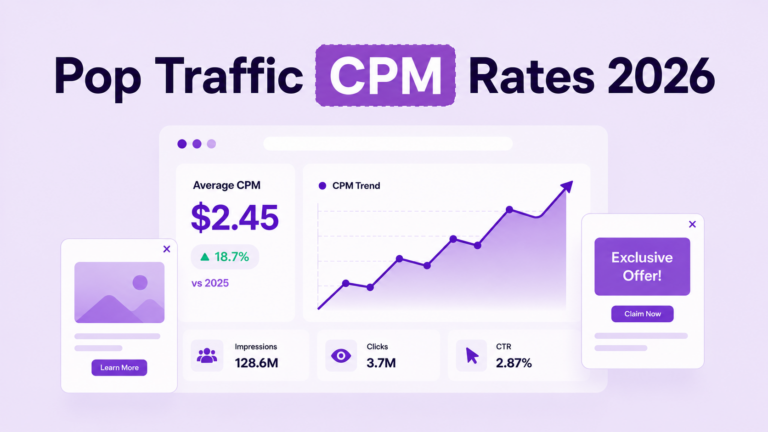
Never run Mobile and Desktop in the same campaign. The user behavior, bid prices, and landing page requirements are completely different. Keep them separate so you can see which one is actually performing. Baseline bids per GEO and device – in our pop traffic CPM benchmarks.
3. The Pre-Lander is Your Filter
Sending pop traffic directly to a registration page is usually a mistake. Use a pre-lander (a bridge page) to frame the offer.
- Example: For a Betting offer, a pre-lander showing “Tonight’s Odds” works better than a generic signup form. It warms the user up and filters out accidental clicks.
Ready to launch with Remoby?
4. Ruthless Placement Hygiene
Popunder performance is often decided by specific “Zone IDs” (websites). You will find that 20% of the sites bring 80% of the conversions. You must actively blacklist the losers and whitelist the winners. This is a daily habit, not a monthly one. We recommend you talk to your account manager about black- and white lists and get familiar with a stage-based framework for this daily habit – blacklist management.
5. Watch the “Boredom” Metrics
Look at your bounce rate and load times. If users are leaving your page in under a second, you don’t have a traffic problem – you have a landing page speed problem. Pop users are impatient; if your page loads slowly, they are gone.
6. Scale Steps, Not Jumps
When you find a winning campaign, resist the urge to double the budget overnight. Pop traffic is volatile. Scale bids and budgets incrementally (10-20%) to ensure the quality holds up as you buy more volume. How to structure those steps inside one source – read in budget allocation in pop traffic blog.
7. Localization is King
You cannot run an English lander in Brazil and expect results. Even small tweaks – like matching the currency symbol or using local slang – can double your conversion rate.
8. Compliance Protects Your Funnel
Especially in Finance and iGaming, aggressive claims get you banned. Ensure your landing pages match the regulatory requirements of the geo you are targeting. It’s better to have a slightly lower CTR than to have your account suspended.
The Bottom Line
Popunder isn’t magic, and it isn’t “dead.” It is a high-volume, industrial-grade tool for performance marketers who know how to build funnels. If you have the discipline to track your data and the patience to optimize your sources, it remains one of the most profitable ways to buy media online.
Ready to test a campaign? Remoby can help you set up your first test with clean traffic and the support you need to avoid the common pitfalls. Contact us, and we will share more insights on how to hit your goals.
Ready to launch with Remoby?
Pop ads FAQ
Still have questions about pop ads? Check this guide.
In most networks, yes. "Onclick" refers to the trigger (the user clicks something), and "Popunder" refers to the action (a new tab opens behind). They are usually sold as the same inventory.
Yes, but the strategy has shifted. You can no longer rely on low-quality, aggressive ads. Success today comes from fast-loading pages, relevant pre-landers, and using anti-fraud tools to ensure you are paying for humans, not bots.
It works best for mass-market appeals: iGaming, Betting, Dating, Utilities (VPNs/Antivirus), and Lead Gen Finance.
They usually fail due to a lack of segmentation. Advertisers buy "Global" traffic mixed across all devices, making the data impossible to read. The second most common reason is slow landing pages.
![Pop Ads CPM in Mexico [2026]](https://remoby.com/wp-content/uploads/2026/07/Screenshot-2026-07-30-at-16.06.45-768x432.png)
![Pop Ads CPM in India [2026]](https://remoby.com/wp-content/uploads/2026/07/Screenshot-2026-07-30-at-17.09.10-768x432.png)
![Pop Ads CPM in Indonesia [2026]](https://remoby.com/wp-content/uploads/2026/08/Screenshot-2026-08-03-at-16.38.38-768x431.png)