Updated: June 8, 2026
|
12 min read
Updated: June 8, 2026
|
12 min read
Ad Network Pricing Models: Decision Guide

The auction doesn’t work the way the sales deck says it does. CPC vs CPA vs CPM vs SmartCPM is really a question of who absorbs the miss when traffic quality, tracking, or funnel math breaks.
CPC vs CPA vs CPM vs SmartCPM: key differences at a glance
CPC, CPA, CPM, and SmartCPM differ by billing trigger, optimization input, and risk transfer. CPC charges on clicks, CPM on impressions, CPA on confirmed conversions, and SmartCPM usually uses a CPM ceiling with automated bid adjustment or pacing logic. The practical difference is not the label. What actually separates them is which signal the network can trust, how fast you can scale, and who pays when CR collapses.
Pick the model that matches your strongest signal, not the one that sounds safest.
What triggers payment in each model
Clicks, impressions, and confirmed conversions create very different burn rates. With CPC, the network gets paid when the user clicks. With CPM, you pay for every 1,000 impressions whether the placement converts or not. With CPA, payment happens only after the tracked action fires in the dashboard. SmartCPM sits in between: you still buy impressions, but the bid or delivery logic adjusts under a cap based on auction pressure or performance patterns.
That changes how you judge a bad zone. On a CPM buy, a weak placement can drain budget before the tracker shows a pattern. On CPC, the same placement at least needs engagement first. On CPA, the network and publisher take more downside, so scale usually tightens and approval friction goes up.
How optimization works across CPC, CPA, CPM, and SmartCPM
Most buyers assume the billing event and the optimization goal are the same. They often are not. A CPC campaign can still optimize toward higher EPC zones if your tracker and postback show clean downstream data. A CPA campaign can still fail if the network gets too little signal to separate one placement from another.
CPM optimization leans on bid, whitelist quality, frequency, creative CTR, and placement competition. CPC optimization leans on click quality and post-click CR. CPA needs repeated conversion feedback — expert input suggests at least 10 to 15 conversions per day, or 50 to 100 per week, before the algorithm can reliably distinguish converting zones from noise. Below that, delivery either over-spends on random placements or throttles to near-zero.
Comparison table: billing trigger, optimization, pros, limits, and best use case
| Model | Payment trigger | Main optimization input | Main advantage | Main limit | Best use case |
|---|---|---|---|---|---|
| CPC | Click | CTR + post-click quality (CR, dwell time) | Better control for traffic campaigns | Cheap clicks can hide bad CR and low intent | Prelanders, article funnels, traffic testing |
| CPM | 1,000 impressions | Bid, reach, frequency, CTR | Maximum scale and predictable delivery | You absorb quality risk quickly if targeting is weak | Awareness, broad reach, retargeting pool building |
| CPA | Confirmed conversion | Postback volume, CVR, conversion quality | Strong cost control with stable signal | Requires solid tracking and sufficient volume | Mature lead gen, ecommerce, proven funnels |
| SmartCPM | 1,000 impressions (algorithmic pricing) | Auction dynamics, pacing, partial performance signals | Flexible automation with potential CPM efficiency gains | Inconsistent definitions across platforms | Display, push, retargeting with semi-optimized goals |
| Verdict | Choose by strongest signal available | Depth of signal > pricing model | CPA = control, CPM = scale, CPC = testing, SmartCPM = hybrid efficiency | Misaligned signal leads to false efficiency | Align model with funnel stage and data maturity |
The cheaper-looking billing event is not always the cheaper acquisition path.
Which pricing model fits awareness, traffic, leads, sales, and retargeting
CPM fits awareness, CPC fits traffic, CPA fits conversion-first campaigns, and SmartCPM fits the middle ground when you want impression scale with some automated bid control. The right choice depends on funnel stage, signal strength, and how much risk you want the network versus advertiser to carry. For weak data or fresh offers, move one step higher in the funnel instead of forcing conversion bidding too early.
Choose the model your current data can support today, not the one you hope to support next week.
Funnel-stage selection matrix
Mapping pricing model to funnel stage makes the decision easier.
| Funnel stage | Primary goal | Best-fit model | Why | Watchout |
|---|---|---|---|---|
| Top of funnel | Reach and recall | CPM | Maximum inventory access and predictable reach curves | Broad targeting and weak segmentation waste spend quickly |
| Top to mid funnel | Qualified visits | CPC | Introduces intent filter before scaling spend | Low-cost clicks may still carry low engagement or zero conversion intent |
| Mid to bottom funnel | Leads or sales | CPA | Aligns cost directly with outcome when conversion signal is stable | Insufficient volume or noisy postbacks break optimization loops |
| Retargeting | Efficient reminder impressions or return visits | Smart CPM or CPM | Maintains delivery across fluctuating auction conditions with partial optimization | Frequency saturation and small audience pools limit efficiency more than bid |
| Recommendation | Start from objective, not model | Validate signal depth before scaling | Fallback to CPC or SmartCPM if signal is weak | Avoid forcing CPA without stable conversion data |
This matrix matters more than any glossary definition.
Best model for top-of-funnel awareness campaigns
Most people assume awareness means “buy the cheapest impressions.” Reality is harsher: cheap CPM with weak placements fills the retargeting pool with users who never click back. CPM is still the default for awareness, but only when targeting, placement controls, and frequency are tight.
For push, pop, or display buys on networks like PropellerAds (push and pop ad network focused on performance traffic), Adsterra (multi-format ad network for performance advertisers), or Remoby, CPM works when your goal is reach, list growth, or audience building. Use it when the offer needs repeated exposure or when the prelander does the heavy lifting.
A wide CPM buy without frequency limits is not awareness. It is leak.
Best model for traffic and engagement campaigns
For sessions, article reads, VSL starts, or prelander clicks, CPC usually gives the cleanest testing environment. You pay after intent shows up, but before you demand full conversion proof from the network.
Affiliates often find the best learning speed here. You can split test creatives, angle shifts, redirect chain changes, and page depth without waiting for a full conversion loop. A non-obvious optimization from live campaign work: when data is thin, run broader targeting in one GEO and one device type instead of spreading budget across five countries and three OS versions. Concentrated signal beats fragmented signal every time. That helps you build a usable whitelist faster.
Best model for lead generation, sales, and retargeting
What goes wrong most often is launching CPA because the payout looks clean on paper, while the postback is unverified and the tracker drops parameters in the redirect chain. Then the algo learns from nothing and spends into random zones. (this is where most teams stop checking)
For lead gen and sales, use CPA only after three conditions are true:
- Verify the postback manually with a test conversion and confirm it appears in the network dashboard.
- Wait for at least 50 confirmed conversions and at least 3 stable days of daily volume before switching, based on expert guidance.
- If volume stays below that, use Smart CPM with a conservative bid ceiling, one GEO, one device type, and 1/24h frequency capping.
That sequence avoids the most expensive false start.
For retargeting, SmartCPM often beats raw CPM because audience size is smaller and auction pressure changes faster. Automated pacing or ceiling-based bidding helps protect burn rate while keeping delivery alive.
Ready to launch with Remoby?
Risk, tracking requirements, and data dependencies by pricing model
The lowest-risk model is not the one with the lowest invoice line. The lowest-risk model is the one your tracking and funnel can measure accurately enough to optimize. This is the part that decides whether a media buy scales or stalls.
Who carries performance risk under CPC, CPA, CPM, and SmartCPM
Buy on CPM and you carry most of the quality risk. If CTR tanks or the prelander misses, spend still goes out. On CPC, the network shares some risk because impressions do not bill, but you still own post-click economics. On CPA, the network and publishers carry more downside, which is why inventory access, compliance checks, and targeting limits often get tighter.
CPA is not automatically safer. Lower surface risk can mean lower scale, stricter approval, and slower learning. Buyers often prefer CPC during expansion because it exposes weak traffic quality sooner than CPM, while keeping more volume than CPA.
Tracking setup required before using CPA or conversion-optimized bidding
50 to 100 conversions per week is the practical threshold for stable CPA optimization. Below that, the model guesses. According to expert input, 10 to 15 conversions per day gives the algorithm enough repetition to separate profitable placements from noise.
Before you enable CPA or any conversion-optimized smart bidding flow, run through this:
- Confirm the tracker-to-network postback works with a forced test conversion.
- Check token mapping in Voluum (affiliate tracking platform), Binom (self-hosted campaign tracker), or RedTrack (ad tracking and attribution platform).
- Make sure redirects do not strip click IDs or sub IDs.
- Compare network conversions against tracker conversions for at least 3 days.
- Move to CPA only when daily signal looks stable, not spiky.
Reliable signal matters more than fancy bidding logic.
A common failure mode: the postback “works” for some placements but not others because of template mismatches or delayed callbacks. The dashboard still shows traffic, so teams trust the setup. That trust is expensive. “The assumption that causes it: ‘I set up the postback, so it must be firing,'” as the expert put it.
When limited data makes CPC or CPM safer than CPA
Most buyers assume CPA protects them when data is weak. It does not. When the network sees too few conversions, it either chases noise or cuts delivery so hard the campaign never exits learning.
CPC or CPM can be safer early. Use CPC when you have a decent angle, a strong prelander, and want to compare placements by click intent. Use CPM when the campaign goal is audience build or retargeting pool growth and you can control frequency. Use SmartCPM when you want a ceiling on bid exposure without pretending the platform has enough conversion signal to optimize to sales.
Waiting an extra week before switching often saves more than any bid tweak. (the docs won’t tell you this)
How SmartCPM works and when it beats standard CPM
Smart CPM is a platform-specific CPM model that adds automated bid or pacing logic on top of impression buying. On some networks, you set a maximum CPM and the system bids below that cap when possible. On others, SmartCPM mostly changes delivery pacing across placements. SmartCPM beats standard CPM when auction pressure varies a lot and the platform uses real auction dynamics rather than only smoothing spend.
The key question is not whether SmartCPM sounds smarter. The key question is what exactly the network automates.
SmartCPM vs standard CPM: what actually changes
A $3.00 CPM is not the same buy under standard CPM and SmartCPM. Standard CPM usually means you bid a fixed rate or close to it. Smart CPM changes how the platform reaches inventory inside the bid landscape. Expert examples describe a ceiling-based model where you cap the max CPM and pay less in lower-competition zones, rather than paying the ceiling every time.
Two practical benefits follow: lower effective CPM in soft auctions and better pacing across mixed-quality placements. There is also one trap: if the system only redistributes budget instead of truly adjusting auction bids, you get smoother charts but not cheaper conversions.
Why SmartCPM definitions vary by ad platform
SmartCPM is not a universal buying model, and treating it as one is where things go wrong. Some networks use it as a legacy name for smart bidding. Others use it for dynamic CPM ceilings. Others use it for pacing automation with no real auction advantage.
Verify the mechanism before you launch:
- Check whether SmartCPM uses a maximum bid cap or just budget pacing.
- Ask whether the model reacts to auction competition, conversion data, or both.
- Confirm whether you still pay on impressions only.
- Review reporting by zone or placement to see if the system hides too much detail.
Same label, different mechanics.
When SmartCPM is useful for display and retargeting campaigns
For display retargeting, cart recovery, or revisit flows, SmartCPM often makes sense because audience pools are narrow and auction temperatures shift by placement and hour. A fixed CPM can either overpay for premium pockets or underdeliver in active ones.
On push and display inventory, SmartCPM works best when you already know the offer and creative convert, but you do not yet have enough postback volume for CPA. It bridges the gap — keeping spend controlled while you gather signal for a later switch to conversion optimization. That is especially true in Tier-2 and Tier-3 GEOs, where bid volatility can be high across placements.
Use simple unit economics to compare models before you spend
The fastest way to kill a bad media buy is to do the math before launch. Pre-launch unit economics expose fake cheap traffic faster than any optimization pass.
If the implied CPA is upside down, no dashboard will rescue it.
Compare CPM and CPC using CTR, conversion rate, and target CPA
A practitioner example makes this real. Expert input used a VPN offer with a $3.00 CPM, 0.15% CTR on pop traffic, and 1.5% landing page CVR. That turns into a $2.00 effective CPC and a $133 implied CPA, according to the expert calculation. Against a $4 payout, that CPM route was 33 times above the target.
Using CPC at $0.04 with the same 1.5% CVR produced an implied CPA of $2.67, according to the same expert example. That is not automatically profitable after other costs, but it tells you which pricing model deserves the test budget. For a broader overview of how these billing triggers differ, see this CPM vs CPC vs CPA pricing model comparison.
Estimate break-even thresholds for each pricing model
For a quick break-even check, use this workflow:
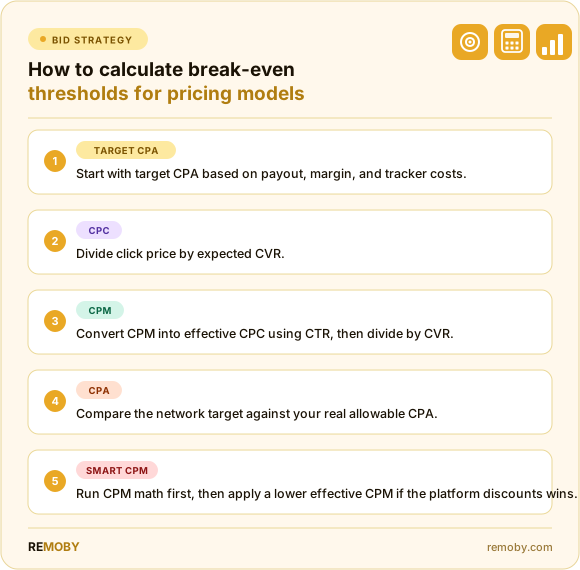
The math usually picks the model before the network rep does.
Common mistakes when choosing CPC, CPA, CPM, or SmartCPM
Most pricing-model mistakes happen before launch, not during optimization. Buyers pick the billing event they want instead of the signal they actually have.
The most expensive errors are predictable:
- Enabling CPA with an unverified postback. The network optimizes toward no real signal.
- Choosing CPM for broad traffic with no placement controls. Bad zones eat budget first.
- Falling for cheap CPC and ignoring post-click CR. Low click price does not mean ROI-positive traffic.
- Moving to CPA before 50 confirmed conversions and stable daily volume. “Switching too early is more costly than waiting an extra week,” according to expert input.
- Assuming SmartCPM always means auction intelligence. On some platforms it only means pacing automation.
- Splitting a small test across too many GEOs, devices, and placements. Signal gets diluted, so no model learns properly.
Match model to objective, verify tracking, and keep early tests narrow enough to produce signal.
Ready to launch with Remoby?
FAQ: How to Choose a Pricing Model
Still in doubts? Let us guide you through the most asked questions.
Pick CPC when the campaign does not produce at least 50 confirmed conversions with stable daily volume yet. CPC gives you faster readouts on creative, prelander, and placement quality without starving delivery. Once the tracker, postback, and zone data look stable, then consider switching the offer to CPA.
CPA bidding requires a verified postback, clean click ID passing through the full redirect chain, and confirmed token mapping in your tracker — Voluum, Binom, or RedTrack all work. Force at least one manual test conversion before launch, then compare tracker and network counts for at least 3 days. If those numbers do not align closely, do not trust CPA bidding yet.
Use CPM if reach is the main KPI and you trust your targeting. Use Smart CPM if the platform gives real bid-cap dynamics and the bid landscape changes across placements. Use CPC only when the campaign is really about qualified visits, not pure awareness.
Smart CPM is an impression-based buying model where the platform automates bid or pacing logic under a ceiling you set. On some networks it lowers your effective CPM in soft auctions by bidding below your cap. On others it only smooths budget delivery without affecting auction bids. The label is not standardized, so verify the exact mechanism with the platform before launch.
Convert CPM into effective CPC by dividing CPM by (CTR × 1,000), then divide that CPC by your expected CVR to get implied CPA. Do the same for your CPC rate divided by CVR. Compare both implied CPAs against your target. The model that lands closer to your allowable CPA deserves the test budget. Run this before launch, not after spend is gone.
No. CPA reduces direct payment risk per conversion, but it raises delivery risk, tracking dependence, and learning risk. If postbacks break or conversion volume is thin, a CPA campaign can become less stable than CPC or Smart CPM while giving you less scale. The lowest-risk model is the one your current tracking and funnel can measure accurately enough to optimize.