Updated: July 28, 2026
|
10 min read
Updated: July 28, 2026
|
10 min read
Affiliate Marketing Tools: A Decision-First Buyer’s Guide by Model and Budget

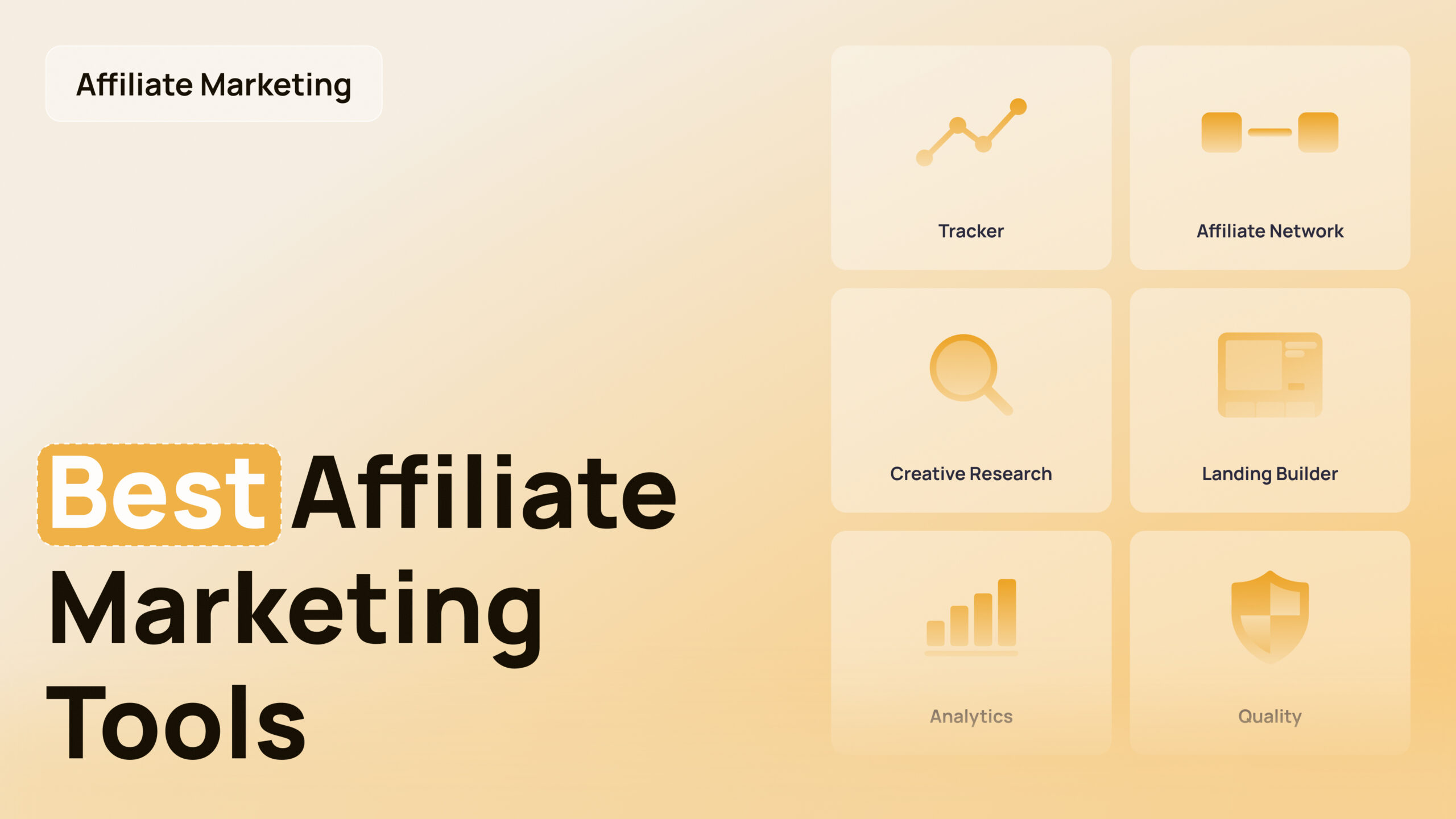
A cheap stack gets expensive when the missing tool hides the loss. You save $69 on a tracker, then spend $2,000 on push or pop traffic without knowing which zone, subID, or lander is burning it. Affiliate marketing tools share not one category, and that is why most “tools” lists lead to the wrong purchase first. We’ll list these tools here, the ones that from our experience make most value.
If you’re still mapping the workflow itself, start with how affiliate marketing works.
What Are Affiliate Marketing Tools?
Affiliate marketing tools are affiliate-side software used to research offers and keywords, manage links, track clicks and postbacks, analyze attribution, build email flows, and monitor funnel performance. Affiliate marketing tools do not include the network where you get offers or the merchant platform that pays partners. Example: Binom tracks paid traffic performance, while Ahrefs supports SEO research, and Kit handles list monetization.
The practical use is simple: tools help you run the workflow after you pick a model. SEO affiliates need research, analytics, and link control. Paid traffic buyers need click-level attribution, fast hosting, domains, and sometimes a cloaker. Email-led affiliates need list management and reporting tied to EPC, not just opens.
The category looks broad because the workflows are broad. Which variable actually moves the margin? Do I need reporting depth, or do I need speed? Is this tool fixing the bottleneck, or decorating the stack?
The harder distinction is not what a tool is. It is what part of the business it actually controls.
Affiliate Marketing Tools vs Affiliate Networks vs Merchant Affiliate Software
Affiliate marketing tools are not the same as affiliate networks. Affiliate-side tools help the affiliate execute and measure campaigns, affiliate networks connect publishers with offers and often handle payouts, and merchant affiliate software helps the advertiser recruit and manage affiliates. Example: Voluum tracks paid traffic, MaxBounty supplies offers, and Impact lets a brand run its own partner program.
This matters because buyers often compare unlike products. A network belongs in the workflow, but it is not a substitute for a tracker, email platform, or SEO stack. If you run Tier-2 pop traffic through Remoby, a network that fits CPA-first Tier-2 strategy, you still need your own reporting layer if you want zone-level decisions.
How the two network types differ from the advertiser side: affiliate networks vs ad networks.
Ready to launch with Remoby?
Scope Comparison Table: Affiliate-Side Tools, Networks, and Merchant Platforms
Merchant affiliate software is advertiser-side infrastructure for managing partners, payouts, tracking rules, and recruitment. Affiliate marketing tools are publisher-side execution software. Affiliate networks sit between both sides as marketplaces or aggregators. Example: Pretty Links helps a publisher manage links, while Affise helps an operator run a program.
| Name | Who uses it | Job | Examples |
|---|---|---|---|
| Affiliate-side tools | Affiliates, media buyers | Research (spy, SEO), tracking, attribution, email marketing, link management, cloaking | Ahrefs, Binom, Pretty Links, Kit |
| Affiliate networks | Affiliates and operators | Provide offer marketplace, handle payouts, compliance, and account management | MaxBounty, ClickDealer, CJ |
| Merchant affiliate software | Advertisers, operators | Run and manage in-house affiliate programs, track partners, control payouts and attribution | Impact, PartnerStack, Affise |
Choose tools based on your workflow needs; choose networks based on offer access and payout reliability
Most wasted software spend starts here: comparing marketplaces to execution tools as if they solve the same problem.
What Affiliate Marketing Tools Do Most Affiliates Actually Need?
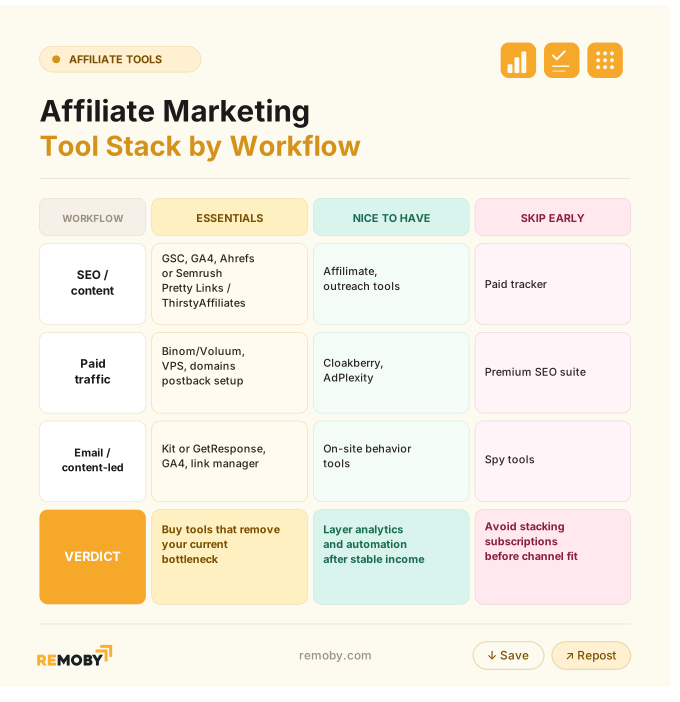
Affiliate marketing tools most affiliates actually need fall into four buckets: research, measurement, link control, and audience ownership. SEO affiliates usually need Google Search Console, Google Analytics 4, one research tool, and a link plugin. Paid traffic affiliates need a tracker first, then VPS and domains. Email-led affiliates need an ESP and analytics tied to revenue, not vanity metrics. Example: a solo SEO site can run lean without a paid tracker.
The missing piece is model fit. For SEO, GA4 plus Search Console is often enough at the start. For paid traffic, network reporting is not enough because zone-level loss stays hidden. One expert example was clear: Binom at $69/month changed decisions because postbacks exposed converting subIDs in real time. Read about what the tracking software actually does under the hood .
Essentials vs Nice-to-Haves by Affiliate Workflow
What most people assume is that every affiliate needs the same stack. In practice, feedback-loop speed decides the stack.
How to Choose the Right Tools for Your Affiliate Model
How do you choose the affiliate marketing tools for your affiliate model? Start with the traffic source, then map the decision speed, attribution depth, and budget tolerance of that model. Choose only the categories required to see the next profitable action. Example: paid traffic needs click-level tracking before a spy tool, while SEO needs intent research before advanced attribution.
Use this order:
- Pick the model first. SEO, paid social, push/pop, or email each has a different data loop.
- Set a hard monthly ceiling. Under $100 forces a lean stack; overbuying breaks payback early.
- Buy the tool that exposes loss first. For paid traffic, that is usually the tracker. For SEO, it is research plus analytics.
- Check overlap before adding another subscription. Ahrefs and Semrush overlap heavily; Binom and Voluum overlap on attribution.
- Delay intelligence layers until profit is stable. Spy tools after profitability, not before. (the math changes here)
That sequence came directly from practitioner experience: prove the vertical works first, then buy the tool that helps you do more of it.
Decision Matrix: Traffic Model, Budget, Growth Stage, Integrations, and Reporting Needs
If you buy before defining reporting depth, you usually pay twice. I have seen teams run Voluum and Binom together during migration for four months and burn roughly $400 in overlap before canceling one (I have watched this happen during tracker migrations, and the overlap always looks harmless until you total the month).
| Factor | If this is true | Buy now |
|---|---|---|
| Traffic model | SEO/content | Research tools + analytics + link management |
| Traffic model | Push/pop/native/Meta | Tracker + VPS + domains |
| Budget | Under $100 | Limit to one core tool category |
| Growth stage | Revenue unstable | Avoid spy tools and premium/non-essential tools |
| Reporting need | Need zone/subID level data | Dedicated tracker (Binom, Voluum, etc.) |
| Integrations | ESP-heavy workflow | Email platform with built-in revenue tracking |
The next mistake is buying by brand name instead of by job to be done.
Ready to launch with Remoby?
Affiliate Marketing Tools by Job to Be Done
The useful comparison shows which tool removes a blind spot in your funnel, offer, or reporting.
Keyword Research and Content Planning Tools
A $99/month Ahrefs subscription only makes sense if search demand is part of the model. Ahrefs is strong for intent mapping and competitor content audits; Semrush covers similar ground with broader workflow breadth (Ahrefs pricing page; Semrush pricing page, checked April 2026). For SEO affiliates, those tools shape presell planning and internal link priorities more than they shape attribution.
Link Management and Cloaking Tools
Failure usually shows up as messy links, broken redirects, and no clean way to update dozens of posts when an offer changes. Pretty Links and ThirstyAffiliates solve operational control on WordPress sites; Cloakberry at $29/month is a different purchase tied to compliance in paid traffic flows, not blog hygiene (official pricing pages, checked April 2026).
Analytics, Click Tracking, and Attribution Tools
For paid traffic, the tracker is the stack. Binom at $69/month is the lean buy-first option; Voluum is cleaner on UI and integrations but costs more at scale.
A full comparison including free and self-hosted options: best affiliate tracking software 2026.
The expert insight here is the one that matters: network-reported data was unreliable at zone level until postbacks and subIDs were visible inside the tracker. GA4 can help with tracking affiliate link clicks in Google Analytics 4 for content workflows, but it is not a replacement for click-level paid traffic attribution. (operators know this — most affiliates never ask)
Email and Audience-Building Tools
If you own the list, revenue reporting matters more than dashboard aesthetics. Kit and GetResponse both cover automation and broadcast workflows; the right choice depends on segmentation needs and deliverability preferences, not feature count alone (official pricing pages, checked April 2026).
Competitive Research and Spy Tools
A $149/month AdPlexity subscription is late-stage intelligence, not starter gear. It shows active creatives, landers, and zone patterns in iGaming, but it does not tell you payout quality, shaving risk, or why the funnel converts. Beginners buy it as a shortcut and end up copying surface details instead of economics.
The stack starts lean. It should. The question is where it expands without turning into subscription drift.
Lean Affiliate Tool Stacks by Model and Budget
The lean stack depends less on ambition than on how quickly bad data costs you money.
Lean Stack for SEO/Content Affiliates on a Small Budget
Lean SEO/content stack for a small-budget affiliate site is Google Search Console, Google Analytics 4, a link management plugin, and optionally one paid research tool only after content velocity justifies it. Lean SEO stacks work because attribution is slower and network reporting usually covers enough of the conversion path. Example: GSC + GA4 + Pretty Links can run under $25/month before adding Ahrefs.
Lean Stack for Paid Traffic Affiliates: What to Buy First
Lean paid traffic stack starts with a tracker, a VPS, and domains because those three control attribution, speed, and deployment. Paid traffic burns money before reports catch up, so the first purchase is the tool that shows subID- and zone-level loss. Example: Binom $69/month + Hetzner VPS about $5 to $15/month lean or about $20/month fuller setup + Namecheap domains averaging $1 to $2/month lean stays under $90/month.
Lean Stack for Email and Content-Led Affiliates
If you monetize a list, start with one ESP and one analytics layer. Kit or GetResponse plus GA4 covers most early workflows. Add landing page split test tooling only when list growth is steady enough to produce real signal.
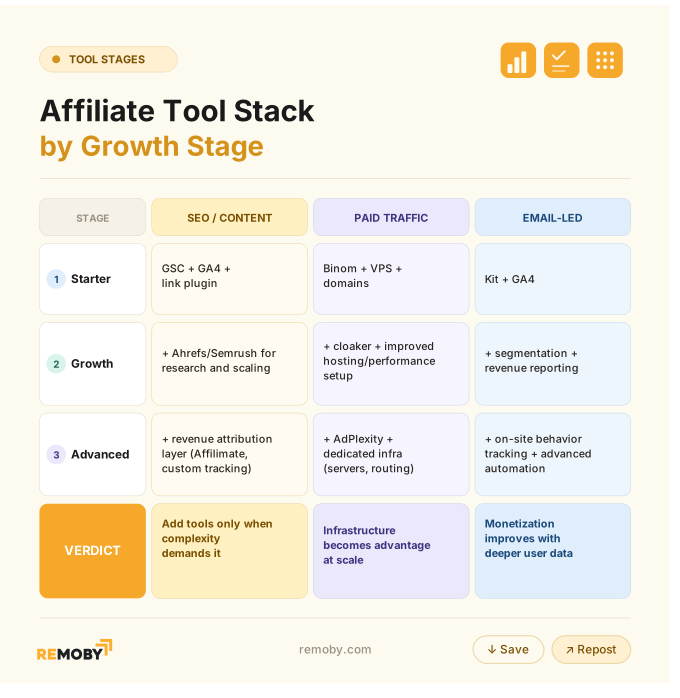
Example Stack Progression: Starter, Growth, and Advanced
Starter stacks should expose loss. Growth stacks should add speed. Advanced stacks should add intelligence.
Where most stacks go wrong is not missing a tool. It is paying twice for the same job.
How to Avoid Paying for Overlapping Affiliate Marketing Tools
Avoid paying for overlapping affiliate marketing tools by mapping each subscription to one decision it uniquely enables. If two tools produce the same next action, keep one. Overlap is common between SEO suites, link plugins, analytics layers, and trackers with built-in reporting. Example: running Voluum and Binom together during migration makes sense temporarily; keeping both after migration usually does not.
Overlap and Substitution Table Across Major Tool Categories
| Category | Common overlap | Usually one is enough when | Keep both when |
|---|---|---|---|
| Ahrefs vs Semrush | Keyword research, competitor analysis, backlink data | One team with unified SEO workflow and reporting needs | Different teams (SEO vs broader marketing) need distinct datasets or features |
| Binom vs Voluum | Click and conversion tracking, attribution | One stable tracker covers all traffic sources and integrations | Migration phase, or specific partner/client requires a certain tracker |
| Pretty Links vs ThirstyAffiliates | Affiliate link cloaking and management | Single WordPress setup with no advanced segmentation | Almost never justified unless edge-case plugin conflicts |
| GA4 vs tracker reports | Conversion tracking and reporting | SEO/content-driven workflows without deep traffic segmentation | Paid traffic requires granular subID/zone-level optimization |
| Verdict | Eliminate overlapping tools that don’t add unique decision value | Keep duplicates only with a clear, temporary or structural reason |
Integration Trade-Offs and When One Tool Can Replace Another
If you run SEO, GA4 plus network reporting often replaces a paid tracker. If you run push or pop, GA4 cannot replace click-level attribution because the losing zone is the decision unit, not the pageview. Shared hosting is another false saving for paid traffic; page speed hits CVR on pop and push hard, and the loss looks like “bad traffic” until you test infrastructure.
Pricing Snapshots and What to Buy First vs Later
The first spend should go to visibility, not convenience.
Official-Source Pricing Snapshot With Last-Checked Dates
| Tool | Entry pricing | Buy first or later | Source |
|---|---|---|---|
| Binom | $69/month | First for paid traffic | Binom pricing page, checked April 2026 |
| AdPlexity | $149/month | Later, after stable profit | AdPlexity pricing page, checked April 2026 |
| Ahrefs | $99/month | First for SEO, later for paid support | Ahrefs pricing page, checked April 2026 |
| Hetzner VPS | ~$5–$20/month | First for paid traffic (infrastructure baseline) | Hetzner pricing page, checked April 2026 |
| Cloakberry | $29/month | Later unless compliance or cloaking is required early | Cloakberry pricing page, checked April 2026 |
Start with infrastructure and measurement; add intelligence tools after profitability
Concise Tool Comparisons Within Key Categories
Binom vs Voluum is mostly a cost-versus-convenience decision. Binom is cheaper and self-hosted. Voluum is smoother on UI and native integrations. Pretty Links vs ThirstyAffiliates is closer: both handle cloak, redirects, and link organization, so the better choice is the one already fitting the site workflow, not the one with the longer feature list.
Ready to launch with Remoby?
FAQ for Affiliate Marketing Tools
Find out what affiliate marketers ask when choosing everyday tools
Affiliate marketing tools are not the same as affiliate networks. Affiliate tools help publishers research, track, manage links, and run email or paid traffic workflows. Affiliate networks provide offer access, payout administration, and account management. Example: ClickDealer gives the offer inventory, while Binom handles the postback and zone-level reporting on the affiliate side. For broader industry context, the outlines how networks, publishers, and advertisers play different roles.
Merchant affiliate software is advertiser-side infrastructure for recruiting partners, managing attribution rules, and handling payouts inside an in-house program. Affiliate marketing tools are publisher-side software used to operate traffic, content, email, and measurement. Example: Impact helps a brand run a program, while Pretty Links or Ahrefs helps the affiliate execute.
Affiliate marketing tools most affiliates need are analytics, one research layer, one control layer, and one model-specific execution layer. SEO affiliates usually need GSC, GA4, and a link plugin first. Paid traffic affiliates need a tracker, a VPS, and domains first. Email-led affiliates need an ESP and revenue-aware reporting before extra automation tools.
Affiliate marketing tools should be chosen by traffic model, data speed, budget ceiling, and reporting depth. Paid traffic needs click-level attribution because losses appear fast at zone and subID level. SEO needs intent research and content reporting. Email-led workflows need monetization data on the list. Buy the tool that reveals the next profitable action, then add intelligence layers later. The cheap stack was never cheap if it kept the loss invisible. If the model needs click-level decisions, buy the tracker first. If the model compounds through content, buy research first. Everything after that depends on whether the tool shortens payback — or only makes the dashboard prettier.
![Best GEOs for Affiliate & Betting Campaigns [2026]: Score Markets by Regulation, Payout & Fit](https://remoby.com/wp-content/uploads/2026/03/Best-GEOs-for-Betting-Campaigns-768x432.jpg)