Updated: April 8, 2026
|
6 min read
Updated: April 8, 2026
|
6 min read
SmartCPM from Remoby: How It Works, When to Use It, and What to Monitor

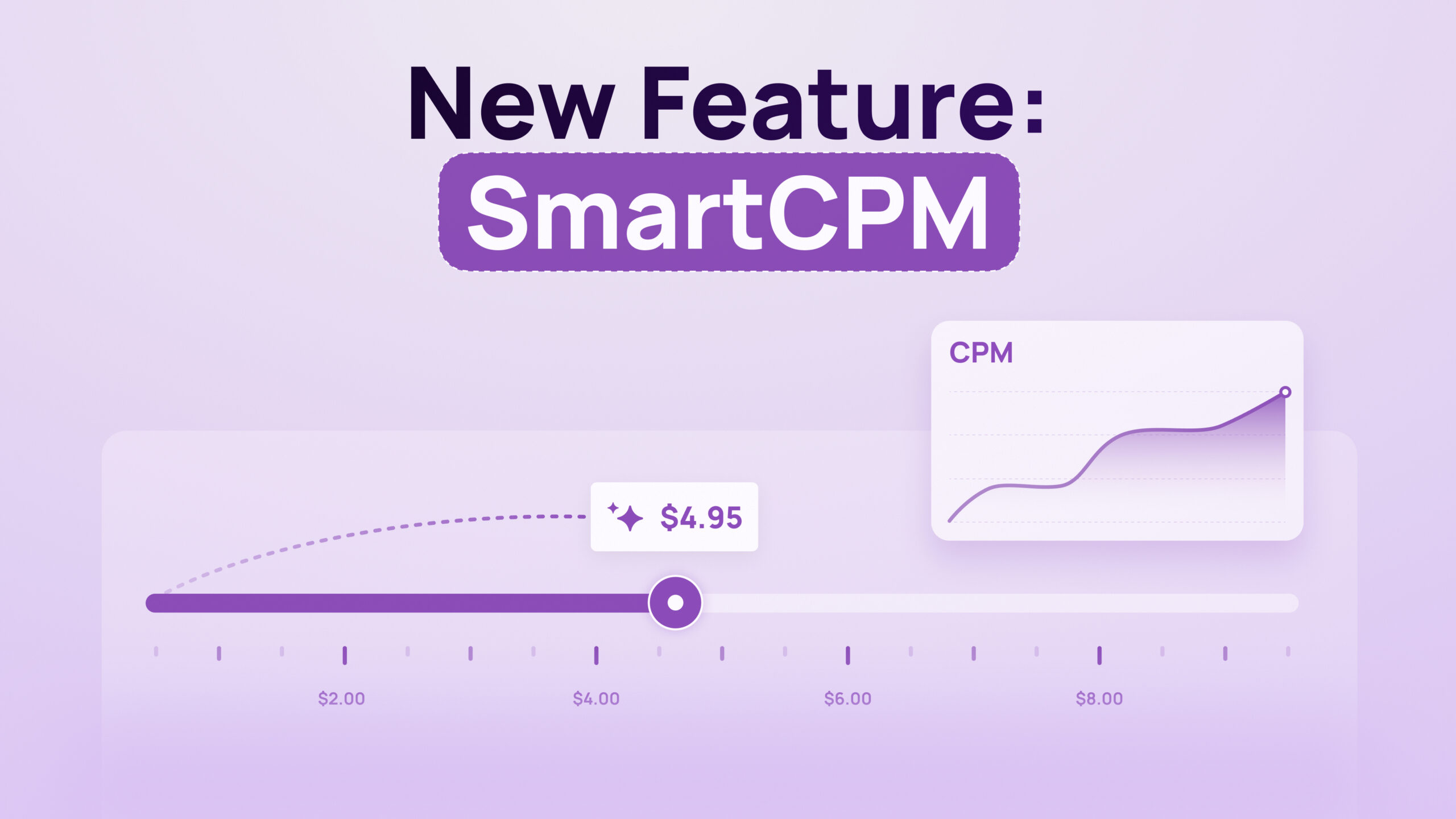
You set a bid, step away, and come back to a starving funnel — because the auction moved while you weren’t watching. SmartCPM fixes that: set a ceiling, let the system handle the rest and most probably pay less than you’d expect. Meet the new bidding model from Remoby.
What changed in Remoby’s bidding workflow with the SmartCPM update
With SmartCPM, advertisers set a maximum CPM instead of a fixed one. The platform then automatically determines the lowest price needed to win the top position in ad rotation. Example: if you set a $5.50 ceiling and your closest competitor bids $4.00, you win the placement and pay just above $4.00 — not your full ceiling.
Where SmartCPM now appears in Pricing & Budget
If you build campaigns in the usual flow, the change shows up in Pricing & Budget. SmartCPM now sits where bid decisions already live, so setup stays close to manual CPM instead of turning into a new workflow.
The practical difference is small in UI terms and large in second-bid auction behavior. You choose SmartCPM in the same area where you would normally lock a manual bid, then enter the ceiling. That keeps testing friction low.
What SmartCPM automates vs what stays manual
Many buyers assume SmartCPM means the platform takes over the whole campaign. In reality, it only automates bid participation and bid level inside your limits.
You still own the strategy — the GEO, the vertical, the funnel, the creative angle, the zone filtering, and the postback setup. The platform decides whether a given impression deserves entry and how aggressively to bid under the ceiling based on spend pace and inventory quality.
That split matters. SmartCPM does not replace traffic shaping at the campaign level. It replaces the worst part of manual CPM: holding one static bid in an auction that keeps moving.
Simple numeric example of SmartCPM in a live auction
Set a $2.50 ceiling and the next bidder comes in at $1.54 — you do not pay $2.50. You clear slightly above $1.54. That gap is where SmartCPM gets its room to work.
A real campaign view looks like this:
- Campaign ceiling: $2.50 CPM.
- Auction competitor bid: $1.54 CPM.
- SmartCPM enters, wins, and clears slightly above $1.54.
- Paid eCPM settles below the ceiling while win rate improves.
You buy competitiveness, not guaranteed overpayment.
Want to start buying traffic with SmartCPM?
How SmartCPM adjusts participation based on pacing and quality signals
Second-price logic alone does not drive results. SmartCPM gets its edge from deciding which auctions to enter, not only from paying the second price.
That matters on volatile inventory. A static bid either misses good traffic or leaks budget into mediocre zones. SmartCPM changes participation as the day moves, using budget pace and quality signals to keep delivery steadier. If eCPM runs up toward 95% of the ceiling and CPA degrades by more than 20%, the system has stopped finding efficient clears — that is a revert trigger.
SmartCPM vs manual CPM: use cases
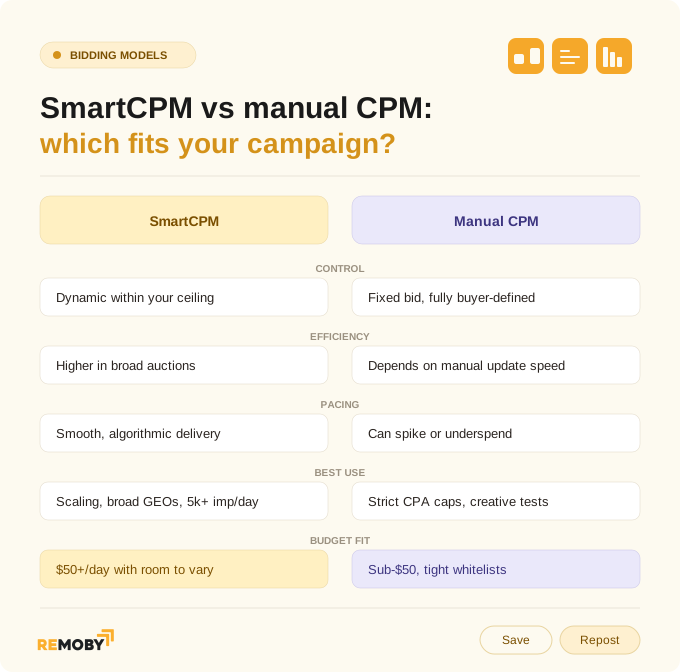
SmartCPM fits advertisers who want competitive bid response, broader delivery, and less manual tuning under a clear ceiling. Manual CPM fits advertisers who need exact bid control, tiny tests, or tightly isolated variables. Example: a broad UK pop campaign with budget to spend usually benefits from SmartCPM, while a $40/day creative split test on a strict whitelist does not.
Comparison table: control, efficiency, pacing, setup, and budget fit
| Factor | SmartCPM | Manual CPM |
| Control | Ceiling-based model where system dynamically adjusts bids within limits | Buyer defines exact CPM and fully controls bid levels |
| Efficiency | Typically higher in broad or competitive auctions due to adaptive bidding | Highly dependent on buyer reaction speed and manual optimization quality |
| Pacing | Smooth and evenly distributed throughout the day via algorithmic pacing | Can underspend or spike depending on bid accuracy and competition |
| Best use | Scaling campaigns, broad targeting, unstable auction environments | Precise benchmarking, strict LTV or CPA caps |
| Verdict | Use when you want automated efficiency within guardrails | Use when precision and granular control outweigh scale |
When to use Remoby SmartCPM and when not to
When is SmartCPM not the right choice for a Remoby campaign? SmartCPM is not the right choice when the campaign has very narrow targeting, under 5k daily impressions, a tiny test budget, or a requirement for exact CPM pacing. The model needs auction volume and room to vary bids. Example: a tightly whitelisted campaign with strict daily spend targets usually performs more predictably on manual CPM.
Best-fit use cases by format, vertical, and impression volume
The more daily impressions you have, the sooner SmartCPM starts making better decisions instead of random ones. Pop is the strongest fit because the auction volume stays high. In-app also fits well.
The best use cases right now: iGaming, Finance, Nutra, and eCommerce on broad targeting, especially in the US, UK, DE, AU, plus active Tier 2 GEOs. Those campaigns usually have enough inventory turnover for SmartCPM to react faster than a buyer updating bids every few hours.
SmartCPM also helps when you have no conversion signal wired into the tracker. Since it does not need downstream event data, you can launch faster and still get auction-level optimization. That is useful when the offer changes fast, the prelander rotates often, or the funnel bundle is still in motion.
When SmartCPM is not the right choice: narrow targeting, tiny tests, or exact pacing needs
Buyers often blame SmartCPM when the real issue is no room to optimize. A campaign with a strict whitelist, micro-budget, and 3k daily impressions gives the system almost nothing to work with.
Stay on manual CPM when you run sub-$50/day tests, isolate creative variables, hold a hard LTV-based bid cap, or need predictable spend by hour. New accounts with no platform history also tend to get cleaner learning from controlled manual tests before moving to auto-bidding.
Second-price vs first-price auctions and what this means for cost expectations
First-price auctions punish lazy ceiling setting. Second-price auctions punish weak ceilings less aggressively, but they still do not print cheap traffic on command.
In first-price setups, aggressive bids turn directly into aggressive costs. In second-price setups, the market still decides the clearing price. If competition stays high across the zone mix, the paid eCPM will climb anyway. Second-price logic improves bid strategy flexibility — not automatic savings [programmatic benchmarks].
Campaign example: switching from manual CPM to SmartCPM
A live example shows the tradeoff faster than any sales copy. On a UK iGaming pop campaign running at $200/day, manual CPM held a fixed $2.00 bid over 14 days and delivered an 18% win rate, about 90k daily impressions, and a $4.20 CPL.
Starting conditions, manual CPM baseline, and switch rationale
The campaign had enough volume, broad enough targeting, and a stable offer — a bad fit for more bid micromanagement and a good fit for smarter auction entry.
The buyer switched to SmartCPM with a $2.50 ceiling because manual delivery had flattened. The goal was not a lower headline bid. The goal was to win more auctions without breaking the same daily budget.
What changed after the switch: win rate, eCPM, spend pace, and efficiency
By Day 3, win rate reached 31%. eCPM stabilized at $1.55, impressions grew to roughly 145k/day on the same budget, and CPL fell from $4.20 to $3.60 by Day 7. That is about 14% better acquisition efficiency on unchanged spend (representative practitioner example).
The non-obvious part: the ceiling went up from the old bid, while paid eCPM went down. That is second-price logic doing useful work under real auction pressure.
Want to start buying traffic with SmartCPM?
FAQ: SmartCPM second price bidding model
Learn more about SmartCPM from Remoby
SmartCPM bidding uses a max CPM ceiling instead of a fixed CPM bid. The system then decides how aggressively to enter each auction based on pacing and traffic quality, which lets the campaign win more selectively while still respecting the buyer's budget and targeting limits.
Second-price auction bidding gives the impression to the highest bidder, but the winner pays only slightly above the second-highest competing bid. That lets buyers set a realistic maximum value without paying that full number every time they win.
SmartCPM fits broader campaigns with enough volume and budget to benefit from dynamic bidding. Manual CPM fits low-budget tests, exact pacing requirements, and cases where the buyer wants fixed bid behavior for cleaner creative or zone-level analysis.
The workflow now places SmartCPM inside Pricing & Budget, where the buyer sets a CPM ceiling instead of one fixed bid. The platform handles auction entry and bid variation, while the buyer still controls budget, targeting, scheduling, and normal campaign constraints.
The difference is the clearing rule. In first-price, the winner pays the full bid. In second-price SmartCPM, the campaign can bid up to its ceiling but usually pays only slightly above the next bidder, which changes how aggressively you should set that ceiling.
Start with win rate and spend pace on Days 1–2, then read eCPM on Days 3–5, then compare CPA or CPL against the manual baseline on Days 6–7. Revert if eCPM pushes to 95%+ of your ceiling, efficiency drops over 20%, or spend becomes unstable.
Skip SmartCPM when the campaign has under 5k daily impressions, narrow whitelists, sub-$50/day tests, or strict hourly pacing requirements. Those setups leave too little room for the bidding logic to find efficient clears or shape traffic effectively.