Updated: August 15, 2026
|
19 min read
Updated: August 15, 2026
|
19 min read
Affiliate Landing Page Strategy Framework: Choose the Right Page by Traffic Temperature and Offer Type

I’ve killed more campaigns than I’d like to admit by skipping this step: matching the lander to the traffic instead of copying a generic CRO template. This affiliate landing page strategy framework is built for affiliates sending traffic to merchant pages, where the real win is better-qualified clicks, higher EPC, and less wasted burn.
What Is an Affiliate Landing Page
Affiliate landing pages (some call them pre-landers) are presell pages built to warm up, filter, and qualify traffic before the merchant click. Standard landing pages usually try to capture the lead or sale on-page. The difference matters because affiliate funnels are judged by downstream EPC and conversion quality. A bridge page with lower outbound CTR can still beat a slick ecommerce-style page if it sends fewer but better-matched users.
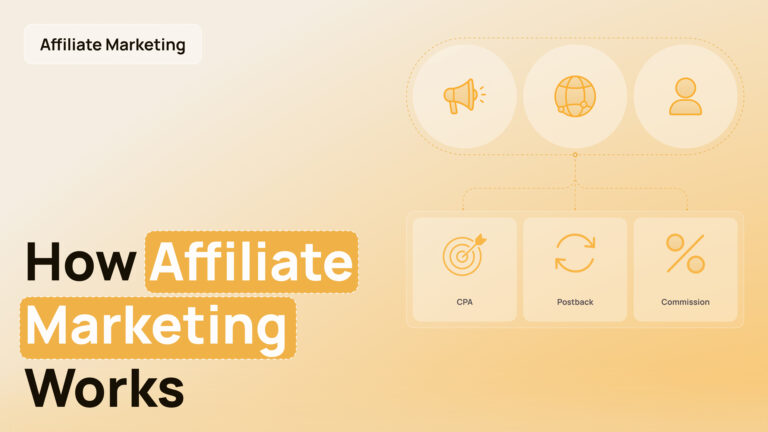
Where the page sits in the full click-to-commission chain – read in how affiliate marketing works blog.
The Real Conversion Goal: Pre-Sell and Qualify the Outbound Click
The biggest mistake is calling every click a conversion. In affiliate, the page’s job is to pre-qualify the user for the offer flow — not to dump cheap traffic into the merchant funnel and hope the tracker saves you.
A standard lead-gen page wants the shortest path to one action. An affiliate page needs to do three things first: match the ad angle, set expectations, and remove the wrong clicks. If your traffic comes from PropellerAds (push and pop ad network focused on performance traffic) or Remoby (push and pop network with direct publisher relationships in Tier-2 and Tier-3 GEOs), that filtering job matters even more because broad traffic can inflate click-through rate fast.
Why Generic CRO Advice Breaks in Affiliate Funnels
Most people assume higher outbound CTR means the page is better. In affiliate, that logic breaks all the time.
Generic CRO advice pushes fewer objections, less copy, and faster CTA access. That works when you own checkout. It fails when the hard conversion happens on a merchant page you do not control. One expert operator summed it up cleanly: “When I see high click-through rates but low earnings, I know something is off with click quality.”
I’ve seen bridge pages crush CTR and still lose money because the angle overpromised, the merchant page under-delivered, and the redirect chain kept feeding the wrong user to the offer. More clicks. Worse EPC.
How Merchant-Page Alignment Changes Page Depth, Messaging, and CTA Strategy
If your pop traffic prelander promises a fast win and the merchant page opens with vague brand copy, conversion falls apart. That gap is where most campaigns bleed.
Pre-sell depth should move inversely to merchant page strength. Strong merchant page? Use lighter qualification and faster CTA access. Weak merchant page? Absorb more selling on your page. “The user should feel like they are continuing the same story when they move from my page to the merchant page,” one operator put it.
That changes page depth in practice. A thin coupon page works if the merchant page is already high-intent and clean. A comparison lander works better when the offer needs context, proof, or expectation-setting before the click.
Why Affiliate Landing Pages Should Optimize for Qualified Clicks and EPC, Not Clicks Alone
What kills profit is chasing outbound CTR while EPC falls. Affiliate pages should send enough clicks to feed volume, but not so many that the merchant page gets flooded with low-intent users. If deeper presell removes weak clicks and improves downstream conversion, it wins even with lower CTR. If the merchant page is already strong, shorter flows often produce more profit by reducing drop-off.
When More Education Improves EPC and Downstream Conversion Rate
If you are running a complex offer, a skeptical GEO, or a weak merchant page, education usually pays for itself.
More copy helps when the extra content answers the exact objection blocking the next click. This is common in finance, software, and iGaming offers where users want comparison, trust, or bonus clarity. In practice, adding one strong proof block and one expectation-setting section often lifts downstream CVR more than adding another button.
When Shorter Pages and Simpler Paths Outperform
Shorter pages win when intent is already present and friction is the only thing left.
Coupon traffic, branded search, and warm email are the obvious cases. The user wants access, confirmation, or a perk. Long presell only slows them down. I’ve also seen broad push traffic convert better on short pages when the offer itself was dead simple and the merchant page was unusually good. (spoiler: it didn’t scale)
Why High Outbound CTR Can Still Produce Low EPC
What goes wrong is angle inflation. The page gets clicks by making the offer sound easier, cheaper, or broader than it really is.
The merchant page then corrects the story. Trust breaks. Conversion dies. The expert operator called this the main diagnostic pattern: CTR helps find problems, but not the right answer. If CTR is strong and EPC is weak, check message continuity, audience match, and whether the page is pre-qualifying or just teasing.
Decision Framework: Choose the Right Affiliate Landing Page Strategy
Affiliate landing page strategy for cold traffic should add context, proof, and tighter qualification before the click. Affiliate landing page strategy for warm traffic should shorten the path and reduce friction because the user already trusts the source or knows the offer category. Cold push traffic often needs a comparison or advertorial-style bridge, while warm email traffic often converts better on a shorter review, bonus, or coupon page.
Cold Traffic: More Context, Stronger Proof, Tighter Expectation-Setting
$0.5–2 CPM on Tier-3 pop traffic and cheap push clicks can look great on paper (industry benchmark). They also hide bad intent fast.
Cold traffic does not know you, and often does not know the offer. The page has to do more heavy lifting. Give the user a reason to care, proof that the offer is legit, and a clear picture of what happens after the click. For paid traffic, especially broad zones and new placements, I prefer landers that pre-qualify hard before the CTA.
A practical rule:
- Use comparison or advertorial flows for pain-aware but brand-cold traffic.
- Put proof above the first CTA when the offer has trust friction.
- Narrow the promise so unready users self-filter out.
That keeps bad clicks off the merchant page.
Warm Traffic: Shorter Paths, Faster CTA Access, Lighter Pre-Sell
If you are emailing your own list, retargeting visitors, or catching branded search traffic, long presell often slows buyers down.
Warm traffic already carries context. Your job is to remove delay, not add more persuasion blocks. Review pages, bonus pages, and coupon pages tend to work because the user wants confirmation or an incentive, not a full education sequence. Warm traffic needs shorter, more direct pages because trust already exists.
Keep the hook tight. Put the CTA early. Let the user jump.
How Paid, Organic, Email, and Social Traffic Change the Page Structure
Using one page template for every source is where most buyers go wrong. The same offer will need a different path depending on where the click came from.
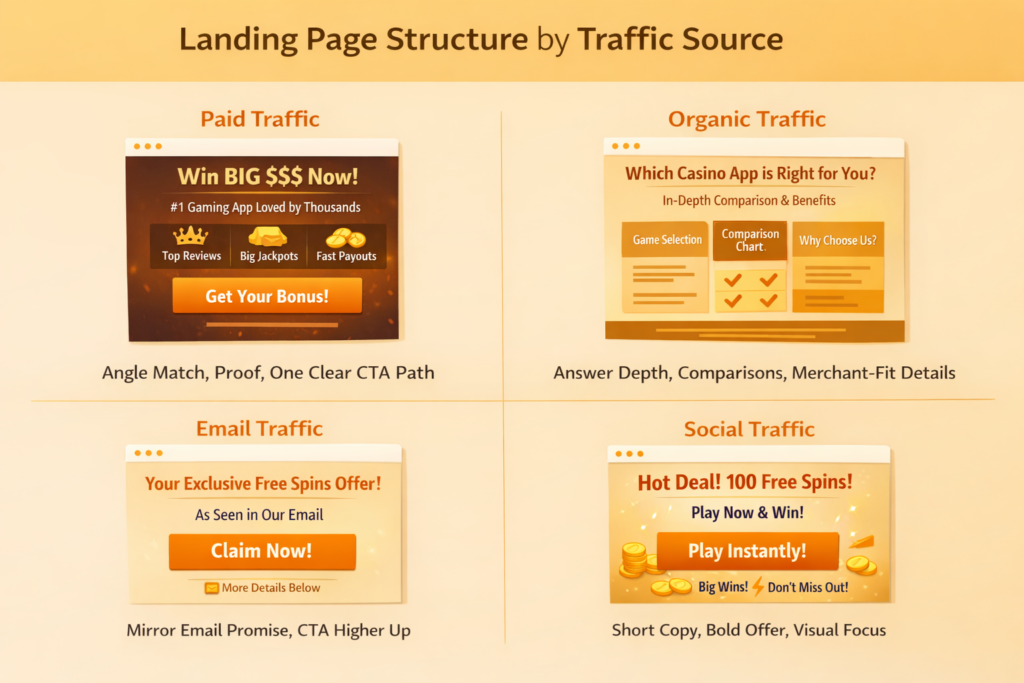
Paid traffic from push, pop, or native campaigns usually needs faster orientation and stronger filtering. Organic search traffic can handle denser content if intent is high. Email traffic benefits from continuity with the message that triggered the open. Social traffic often needs cleaner visual hierarchy and fewer text walls because interest is softer.
Use source-specific page structure:
- Paid traffic: lead with angle match, proof, and one clear CTA path.
- Organic traffic: lead with answer depth, comparisons, and merchant-fit details.
- Email traffic: mirror the email promise and move the CTA higher.
- Social traffic: shorten copy, tighten visuals, and avoid burying the offer.
Source changes structure more than most buyers admit.
Affiliate Landing Page Format Comparison
Most buyers do not need more page ideas. They need a fast way to know which format fits the funnel.
| Page type | Best for | Traffic source fit | Pre-sell depth | Main strength | Main risk |
|---|---|---|---|---|---|
| Review page | Trust-building around one offer | Organic, email, retargeting | Medium | Builds credibility and handles objections | Too long for low-attention paid traffic |
| Comparison page | Users deciding between options | Paid, organic, native, push | Medium to high | Strong click qualification and decision framing | Needs clear merchant-page alignment |
| Bridge page | Simple offers or fast funnels | Pop, push, broad paid traffic | Low | Fast click path and easy testing | High CTR but weak EPC if traffic is unready |
| Quiz page | Personalized angles | Social, native, email | Medium | Segments users before the click | Extra step can kill momentum |
| Coupon page | High-intent deal seekers | Organic search, email | Low | Converts intent already present | Weak for cold traffic |
| Bonus page | Incentive-led offers | Email, influencer, retargeting | Low to medium | Gives users a reason to choose your link | Bonus can distract from core offer |
Ready to launch with Remoby?
When to Use a Review Page vs a Comparison Page vs a Bridge Page
In one expert test on an iGaming app offer using pop ads, the comparison page beat both the review page and the bridge page on EPC. That result surprises people because the bridge page had the highest outbound CTR in the same test.
Use a review page when the user mostly needs trust. Use a comparison page when the user needs a decision frame. Use a bridge page when the offer is simple and the click intent is already decent. The bridge page won the click but lost the money, while the comparison page produced the best downstream return.
That is the tradeoff in one test result.
Strengths, Tradeoffs, and Qualification Patterns for Each Format
Most people assume shorter pages scale better. Reality: shorter pages scale bad traffic faster too.
Comparison pages usually pre-qualify the cleanest because they force contrast and set expectations. Review pages are softer but useful when the merchant brand is weak. Quiz pages can improve CR by segmenting users, though they need a tight tracker setup and clean postback logic. Coupon and bonus pages are high-intent closers, not openers. Bridge pages are useful for quick angle tests, placement testing, and burn-rate control — but they are the first format I blacklist when EPC drops and CTR still looks pretty. (this is the part everyone skips)
How Much Pre-Sell to Use Based on Traffic Warmth and Merchant-Page Strength
Add only enough presell to improve downstream conversion. Cold traffic, complex offers, and weak merchant pages need more education. Warm traffic, strong merchant pages, and high-intent coupon or bonus traffic need less. The practical rule: pre-sell depth should move inversely to merchant page strength, and the user should feel like they are continuing one story from your page to the offer.
A Decision Rule for How Much Pre-Sell to Add Before the Merchant Click
5–10x the offer payout is a reasonable starting test budget for new affiliate funnels (industry benchmark). Use that learning window to decide page depth with data, not preference.
- Start with traffic temperature: colder traffic gets more context.
- Check merchant-page strength: weaker merchant pages need more selling on your page.
- Check offer complexity: more complexity needs more qualification.
- Watch EPC by source and subID, not headline CTR alone.
- Remove any section that does not improve downstream conversion quality.
Add presell only where it earns its place.
Core Page Elements That Drive Qualified Affiliate Clicks
Affiliate landing pages that improve qualified clicks need six core elements: a headline matched to visitor intent, a hook that frames the problem, proof that lowers skepticism, clear offer framing, CTAs placed around readiness points, and a click path that fits traffic temperature. Cold paid traffic often needs proof before the first CTA, while warm email traffic can click earlier if the message matches the merchant page.
Headline and Hook: Match the Visitor’s Awareness Level and Intent
Miss the hook and the rest of the page rarely matters. Paid traffic will bounce or misclick before your proof even gets seen.
Your headline should continue the ad angle, not restart the story. For cold traffic, call out the problem and the decision frame. For warm traffic, move toward confirmation. In native or push funnels, I often split test one curiosity hook against one direct problem hook rather than five cosmetic headline changes. That gives cleaner signal by zone and placement.
Proof and Trust Builders: Evidence, Specificity, and Risk Reduction
1–3% click-through rate on native ads in iGaming verticals is a normal starting range (industry benchmark). That does not mean users trust what they clicked.
Use proof that reduces uncertainty fast: practical specifics, screenshots where allowed, realistic testimonials, review criteria, and clear disclosures. According to the Federal Trade Commission (FTC), endorsements and material connections must be disclosed clearly and conspicuously. Fake authority blocks hurt more than they help. Real specifics convert better.
Offer Framing: Who It Is For and What Problem It Solves
Vagueness is where offer framing breaks down. Buyers say “best solution” and “top offer” without telling the user who the offer fits or what the next step looks like.
Good offer framing filters. Say who should click, who should not, what the user gets, and what the merchant page will ask them to do next. “If I hide important details just to get more clicks, I end up sending the wrong people.” That is the whole game.
CTA Placement and Click Path Design
Most people assume more CTAs means more money. Usually it means more noise.
CTA count should follow readiness. Warm traffic can handle one clear above-the-fold CTA and one mid-page repeat. Cold traffic often needs a first CTA after proof, not before. Multi-click paths help when you need a small commitment step before the merchant click. Choose one clean path first. Then refine.
Page-Element Checklist for Building or Revising the Page
The fastest way to fix a weak lander is to audit the structure before touching the creative.
- Check headline match with the ad or source message.
- Check whether the hook filters or overpromises.
- Check proof depth before the first CTA.
- Check offer framing for fit, not hype.
- Check CTA position against traffic temperature.
- Check disclosure visibility and claim language.
- Check merchant-page continuity in tone, price, and promise.
- Check tracker, subIDs, and postback before sending volume.
Good pages qualify first and decorate second.
High-CTR, Low-EPC Diagnosis: What to Check First
High outbound CTR with low EPC almost always means one of three things: the page angle is inflating expectations beyond what the merchant delivers, the traffic source is sending unready users who click but do not convert, or the merchant page breaks the story your lander built. Check those in order before touching creative.
The Diagnostic Sequence When EPC Drops
First, check message continuity. Does the merchant page match the angle, price, and promise on your lander? If there is a gap, that is usually the culprit.
Second, check source and subID segmentation. One bad zone can drag the whole campaign’s EPC without being obvious in aggregate numbers. Third, check offer framing on the page itself – if you are over-promising to get the click, you are building your own conversion problem. Fix the story before adjusting bids or budgets. When you do test fixes, change one variable at a time — the protocol is in split testing ads framework.
Measurement and Tracking Stack for Affiliate Landing Pages
Most people track outbound CTR first because it is easy. That is backwards. EPC is the primary metric when the sale happens on the merchant site. CTR is a diagnostic metric for finding friction, mismatch, or bad qualification. SubID segmentation by source, angle, and audience is what turns a page test into a useful buying decision. If you cannot tie the click to revenue quality, you are guessing.
How trackers tie those together – click IDs, postbacks, dedupe – is covered in affiliate tracking software.
Primary Metrics: Outbound CTR, EPC, Conversion Quality, and CVR by Source
EPC is the scorecard. CTR is the warning light.
Track outbound CTR, EPC, source-level CVR, and any downstream quality signal available from the network or advertiser. In MaxBounty (affiliate network) or ClickDealer (performance marketing affiliate network), that often means watching approved leads, not raw leads. Segment by GEO, placement, angle, and device.
Diagnostic Metrics: Scroll Depth, Engagement, Click Segmentation, and SubID Tracking
Without visibility into where quality changes, you cannot optimize the page.
Voluum, Binom, RedTrack, and Keitaro affiliate tracking software all make this easier. Track scroll depth, click position, first CTA vs lower CTA clicks, and subIDs at ad, angle, and audience level. This is how you find out whether a whitelist is actually good or whether one zone is padding cheap clicks with weak intent.
Testing Priorities: Messaging, Proof Depth, CTA Timing, and Page-Length Experiments
Most buyers start by testing colors. That is wasted time.
Test in this order:
- Angle and headline match.
- Proof depth and objection handling.
- CTA timing and placement.
- Page length and content order.
- Layout polish after the funnel logic works.
Test the story before the styling.
Trust, Transparency, and Compliance on Affiliate Landing Pages
Most buyers treat compliance like a legal checkbox. It also affects conversion because users detect fake pages fast. Transparent pages get cleaner clicks and fewer nasty surprises.
Affiliate Disclosures and FTC-Aligned Transparency Placement
Put the affiliate disclosure where users can see it before or near the recommendation — not buried in the footer. According to the Federal Trade Commission, disclosures should be clear, conspicuous, and close to the claim they qualify.
For advertorial or native-style pages, label the page honestly. If your lander looks editorial, say what it is. That protects the account and reduces the trust drop after the click.
Claims, Testimonials, Pricing References, and Realistic Expectation-Setting
If your page promises more than the merchant page supports, you are building your own refund-and-rejection problem.
Use testimonials carefully, keep pricing current, and avoid outcome claims you cannot defend. According to the FTC’s Consumer Reviews and Testimonials rule, deceptive review and testimonial practices are prohibited. In affiliate, realistic framing is not a buzzkill. It is a filter.
Trust Signals That Support the Click Without Looking Like Fake Authority
Blank trust badges do less than concrete details.
Use real comparison criteria, specific benefit explanations, review methodology, author or site transparency, and destination previews where allowed. A clean design helps, but trust mostly comes from internal consistency. When the page, CTA, and merchant story align, users keep moving.
Worked Examples: Affiliate Funnel Scenarios by Traffic Type
The right page only makes sense inside the full funnel. Ad, prelander, offer, and tracking have to agree.
Cold Paid Traffic to a Comparison Offer
If you buy broad push or pop traffic, start with a comparison page before sending users to a single merchant. That gives cold users a decision frame and filters curiosity clicks.
A workable flow: ad angle → comparison lander → top pick CTA → merchant page. Use subIDs by angle, zone, and GEO. This is also where Remoby fits as one network worth testing for Tier-2 push when you want more controlled source segmentation.
Warm Email Traffic to a Review or Bonus Page
Warm email clicks rarely need a long story.
Use the email to create the angle, then land on a review or bonus page that confirms the choice and puts the CTA early. Keep the copy aligned with the email promise. If the bonus is the hook, show it fast and make redemption expectations clear.
Organic Search Traffic to a High-Intent Comparison or Coupon Page
Treating all searchers the same is where SEO traffic goes wrong. Someone searching a comparison query wants decision help. Someone searching a coupon query wants access.
Match the page to the query. Comparison intent gets structured analysis and merchant differentiation. Coupon intent gets deal visibility, restrictions, and an immediate click path. Do not force a review-page essay onto transactional traffic.
FAQ: Affiliate Landing Page Strategy
How Do You Decide Between a Review Page, Comparison Page, or Bridge Page for an Affiliate Offer?
Choose by decision stage and traffic source. Review pages build trust around one offer and work best with organic or email traffic. Comparison pages help users choose and pre-qualify better — use them for paid or native traffic when the user is deciding between options. Bridge pages fit simple offers or fast placement tests, but need close EPC monitoring because they tend to over-send weak clicks.
Should an Affiliate Landing Page Aim for More Clicks or Better-Qualified Clicks?
Better-qualified clicks. More clicks only help when merchant conversion quality stays intact. If a lower outbound CTR produces stronger EPC, a higher approval rate, or better downstream CVR, the page is doing its job. Chasing raw click volume while EPC falls is the fastest way to burn budget on traffic that does not convert on the merchant side.
How Much Pre-Sell Should You Add Before Sending Affiliate Traffic to the Merchant Page?
Add only enough presell to improve downstream conversion quality. Cold traffic, complex offers, and weak merchant pages need more education before the click. Warm traffic, strong merchant pages, and high-intent coupon or branded search traffic need less — extra presell there just adds drop-off. Use EPC by subID to decide what stays and what gets cut.
Can You Choose the Right Affiliate Landing Page Structure for Cold Facebook Traffic to a Comparison-Style Offer?
For cold social traffic hitting a comparison offer, use a bridge or short comparison page with strong visual hierarchy, a clear decision frame, and proof above the first CTA. Social traffic has soft intent, so a text-heavy review page loses people fast. Lead with the key contrast between options, filter unready users with offer framing, and keep the CTA path to one step.
What Metrics Matter Most When the Sale Happens on the Merchant Site?
EPC matters most, followed by conversion quality and CVR by source or subID. Outbound CTR is useful only as a diagnostic metric — it shows friction or mismatch, not revenue quality. Track by GEO, angle, placement, and device. Use subID segmentation to isolate where quality breaks rather than optimizing against blended averages.
What Trust and Compliance Elements Should Appear on an Affiliate Landing Page?
Use a clear affiliate disclosure placed near the recommendation, realistic claims that match what the merchant page delivers, accurate pricing references, and trust signals grounded in specifics rather than generic badges. Follow FTC guidance on endorsement transparency. Avoid outcome claims you cannot support. Realistic framing filters unready users and reduces post-click trust collapse — which is where most EPC damage actually happens.
Why Do Some Affiliate Landing Pages Get High Click-Through Rates but Low EPC?
High CTR with low EPC almost always means the page is sending unqualified traffic to the merchant. The most common cause is angle inflation — the lander over-promises on price, ease, or outcome, the merchant page corrects the story, and users drop off without converting. Check message continuity between your page and the merchant page first, then check source segmentation to find which zones are driving clicks without downstream value.
![Best GEOs for Affiliate & Betting Campaigns [2026]: Score Markets by Regulation, Payout & Fit](https://remoby.com/wp-content/uploads/2026/03/Best-GEOs-for-Betting-Campaigns-768x432.jpg)